
Bangladesh has secured exemptions for certain garments and textiles made with U.S.-produced materials, such as cotton, under a new agreement announced on Monday, February 9.
As part of the agreement, Washington will reduce its tariffs on Bangladesh from 20% to 19%, in exchange for Dhaka opening its markets to a wider range of American goods.
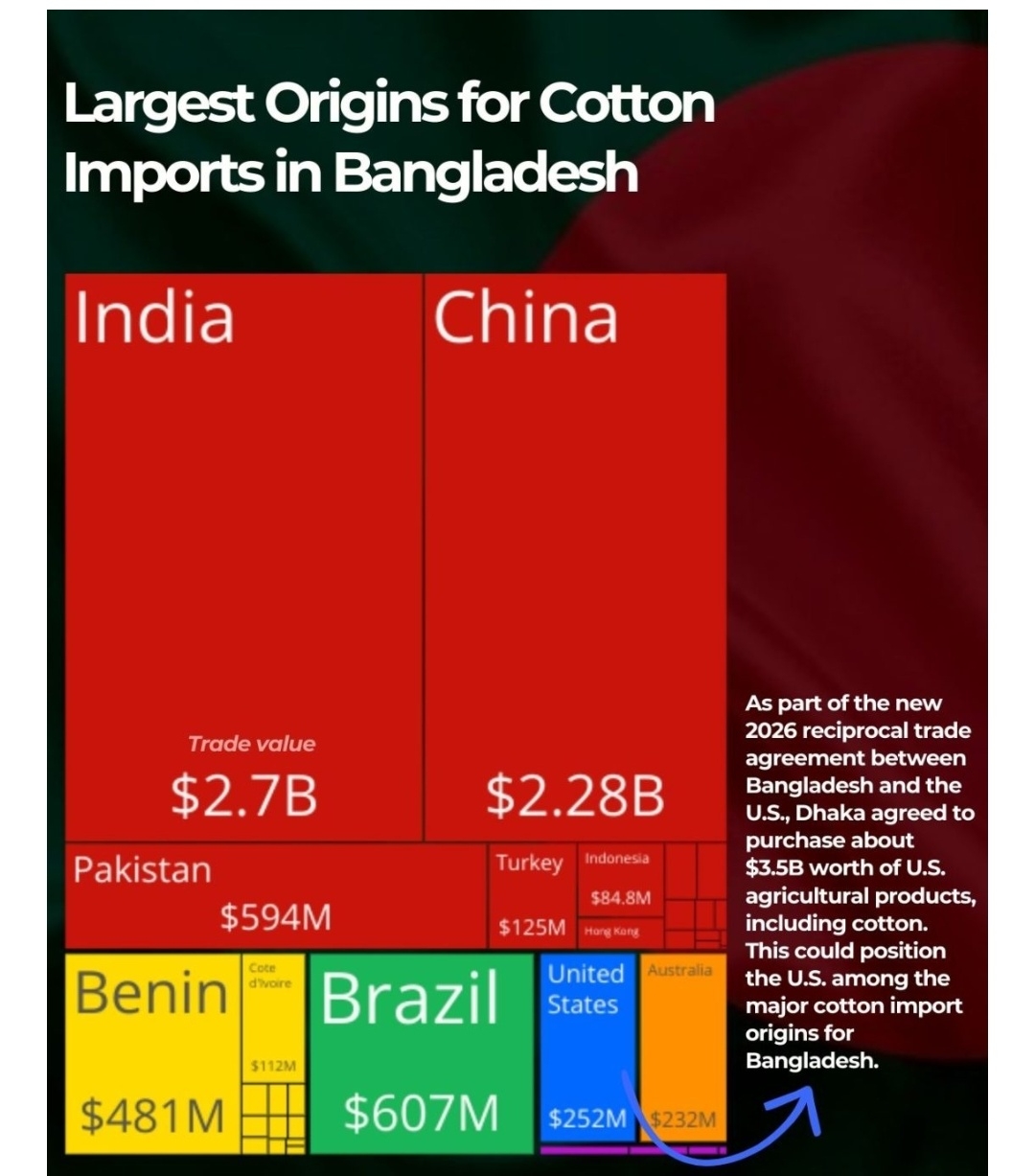
Today’s visualization shows that Bangladesh currently imports cotton worth billions of dollars from India and China, but only $252 million from the U.S.
This new deal is designed to potentially flip those numbers, while avoiding the 19% “tax penalty.”
TL;DR
Bangladesh imported $7.69B in Cotton in 2024, mainly from India ($2.7B), China ($2.28B), and Brazil ($607M).
The new 0% duty mechanism for U.S.-sourced garments could potentially displace billions of dollars in Chinese and Indian cotton imports into Bangladesh.
Bangladesh benefits from trade terms that secure lower tariffs on its garment and textile exports and support its domestic industry.
The data used in the graphics above comes from the Observatory of Economic Complexity (OEC) trade profile for cotton imports into Bangladesh as of 2024, the most recent available.
Ranked: Import Origins Countries of Cotton into Bangladesh
Exporter Country Into Bangladesh (2024) , Cotton Trade Value ($ M)
India 2,701.51
China 2,278.23
Brazil 607.22
Pakistan 593.94
Benin 480.61
United States 251.68
Australia 231.56
Turkey 125.46
Cote d'Ivoire 112.01
Indonesia 84.85
The leading exporters of cotton to Bangladesh are India, China, Brazil, and several West African countries, including Benin.
This might change soon, as Bangladesh is diversifying its sources of cotton imports to reduce dependence on any single country and secure more stable pricing and supply chains.
The $3.5 Billion Buy-In
As part of the new reciprocal trade agreement between Bangladesh and the United States, Dhaka agreed to purchase approximately $3.5 billion in U.S. agricultural products.
These products include cotton, soy, wheat, and other agricultural products.
All these are in exchange for improved market access and tariff relief on its exports to the U.S. market.
Bangladesh has also committed to purchasing 14 Boeing aircraft, thereby increasing the total value of its procurement from U.S. suppliers at the outset of the deal.
This “buy‑in” is Bangladesh’s way of securing a more favorable tariff arrangement, by agreeing to increase imports of U.S. goods, especially cotton and other agricultural commodities, the country gains reciprocal trade benefits
This also includes reduced tariffs on its textile exports and zero‑tariff access on products made with U.S. cotton.
It’s Geopolitical “Stitch”
By agreeing to buy U.S. cotton, Bangladesh secured preferential access to the U.S. market.
This trade strategy allows Bangladesh to benefit from reciprocal trade terms, including lower tariffs on its garment and textile exports.
By investing in U.S. products, Bangladesh “buys” its way into more favorable market access, strengthening ties with the U.S. while supporting its own textile industry.
Now, for every $1 of U.S. cotton Bangladesh buys, it saves about $0.19 in U.S. tariffs later, making American cotton, which is more expensive than Indian cotton, the cheapest option for Bangladeshi factories.
This gives Bangladeshi garments a 0% tariff rate in the U.S., making them cheaper than Indian exports, which still face an 18% reciprocal tariff.
This arrangement not only enhances Bangladesh’s competitiveness but also strategically positions its textile industry in the global market.
ELI5
India is presently Bangladesh’s top cotton supplier. As of 2024, the trade value was $2.7 billion.
However, Bangladesh has reached an agreement with the United States, under which it will purchase U.S. agricultural and industrial goods in exchange for improved access to the U.S. market.