
At the early stage of any protocol, the greatest risk is not a lack of users, but flawed incentive design. Most new projects choose to emit tokens first to attract participation, hoping real value will follow later. Fabric takes the opposite approach. From the very beginning, its reward distribution mechanism is tightly anchored to verified economic value.
The formula is straightforward:

Here, E_t represents the total emission in a given epoch, and HGV_i is the Hybrid Graph Value of robot i. Each robot’s reward is proportional to the share of value it contributes to the entire network.
What makes this shine is not the proportional allocation itself, but what sits in the numerator and denominator: HGV.
HGV does not measure promises. It does not measure the number of nodes. It does not measure “participation.” It measures verified actions and the real economic value generated from those actions. A robot can execute thousands of tasks, but if no real user pays for them, its position in the graph remains weak. Conversely, a robot that operates less frequently but generates real revenue and maintains genuine economic relationships with users is rewarded accordingly.
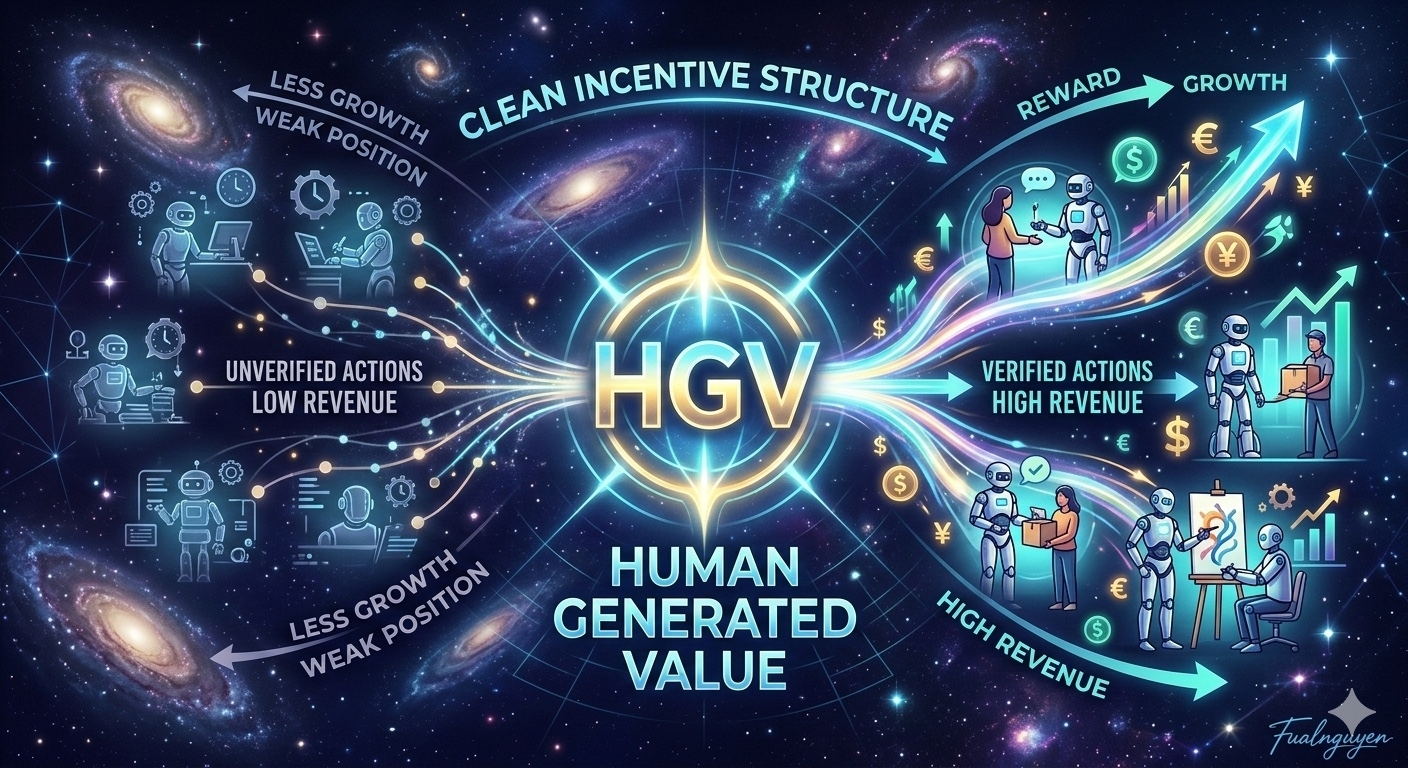
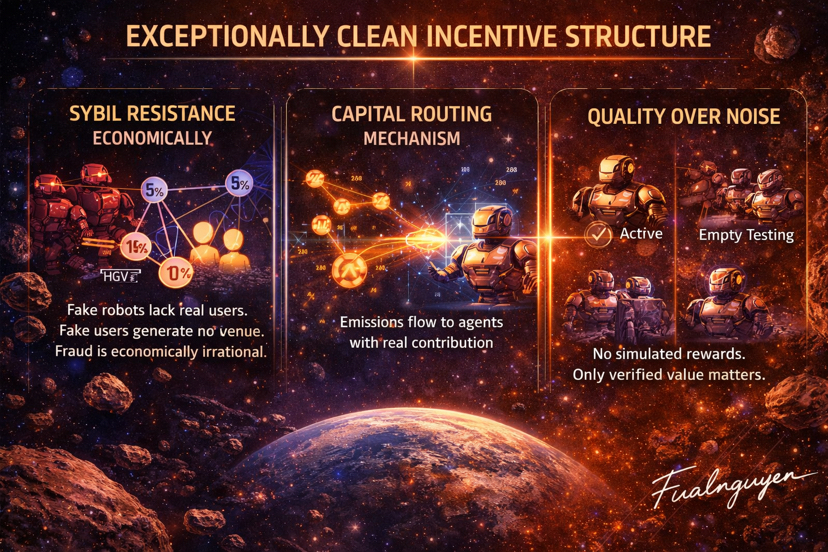
This creates an exceptionally clean incentive structure.
First, Sybil resistance emerges economically. Fake robots do not have real users. Fake users do not generate real revenue. Without authentic economic edges in the graph, HGV approaches zero. The system does not need blacklists or rigid gatekeeping because fraud simply becomes economically irrational.
Second, emission is no longer blind inflation. It becomes a capital routing mechanism. Tokens are not scattered to simulate activity; they are directed toward agents that create measurable economic contribution within the robot economy.
Third, competition shifts from noise to quality. Rewards cannot be farmed through simulations. Empty testing does not accumulate value. Only verified action that produces real economic output leads to meaningful rewards.
For a protocol at its inception, getting the incentive layer right matters more than any marketing campaign. Fabric does not merely introduce a reward mechanism. It establishes a rule of the game: capital flows to those who generate verifiable economic value.
In robotics, where actions can have physical consequences and tangible costs, tying rewards directly to verified value is not an optimization. It is a necessity. Without precise incentives, a system that governs machines acting in the real world would eventually distort itself.
That is why, for a project just getting started, Fabric’s reward distribution formula is not a minor technical detail. It is a signal. A signal that the foundation of a decentralized robot economy cannot be built on speculation. It must be built on real value, verified action, and disciplined capital allocation from day one.
@Fabric Foundation #Robo $ROBO #Fualnguyen
