
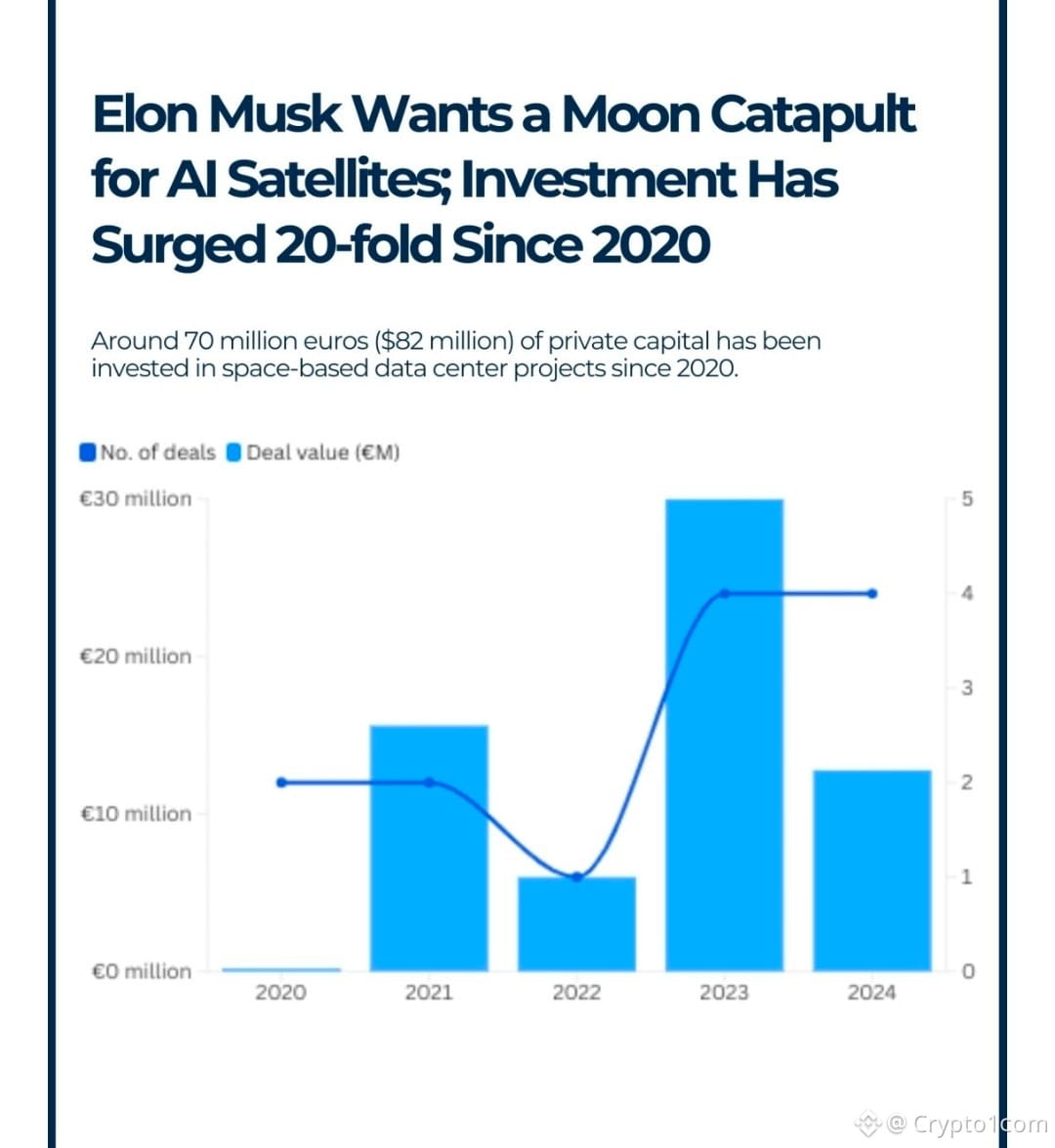
Elon Musk told xAI employees last week that the company needs a factory on the Moon to build AI satellites and a massive electromagnetic catapult to launch them into orbit.
Today’s visualization makes his plan suddenly realistic.
Since 2020, private investment in space-based data centers has increased 20-fold, turning orbital compute from sci-fi into the only viable solution to Earth’s energy crisis.
This data comes from the European Space Policy Institute (ESPI).
TL;DR
Private investment in space data centers has increased by 20-fold since 2020, reaching €70 million ($82 million).
A 1-gigawatt orbital data center costs $114 billion, seven times more than on Earth, but Musk’s lunar mass driver aims to reduce this by 2030 through low-cost Moon-launched satellites and zero-gravity cooling.
Musk’s $1.25 trillion merger of xAI and SpaceX consolidates AI and lunar transportation, paving the way for a Moon-based AI factory.
Private Capital in Space-Based Data Centers (2020–2024)
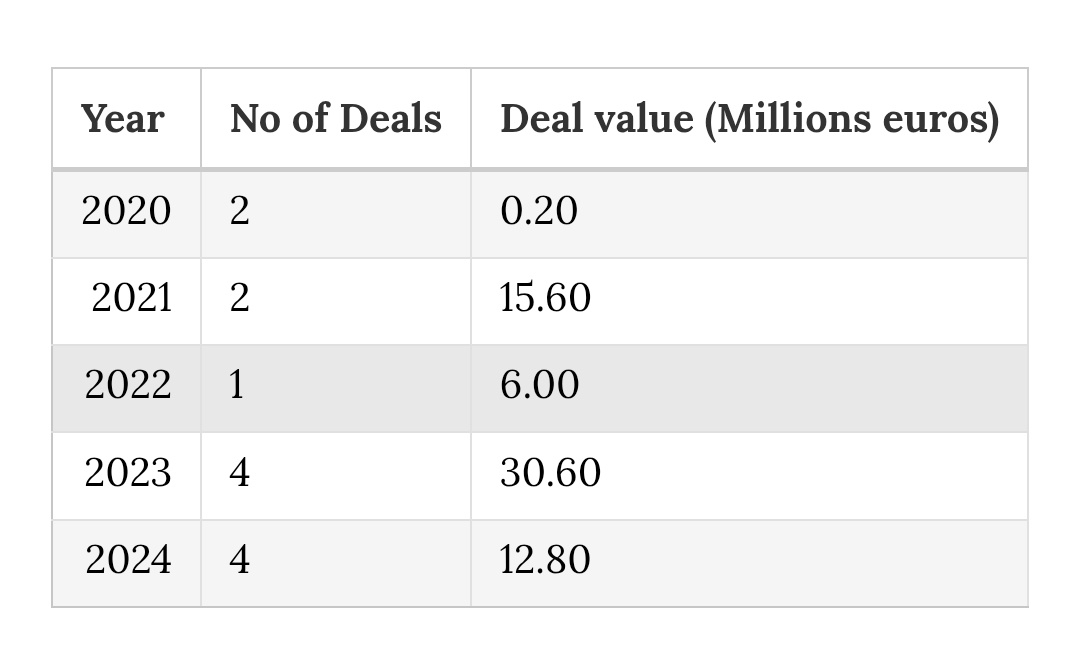
Since 2020, nearly 70 million euros in private capital has flowed into space-based data centers through 13 deals.
Deal values surged about 20 times since 2020, especially after 2023, driven by confidence that orbital computing can overcome Earth’s energy and cooling limits.
The main factors driving this feat are a projected 165% increase in terrestrial data center energy use and the AI industry’s significant power needs.
In November, Starcloud, the startup backed by Nvidia, sent a chip into outer space that’s 100 times more powerful than any GPU compute that has been in space before.
Reusable launchers like Starship, abundant space solar energy, and zero cooling costs make orbit increasingly attractive.
The $114 Billion Cost Gap
Building a 1-gigawatt data center in space currently costs $114 billion, which is seven times more than on Earth.
Tiger Brokers reports that this high cost is mainly due to launch expenses and the need to protect hardware against harsh orbital conditions.
Musk’s proposed Lunar Mass Driver, an electromagnetic catapult on the Moon, addresses this issue.
By launching materials from the Moon’s low gravity at a lower cost than Earth-based rockets, it reduces the main obstacle that makes space data centers so expensive today.
According to Deutsche Bank’s latest analysis, costs could soon become more comparable.
When Starship’s reusability combines with lunar mass-driver economics, the gap narrows quickly.
They even estimated a key cost parity point by 2032, after which orbital data centers could be cheaper to build than on Earth.
“Zero-Gravity” Latency
Musk’s lunar mass driver launches pre-built AI satellites from the Moon into Earth orbit, where the lunar escape velocity is only 2.38 km/s, which is just 21% of Earth’s 11.2 km/s according to NASA.
This reduces launch energy and limits atmospheric friction.
Once in orbit, optical links in free space transmit data at roughly half the speed of light in a vacuum, about 50% faster than signals traveling through fiber-optic cables with a refractive index of 1.47.
This transmission enables ultra-low-latency networks with tens of terabits per second between closely spaced satellites, as stated in a 2012 analysis by James Hamilton and confirmed in recent Free-Space Optical (FSO) studies.
The Lumen Orbit White Paper posits that this vacuum of space provides unlimited passive cooling to the cosmic background temperature of −270 °C.
For context, a single 1 m² radiator at 20 °C can shed approximately 770 W from both sides before minor Earth-albedo losses, while permanently shadowed lunar craters remain at or below −173 °C.
Earth-based data centers consume up to 40% of their power just for cooling.
In contrast, orbital setups eliminate this need, operate continuously with solar energy at about 40% higher intensity than at ground level, and allow chips to run cooler and faster without throttling.
This breakthrough could significantly accelerate the training of large AI models while maintaining peak performance.
The $1.25 Trillion Merger
This month, Reuters reported Elon Musk merged SpaceX and xAI into a single $1.25 trillion entity, making it the largest private-company deal in history.
With the merger in an all-stock transaction, the rocket giant is now valued at $1 trillion, and the AI startup at $250 billion.
The numbers now make perfect sense.
You cannot build a lunar AI factory without owning both the “brain,” which is xAI’s models and training tech, and the “bus” driven by SpaceX’s Starship fleet and lunar mass driver.
Therefore, Vertical integration eliminates the multi-billion-dollar launch contracts and coordination delays that would otherwise kill the economics.
One company, X, now controls the entire stack, from Grok training clusters to the catapult that hurls them to the Moon.
The merger data validates the move.
With terrestrial data-center power demand exploding and orbital cooling offering 22× lower energy costs, only full ownership of launch + AI delivers the speed required to win the global AI race.