
The more I explore Fabric Foundation, the clearer its vision becomes: the future of robotics isn’t just smarter machines — it’s trusted machines.
Many decentralized technologies begin with ideology: decentralize everything and then search for use cases. But Fabric flips the model. It starts with a real-world challenge — robots acting autonomously in physical environments — and asks a deeper question:
How do we make those actions transparent and accountable?
In robotics, outcomes are rarely deterministic. A robot’s behavior depends on sensors, environmental variables, real-time decisions, and probabilistic algorithms. Two identical robots placed in different environments may behave entirely differently.
That unpredictability creates a fundamental problem: trust.
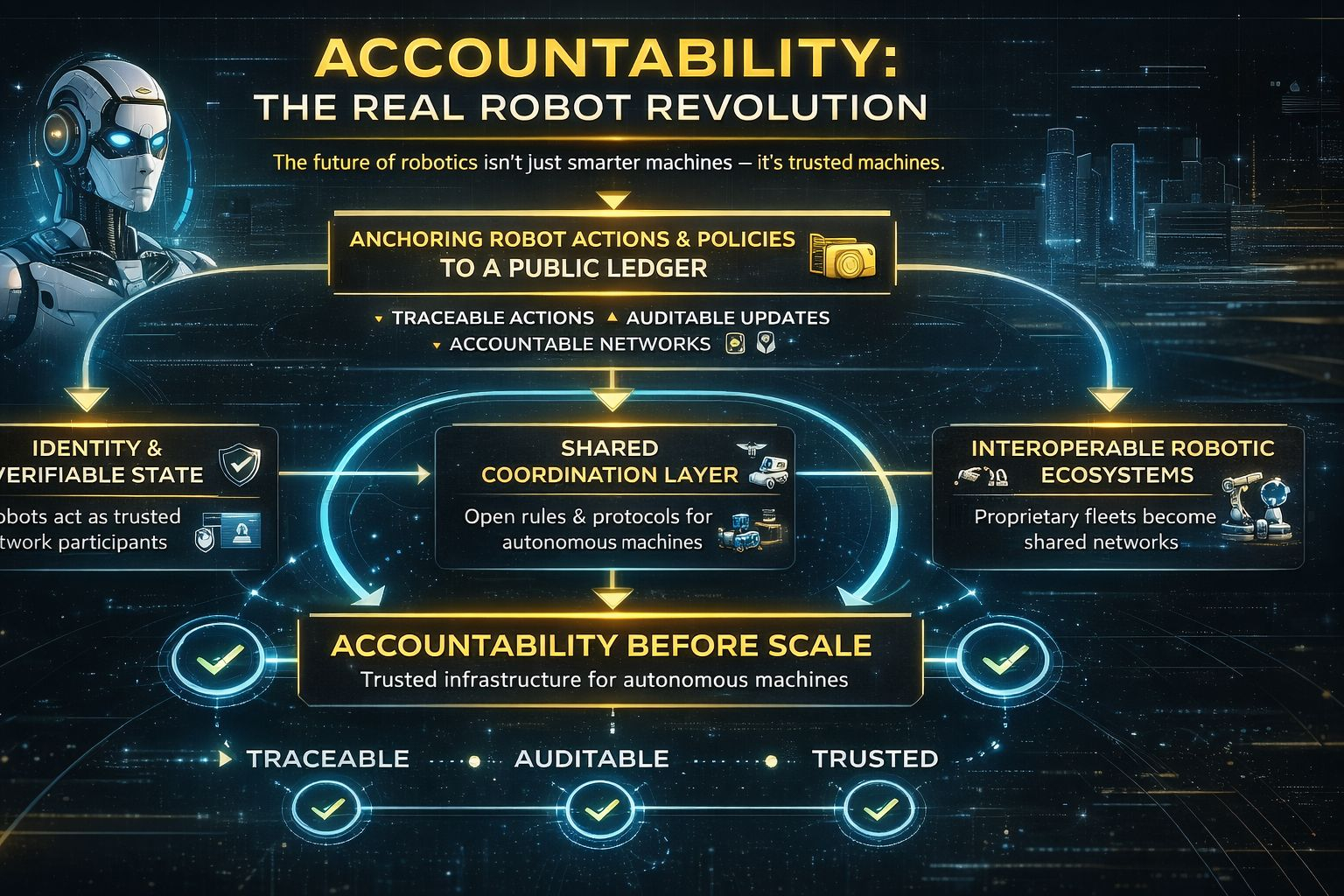
Fabric addresses this by anchoring robot actions and policy updates onto shared public infrastructure. Instead of isolated devices operating in black boxes, robots become network participants with verifiable identities, state histories, and rule frameworks.
Every action becomes traceable.
Every update becomes auditable.
Every interaction becomes accountable.
This approach introduces something robotics has lacked for decades: an open coordination layer for autonomous machines.
Rather than relying on proprietary fleets controlled by single vendors, Fabric proposes interoperable robotic ecosystems where different machines, operators, and organizations can coordinate through shared protocols.
The implications are massive.
Industrial robots, logistics drones, autonomous delivery vehicles, and service robots could all interact within a transparent coordination network rather than fragmented systems.
What stands out most is Fabric’s practical framing.
It’s not trying to decentralize robotics for philosophical reasons. Instead, it focuses on governance infrastructure — the systems that ensure autonomous machines behave within trusted boundaries.
Here, distributed ledgers function less like financial rails and more like accountability frameworks for automation.
Adoption may not happen overnight. Robotics evolves slower than software because physical systems require testing, safety validation, and real-world deployment cycles.
But the architectural direction is becoming clear.
If robots are going to operate everywhere — in factories, hospitals, cities, and homes — they will need shared trust infrastructure.
Fabric’s thesis is simple but powerful:
Before robots scale globally, their actions must first be traceable anywhere.
And that principle — accountability before scale — may ultimately define how the next generation of autonomous robotics networks emerges.