Liquidity doesn’t appear randomly; it forms where conviction gathers. I’ve watched enough token launches to distinguish temporary excitement from foundational change. When Fabric Protocol introduced $ROBO on Binance Alpha on February 27, 2026, it wasn’t just another symbol lighting up the exchange screen. It marked a serious experiment - a live stress test for a machine-driven economic layer.
Fast forward to March 3, when price printed a new high at $0.0607. That move wasn’t just speculation playing out. The Binance Spot Trading Task functioned exactly as engineered — it connected retail liquidity with the future mechanics of robotic labor. Strange, isn’t it? People trading today so machines can transact tomorrow paying for power, compute, and coordination using the same token.
Market Structure Overview (March 3, 2026)
• Launch Low (Feb 27): $0.0328
• New High: $0.0607
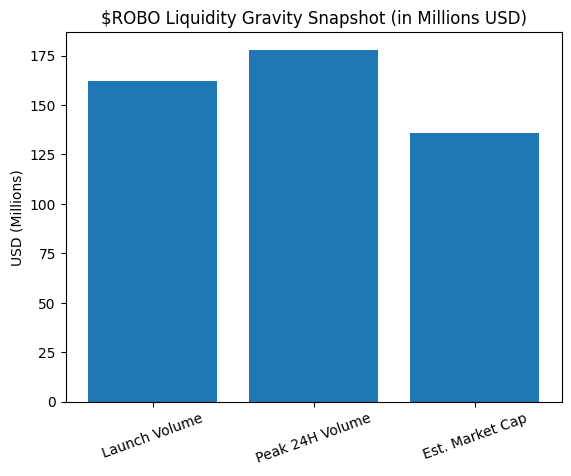
• 24H Volume Range: $162M – $178M
• Circulating Supply: ~2.23B
• Volume / Market Cap Ratio: Frequently above 130%
• ROBOUSDT Perpetual Leverage: Up to 20x
This isn’t random volatility.
It’s intentional liquidity formation.
Volume behavior reveals the real gravity. Since opening at $0.0328, daily turnover consistently pushed into the $162–178 million zone. With roughly 2.23 billion tokens circulating, that keeps the volume-to-market cap ratio unusually elevated — often beyond 130%. That level of activity signals deliberate participation, not passive holding.
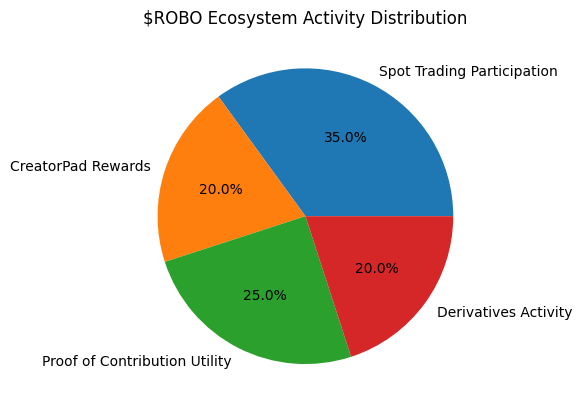
The 8.6 million token CreatorPad reward pool clearly activated a wide retail base. Entry requirements were minimal — a single $10 transaction — but that accessibility acted as a funnel. Add the educational tasks explaining the Fabric Foundation and OM1 operating system, and you create a feedback loop: learn, participate, transact.
Productive Friction
Not everything felt smooth. The 256 Alpha Point requirement for the first airdrop excluded many hopeful participants. But that friction served a purpose. It clarified the nature of the asset.
ROBO wasn’t designed for idle speculation. Fabric’s Proof of Contribution framework rewards measurable action — completing tasks, providing data, coordinating hardware. Value is earned through participation, not waiting.
The token operates as operational fuel for OM1 — effectively an “Android for robotics.” It enables machines to communicate, verify execution, and settle payments directly on-chain. That’s utility embedded into architecture.
Where Spot Meets Derivatives
The launch of the ROBOUSDT perpetual contract with up to 20x leverage added a second dimension. Now institutional arbitrage and retail momentum coexist in the same ecosystem.
With funding rates recalibrating every four hours, spot and derivatives markets remain tightly linked, supporting efficient price discovery despite volatility spikes.
Signals traders are monitoring:
• Funding rate momentum shifts
• Open interest expansion during consolidation
• Basis spread between spot and futures
• Liquidation zones near psychological levels
While some chased the breakout, others focused on structural positioning.
Meanwhile, the Fabric Foundation is actively rolling out robot identity and on-chain task settlement modules this quarter. Development isn’t theoretical — it’s operational.
Sustainability vs Purpose
Will volume remain at hyperactive levels? Unlikely.
But sustainability of peak turnover was never the core objective. The Spot Trading Task wasn’t about short-term frenzy; it was about building deep, functional liquidity.
If machines are expected to purchase compute or energy in $ROBO, they need tight spreads and resilient order books. Thin markets don’t support autonomous economies.
By incentivizing early participation, the campaign essentially constructed the marketplace infrastructure before machine adoption scales.
Structural Observations
• ROBO aims to anchor the machine-economy utility layer
• Liquidity depth was strategically engineered
• Proof of Contribution aligns incentives with activity
• Futures integration accelerated capital efficiency
• Robot financial identity is the bottleneck being addressed
The broader shift is simple.
We’re transitioning from trading narratives to trading productivity.
ROBO isn’t just another ticker; it represents exposure to a developing robotic economic framework. Whether accumulating governance influence through veROBO or positioning ahead of a planned Layer 1 migration, the underlying thesis remains the same: machines require financial identity.
They need wallets.
They need verifiable work history.
Fabric provides the infrastructure.
Even if daily volume cools from the $160 million range, the structural momentum behind machine-native finance continues to build.
This isn’t hype-driven experimentation.
It’s economic architecture in progress.
Let the machines generate value and settle it.
@Fabric Foundation #ROBO $ROBO