
A more serious idea is hiding underneath the surface
When I first came across @Fabric Foundation , I honestly thought it would be easy to dismiss. The language around robot economies, public ledgers, decentralized coordination, and machine-native payments can sound like the kind of narrative crypto loves to overproduce. But the more I looked into it, the less it felt like a shallow AI-token pitch and the more it felt like an early attempt to answer a question that I think is going to matter a lot: who owns the value created by machines once robots begin doing economically useful work at scale? Fabric’s own positioning is very direct here. It says it is building the payment, identity, and capital-allocation network that would allow robots to operate as autonomous economic participants, while OpenMind’s OM1 acts as the open software layer underneath that broader vision.
That framing is what changed my view. I stopped seeing Fabric as “just another robot coin” and started seeing it as an infrastructure thesis around machine labor. In other words, this is not only about robots existing. It is about how robot work gets registered, verified, coordinated, paid for, and potentially shared across a broader network instead of staying locked inside closed corporate systems. Fabric’s official material repeatedly ties the project to this bigger ambition through its “Own the Robot Economy” framing and through the idea that anyone should be able to help coordinate, supply, and operate robots in real-world settings.
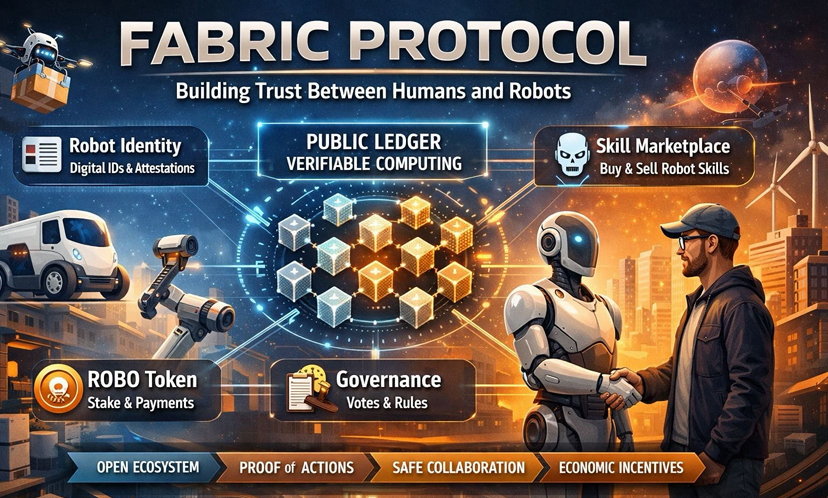
The deeper issue is not whether robots will work. It is who will own the economic upside when they do.
The real story is not robotics alone. It is market structure.
I think this is the part most people still miss. Public discussion around robotics usually stays at the level of capability: can humanoids work in warehouses, can delivery systems scale, can autonomous machines become useful in care, logistics, or inspection? Those are important questions, but they are not the only ones. A robot that can repeatedly perform useful labor is not just a machine in the ordinary sense. It starts to look like a productive asset. And once something becomes a productive asset, the harder question becomes economic: who controls it, who receives the revenue, and who sets the rules around access?
That is why Fabric feels more important to me than its branding might suggest at first glance. The project is reacting to the possibility that robot labor could follow the same concentration pattern we have already seen in software: private stacks, proprietary data loops, centralized updates, closed operational control, and most of the value flowing to whoever owns the platform. Fabric’s counter-argument is that before robotic labor becomes deeply embedded in the economy, there should be open rails for identity, payments, coordination, and verification. Whether that ambition fully works is a separate matter, but I do think the instinct behind it is serious.
What Fabric is actually trying to build
The simplest way I would describe Fabric is this: it is trying to build a coordination layer for machine labor. According to Fabric’s own materials, the protocol is meant to enable the genesis and activation of robot hardware, create a way for robots to participate in task allocation, and provide the identity and payment rails needed for machines to function inside a wider economic network. That is a lot more specific than the lazy phrase “putting robots onchain.”
Under that model, the robot economy needs more than hardware. It needs institutional rails. A robot needs a persistent identity. It needs a wallet or payment mechanism. It needs some system for receiving work, proving completion, and building a usable record of reliability over time. It also needs to exist inside standards that make interoperability possible. This is where OM1 matters. OpenMind describes OM1 as a modular AI runtime for robots and other environments, designed to let developers deploy multimodal agents across physical robots, apps, websites, quadrupeds, and more. That tells me Fabric is not trying to create economic abstraction in a vacuum. It is being paired with a software layer that is meant to reduce fragmentation across machines and make broader participation possible.
Why the identity layer matters more than most people think
One reason I take this more seriously now is that identity is the unglamorous part of robotics that becomes critical the moment machines enter real markets. Human economies work because participants are legible. We know who signs contracts, who receives payment, who carries liability, and who can be audited. Robots do not naturally fit into those systems. Fabric’s answer is to give robots onchain identities and participation rails so their activity can be recognized, tracked, and economically coordinated. Official and ecosystem descriptions of Fabric repeatedly emphasize onchain identities, wallets, and machine participation in labor markets as core design elements.
That may sound technical, but I think it is actually foundational. If robots are going to inspect, assist, deliver, assemble, or monitor in environments that matter, their work cannot remain opaque. Someone has to verify what happened. Someone has to know which machine acted, under what permissions, and with what record. The minute you think about robots not as demos but as operational infrastructure, identity stops being a side issue and becomes part of economic trust itself.
A machine economy only becomes real when machine work becomes legible.
Trust may matter just as much as intelligence
A lot of people still assume the hardest problem is robot intelligence alone. But in my opinion, if robots are going to become part of real labor systems, trust becomes just as important. Not emotional trust, but institutional trust. Can work be verified? Can performance be checked? Can a false claim be challenged? Can payment be tied to evidence instead of marketing? Fabric’s pitch around verified robotic work matters because it aims at exactly this layer. Third-party explainers and exchange overviews describe Fabric’s model as one where rewards are tied to verified work rather than passive holding, and where participation is based on actual machine contribution and task coordination.
This is where the idea either becomes meaningful or falls apart. If machine labor cannot be proven in a robust enough way, then the whole robot economy story stays soft and rhetorical. But if work can be tracked, challenged, and settled with enough reliability, then something more interesting starts to emerge: a labor market where machine output is not just asserted by a company behind closed doors, but increasingly made visible to a wider network. I think that is one of the strongest parts of Fabric’s conceptual design, even if execution will be very hard.
The most uncomfortable part of the thesis is also the most important
The strangest part of Fabric is that it effectively treats robots as economic actors. I do not mean that in a philosophical sense, as if the project is trying to declare robots equal to people. I mean it in a functional economic sense. A robot that can receive a task, complete a task, verify a task, receive payment, and pay for maintenance, charging, or compute is no longer just inert equipment. It becomes part of an economic loop that looks more active than traditional machinery. Fabric’s own blog describes this as allowing robots to operate as autonomous economic participants, and multiple ecosystem explanations frame the protocol around machine-native finance and coordination.
That shift matters because our current institutions are not really built around it. Payment systems, legal assumptions, and ownership models still assume the key economic actor is a person or a conventional firm. Fabric is working from the idea that this assumption may not hold forever. If large amounts of useful labor start being performed by systems that are software-defined, networked, and partially autonomous, then machine-native ways of transacting and auditing will stop sounding strange and start sounding necessary.
$ROBO is more interesting to me as labor infrastructure than as a ticker
I think this is where people can misunderstand the token. It is very easy to reduce $ROBO to the usual market conversation: listings, speculation, narratives, launch hype. That will obviously happen. But the more meaningful question is whether the token actually works as a coordination asset around machine labor. Fabric says $ROBO is the core utility and governance asset of the foundation and links it to participation, initialization, governance, and access to protocol functionality. It also says some protocol revenue is used to acquire $ROBO on the open market, while public breakdowns describe the token as tied to payments, identity, task allocation, and governance rather than direct hardware ownership.
The tokenomics also tell part of the story. Third-party summaries referencing the project note a fixed 10 billion supply, with 29.7% allocated to ecosystem and community, and rewards designed around verified work rather than passive emissions. That is an important distinction to me. If Fabric is serious, the token should become secondary to the labor it coordinates. If the token grows louder than the actual machine work beneath it, then the whole thesis gets weaker. But if the labor layer eventually matters more than the financial layer, then $ROBO starts to look less like a speculative wrapper and more like a pricing and settlement instrument inside a new kind of economic network.
The strongest version of the thesis is not that $ROBO becomes valuable first. It is that machine work becomes valuable and $ROBO ends up coordinating it.
Why standards and shared interfaces could decide everything
One reason I think Fabric has more depth than people assume is that it seems to understand a truth that is easy to ignore: markets do not emerge from tokens alone. They emerge from standards, interfaces, observability, and coordination. OM1 matters here because a universal or at least broadly portable robot runtime reduces the problem of fragmentation. If every manufacturer has a private kingdom with its own logic, it becomes much harder for a wider robot economy to exist. Shared interfaces are what make interoperability, development, and market comparison possible.
This is also what makes Fabric feel like a market-structure project rather than only a robotics narrative. If robots are going to enter common labor markets, they need common ways to identify themselves, represent capability, accept assignments, and prove performance. Without that, there are only silos. And silos almost always favor incumbents. That is why I think the standards layer here deserves more attention than the token chatter around it.
The biggest risks are obvious, and Fabric cannot dodge them
That said, I do not think anyone should read this project uncritically. The most obvious challenge is adoption. Why would powerful robotics companies plug into open infrastructure if private control is more profitable? Fabric’s model is attractive precisely because closed systems are likely to dominate unless something pushes against them. But that also means incumbents have little natural incentive to help open rails win.
The second challenge is verification in the physical world. It is much easier to verify some digital events than embodied work. Real-world tasks are messy. A task can be completed badly. Safety is contextual. Quality is often not binary. So even if “proof of robotic work” is directionally the right idea, making it robust across real environments is extremely difficult. Fabric can frame the right question and still find that the execution burden is much higher than the theory suggests. This is an inference based on the project’s reliance on verified work and real-world deployment, rather than a claim the team itself makes directly.
The third risk is that the financial layer outruns the labor layer. This is a classic danger in crypto-adjacent systems. If token attention scales faster than actual machine activity, the protocol can become more symbolic than economically grounded. That is why I keep coming back to the same test: does real robot work eventually flow through the system in a meaningful way, or does the market price the story long before the labor market exists?
Why I still think Fabric deserves attention
Even with those risks, I think Fabric stands out because it is one of the few projects willing to look directly at the ownership question behind automation. Most people are still talking about whether AI will change work. Fabric is talking about who captures the value once machine labor becomes normal. That is a more uncomfortable conversation, but it is also the one that matters more. Its own mission language is explicit that the goal is broader participation in the robot economy, not just closed optimization inside private systems.
And honestly, even if Fabric never fully succeeds, I think the question it is asking will remain. Robots will keep improving. Machine labor will keep moving further into the physical economy. Systems that can clean, transport, inspect, assemble, assist, and monitor will eventually force a broader conversation about ownership, payment, and governance. If that conversation is not answered deliberately, it will be answered the usual way: by whoever owns the machines, the interfaces, the software loops, and the rules.
Final view
My view now is that Fabric Foundation is important not because it has already solved the future, but because it is one of the few projects trying to build around the part of the future that many people still avoid naming clearly. The core issue is not the robot itself. It is the economic order around robot labor. Fabric is trying to build identity rails, payment rails, standards, and coordination systems before that order hardens entirely around closed corporate control. That is why I find it worth taking seriously.
I do not think the bet here is simple. It depends on standards, adoption, verification, and whether real machine work can actually anchor the network. But if the world really is moving toward a future where useful labor is increasingly performed by nonhuman systems, then projects that think seriously about ownership and coordination will matter a lot more than they do today. Fabric is one of the clearest examples of that thesis I have seen so far.
