
The gold rush for Artificial Intelligence has hit a familiar snag: the reliability gap. We’ve all seen it—the "hallucinations" where an LLM confidently invents a legal precedent or the subtle biases that creep into automated decision-making. For casual users, it’s a quirk; for enterprise-level autonomous systems, it’s a catastrophic liability. This is the specific friction point where Mira Network is positioning itself. Rather than trying to build a "better" model to compete with the silicon giants, Mira is building the decentralized "truth layer" that the industry desperately needs to move beyond experimental chatbots.

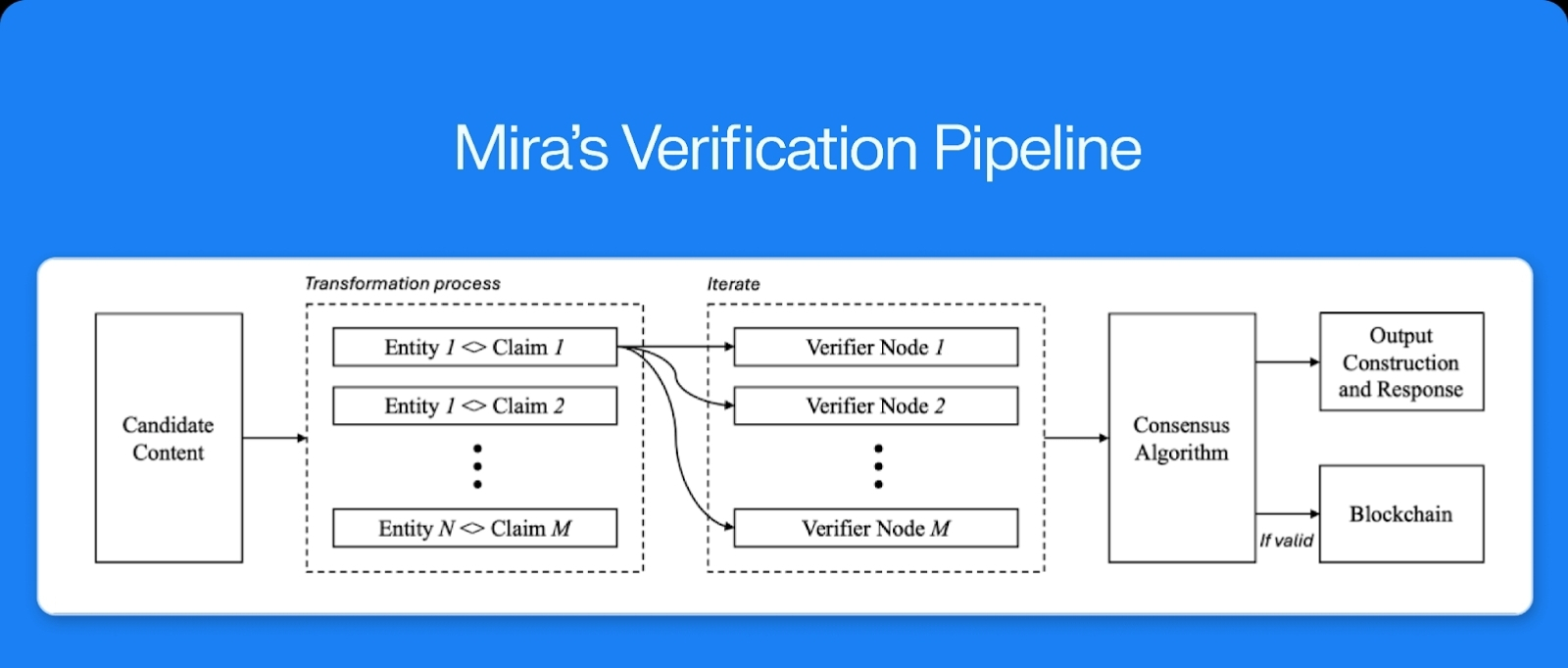
From an analyst's perspective, Mira’s architecture is a clever pivot toward infrastructure. By breaking down complex AI outputs into individual, cryptographically verifiable claims and distributing them across a network of independent nodes, the protocol replaces centralized trust with mathematical certainty. It functions essentially as a decentralized jury for data. If an AI claims "X is true," Mira doesn't just take its word for it; it forces a consensus through economic incentives. This move from "black box" AI to "verified" AI is exactly what institutional players need before they can fully hand over the keys to autonomous agents.
Looking at the current market climate, the psychology of AI tokens has shifted significantly since the frantic hype cycles of 2024 and 2025. We are no longer in a "buy anything with AI in the name" phase. Investors have become more discerning, looking for projects that solve actual bottlenecks. This is where Mira finds its footing. Currently, the asset is navigating a classic re-accumulation zone. After the initial volatility that follows any infrastructure launch, we are seeing a steadying of the price floor as "weak hands" exit and long-term believers in AI verification begin to build positions.

Technically speaking, the $MIRA token is testing a critical psychological level near $0.10. For a trader, the logic here is straightforward: we are looking for a sustained daily close above this resistance to signal a shift in momentum. On the downside, the $0.085 region has acted as a robust "value area" where buyers have historically stepped in. A prudent risk management strategy would involve keeping a close eye on the 50-day moving average; as long as the price remains above this trendline, the structural integrity of the recovery remains intact. However, one must always account for the broader correlation with Bitcoin—if the king of crypto catches a cold, even the strongest altcoin narratives can feel the chill.
When comparing Mira to past launches, there are echoes of the early days of Chainlink. Many originally dismissed oracles as "boring" back-end tech, only to realize later that DeFi couldn't exist without them. Mira is betting on a similar trajectory—that autonomous AI can’t scale without a verification layer. While the road to mass adoption is never a straight line, the fundamentals here are grounded in a real-world problem. The long-term sustainability of the project will depend on its ability to integrate with existing AI workflows, but the "truth-as-a-service" model is perhaps one of the most compelling narratives in the current cycle. For those looking past the daily candles, the focus should remain on developer activity and the growth of the node operator ecosystem.
