
Every connected device leaves a trace. In a world where billions of machines—sensors, autonomous agents, IoT endpoints, robotic systems—are talking to each other without human supervision, the question isn't just who owns the data. It's who owns the identity. Fabric Foundation ($ROBO ) is building infrastructure to answer that. But the privacy implications of a global machine identity system deserve a harder look than most crypto narratives are giving it.
The Landscape: Machine Identity Is a $20B+ Problem
Machine identity management is already a large and underserved market. According to CyberArk's 2024 Identity Security Threat Landscape Report, machine identities now outnumber human identities by a ratio of roughly 45:1 across enterprise environments, with the average organization managing over 250,000 machine credentials. Mismanagement of those credentials was cited in 68% of major breaches tracked over the past 18 months.
Fabric Foundation targets this gap specifically in decentralized and autonomous contexts—AI agents, robotic systems, and IoT devices that operate across permissionless environments where traditional certificate authorities simply don't apply. The protocol assigns verifiable, on-chain identities to machines and enables those machines to authenticate, transact, and log behavior without centralized intermediaries.
The ROBO token sits at the center of this system—used for identity staking, validator rewards, and governance over the identity registry.
Why This Matters Now
The timing here is pointed. Agentic AI frameworks—AutoGPT, LangChain-based deployments, and enterprise copilots—are proliferating faster than any identity standard can keep up with. The EU AI Act, which began phased enforcement in 2025, explicitly requires traceability for high-risk autonomous systems, creating regulatory pressure for exactly the kind of verifiable machine provenance Fabric is building. If no credible decentralized identity layer exists by the time agentic deployments scale into critical infrastructure, the default will be closed, surveillance-heavy corporate registries. Fabric's window to establish an open alternative is narrow and closing.
Deep Analysis: The Privacy Tension at the Core
Here's the structural irony Fabric has to navigate: a machine identity system is, by design, a surveillance system. To verify that a machine is who it claims to be, you need a persistent, queryable record of its behavior and credentials. That record is exactly what malicious actors, overreaching regulators, or competitive intelligence operations would want to access.
Fabric's proposed solution involves several layers worth unpacking:
Zero-Knowledge Attestations. Rather than broadcasting a machine's full credential history on-chain, Fabric's architecture uses ZK proofs to allow a machine to prove it meets certain conditions (registered, non-revoked, compliant with a given policy) without revealing the underlying identity data. This mirrors the approach used in human identity protocols like Polygon ID, though applied to non-human actors.
Selective Disclosure. Machines can reveal identity attributes to counterparties on a need-to-know basis. A manufacturing robot proving its maintenance certification to a quality auditor doesn't need to expose its full operational log to every node in the network.
Decentralized Key Management. Rather than a single CA holding root keys, Fabric distributes key custody across validators, reducing the single-point-of-failure risk that has made centralized machine identity systems (like compromised IoT certificate authorities) such attractive targets.
These are real design choices. They're also untested at scale. The gap between cryptographic architecture and production-grade privacy resilience is where most protocols eventually struggle.
Economics: What the Identity Stack Actually Generates
Fabric's economic model ties protocol revenue to identity registration, renewal, and staking activity. Based on publicly referenced tokenomics (illustrative model using disclosed parameters):
Estimated active machine identities at launch target: 500,000 registered endpoints in Year 1
Registration fee: approximately 0.5 $ROBO per identity (illustrative based on disclosed fee structure)
Annual renewal: 0.2 $$ROBO per identity
Example calculation: At 500,000 registered identities with an average blended fee of 0.35 ROBO and a ROBO price of $0.10 (illustrative), that's $17,500 in annualized protocol revenue from fees alone—a modest figure that scales dramatically if machine identity adoption reaches the millions-of-endpoints range that enterprise IoT and autonomous vehicle deployments imply.
Validator staking rewards are separate, funded through token emission, with early-stage APY reportedly in the 15–25% range according to Fabric's testnet documentation. That range matters because it determines whether validators are economically incentivized to run honest, high-uptime nodes—which is foundational to identity system reliability.
Risks: Two Challenges That Could Define or Break This
1. The Regulatory Paradox of Verifiable Machine Identity
Governments want traceability. Fabric's privacy-preserving design explicitly limits it. In jurisdictions where authorities can compel disclosure of machine activity logs—which is most of them—a ZK-based identity system creates legal friction. There's no clean answer here. Either Fabric builds in compliance backdoors (which defeats the privacy value proposition) or it operates in a legal gray zone that may foreclose enterprise adoption in regulated industries.
2. Token Concentration and Governance Capture
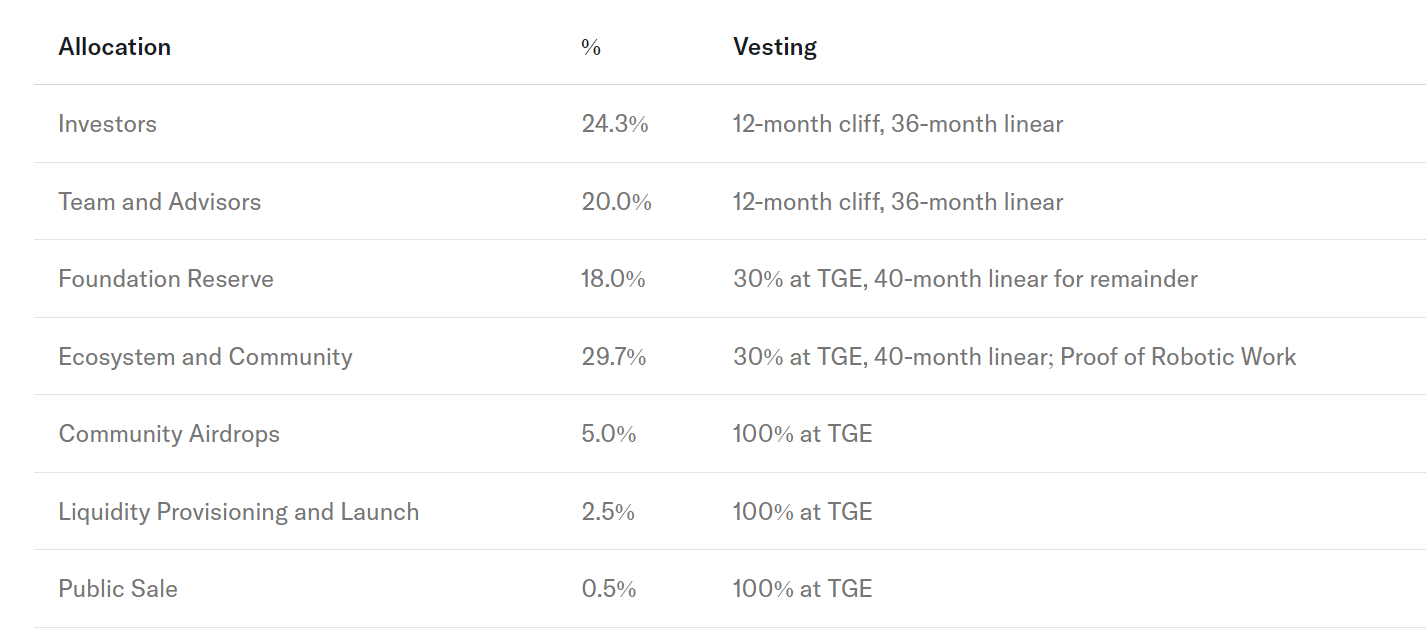
Based on available information, a significant portion of ROBO supply was allocated to early investors and the foundation treasury, with vesting schedules extending through 2026–2027. If a small cohort of stakeholders controls governance before the identity registry achieves meaningful distribution, they can effectively set policies for who gets registered, who gets revoked, and what data gets disclosed—outcomes that could compromise the neutrality the protocol needs to be credible infrastructure.
Outlook: Infrastructure First, Speculation Later
Fabric isn't pitching itself as a trading token. It's pitching foundational infrastructure for a machine-native internet. That's either the most durable value thesis in the space—or the hardest one to validate in a market that rewards short-term price action.
The ZK-based privacy architecture is technically sound in design. The real test is enterprise sales cycles, regulatory navigation in the EU and US, and whether the developer tooling is good enough that AI agent frameworks actually integrate Fabric identity rather than building their own.
The projects that win in identity infrastructure tend to win through network effects, not technical superiority alone. Fabric needs early anchor clients—one major robotics firm, one autonomous fleet operator, one enterprise AI platform—to create the gravitational pull that makes ROBO identity the default, not the alternative.
As agentic AI deployments scale into regulated industries, can Fabric's privacy-first machine identity architecture survive contact with compliance requirements—or will it have to choose between privacy and adoption? 👇
Note: Fee calculations and registration estimates are illustrative models based on disclosed tokenomics parameters. Always conduct independent research.
@Fabric Foundation #Robo