

Cryptocurrency exchanges establish emergency measures when the situation in Middle East bases escalates and poses a security threat to employees in the region.
Some key platforms also deployed contingency plans as threats of missiles and military interventions got worse over the weekend.
The measures will secure the employees and will not interfere with trading services.
Exchanges activate staff safety measures
Cryptocurrency exchanges such as Binance, Bybit, and Bitget made available to the teams in the Middle East shelter guidance and emergency responses.
Remote working guidelines and evacuation assistance were also verified through internal communications and communicated to the public.
Bitget CEO Gracy Chen told the community that the exchange would protect the 2, 204 employees in the region.
The company made a commitment to pay full salaries irrespective of the disruption in its operations.
It also promised to provide temporary accommodation, transportation, emergency rations, and medical treatment.
The company indicated it would pay airfare and relocation expenses in case there is a need to relocate it.
The employees were advised at all costs to work at home and report on a daily basis to ensure they were safe.
The founder of Binance, Changpeng Zhao, made a post on X where he wrote that he is confident in the UAE leadership and the defense system.
He encouraged the community to be on guard during times of overheated tensions.
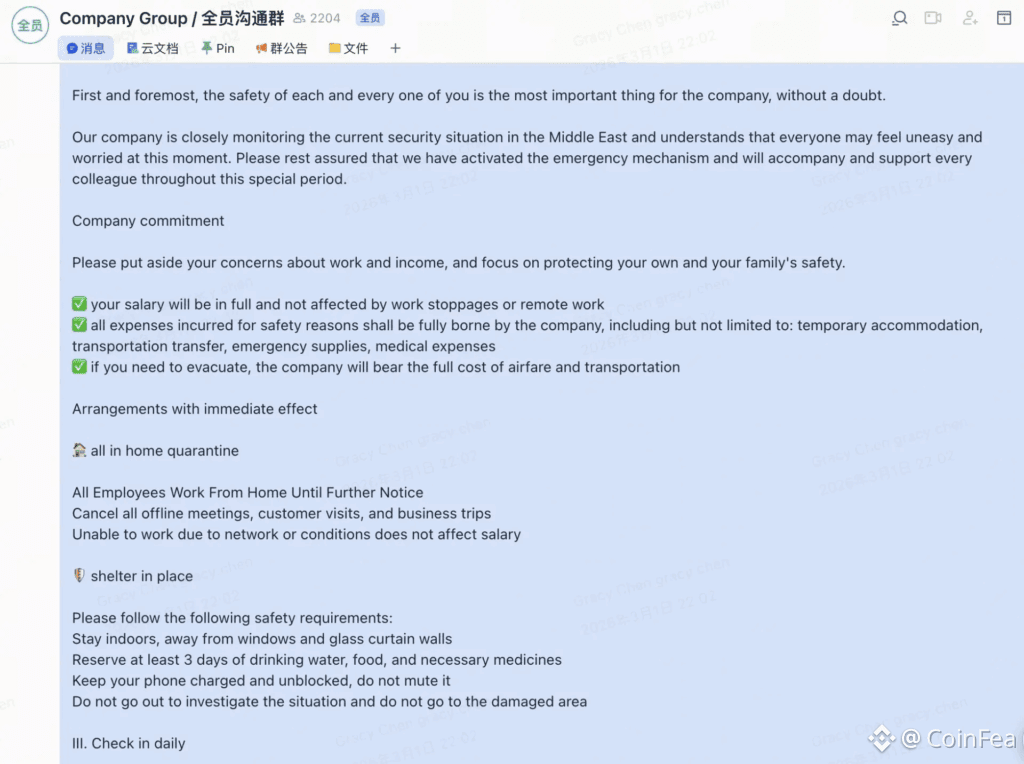
Bitget’s CEO, Gracy Chen, shared safety protocols for staff as Middle East tensions spilled over from the weekend.
Binance allegedly issued a March 1 announcement advising UAE-based employees to adhere to the official government advice on safety.
The local alerts were suggesting people take shelter in the nearest areas and not to be around the windows or open areas since the missiles might hit them.
Lots of people reached out. All good, and very calm here actually, considering the circumstance. UAE citizens and tourists have a lot of confidence in the country's leadership, and defense system. Seen a few smoke in the sky and heard a few booms.This seems to be the most… https://t.co/7DmtPwTLqr
— CZ BNB (@cz_binance) February 28, 2026
Transactions focused on communication with local governments and in-house security organizations.
Regional presence increases operational focus
The Middle East is now one of the main centers of digital assets companies.
The UAE, Bahrain, and Saudi Arabia launched laws that brought international transactions.
Binance affirmed plans to set up its base in the UAE last year. OKX, Rain, and CoinMENA continue to have strong operations within the area.
OKX said that its risk teams were keeping a close eye on the developments.
The exchange declared that it would be able to recreate financial records and keep obligations when the systems are disrupted.
The conventional financial institutions responded in a timely manner.
The Sumitomo Mitsui Financial Group and Mitsubishi UFJ Financial Group of Japan are said to have delayed coming to the region and joined Standard Chartered in giving advisories.
In the meantime, the UAE Capital Market Authority gave notice of the shutdown of the Abu Dhabi Securities Exchange and the Dubai Financial Market, no later than March 3, 2026. Authorities gave the reason of continued security threats.
Crypto markets operate as tokenized gold surges
The markets of digital assets responded instantly because of their continuous trading nature. Bitcoin dropped to $62,938 on the weekend but has since recovered to be above $66,000.
Ether declined to $1,783 and then started climbing past $1,900.
The tokenized commodities experienced high demand with the traditional exchanges closed.
Tether Gold was nearly $5,500 and registered over $1 billion of trading transactions per day. Pax Gold overcame $5,500 of approximately $900 million turnover in a day.
The majority of the action was done on centralized and decentralized crypto exchanges.
The spurt was an indication of investor demand for gold-correlated assets when the geopolitical environment was strained.
The other test of resilience is the one that is now facing crypto exchanges.
Their international structure and past experience of managing crises can assist them in overcoming the uncertainty and also focus on the safety of the staff.
The post Crypto exchanges set up emergency plans as tensions rock Middle East bases first appeared on Coinfea.