
As we progress through the first quarter of 2026, the global AI landscape has shifted from a race for raw processing power to an urgent struggle for institutional reliability. In the previous two years, generative AI models reached a zenith of creative capability, yet they remained fundamentally unequipped for the rigors of high-stakes enterprise applications. We have entered the era of the "Trust Crisis." While Large Language Models (LLMs) can now simulate human reasoning with uncanny precision, they still operate as "black boxes"—opaque systems that offer no cryptographic proof of their accuracy. For a doctor diagnosing a patient, a lawyer citing precedents, or a financial analyst forecasting market shifts, "mostly correct" is a catastrophic liability.
@Mira - Trust Layer of AI MIRA has emerged as the definitive solution to this existential problem. It doesn't aim to build yet another competing AI model; instead, it has constructed the decentralized "Trust Layer" of the modern web. By providing a protocol that can independently verify any AI output, Mira is turning the chaotic "black box" of intelligence into a transparent, audit-ready utility.
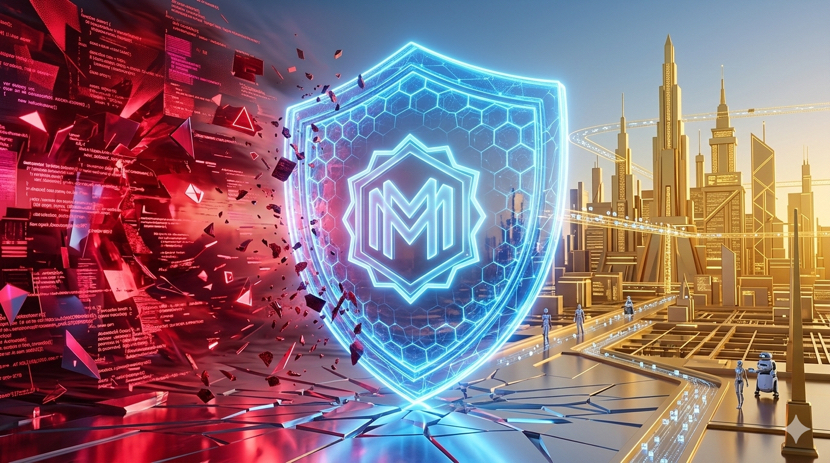
The Core Innovation: Proof-of-Verification (PoV)
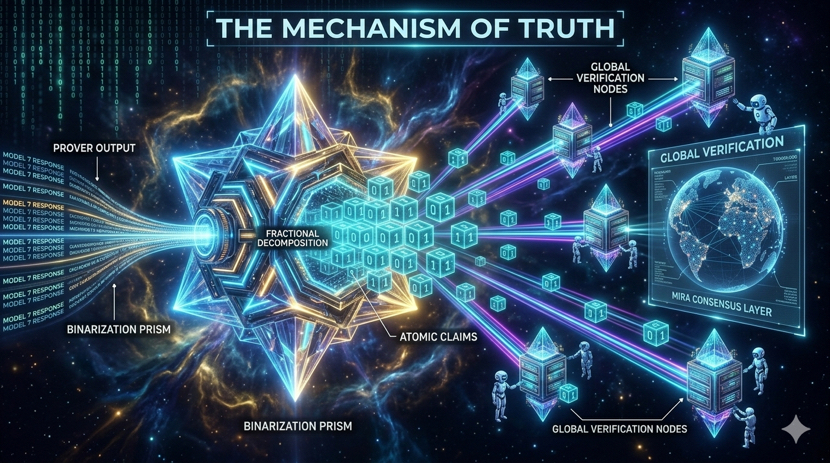
At the heart of Mira Network is a revolutionary consensus mechanism known as Proof-of-Verification (PoV). Traditional AI interactions are based on blind trust: the user asks a question, the model provides an answer, and the user hopes for the best. PoV dismantles this outdated model through a proprietary process called Binarization.
When an AI (acting as the "Prover") generates a complex response, the Mira protocol immediately intervenes. It algorithmically deconstructs the response into "Atomic Claims"—the smallest possible units of factual assertion that can be independently proven true or false. These fragments are then randomly and anonymously routed through a global mesh of Auditor Nodes.
Because these nodes are decentralized and run a diverse array of underlying models (such as GPT-4o, Claude 4, and Llama 3.3), the network achieves a "wisdom of the crowd" that no single model could match. Only when a majority of these independent auditors reach a consensus is the final output signed with a cryptographic certificate of accuracy. This process effectively bridges the reliability gap, reducing AI error rates from a standard 25% down to a verified 4% or less.
MIRA Tokenomics: The Economy of Truth
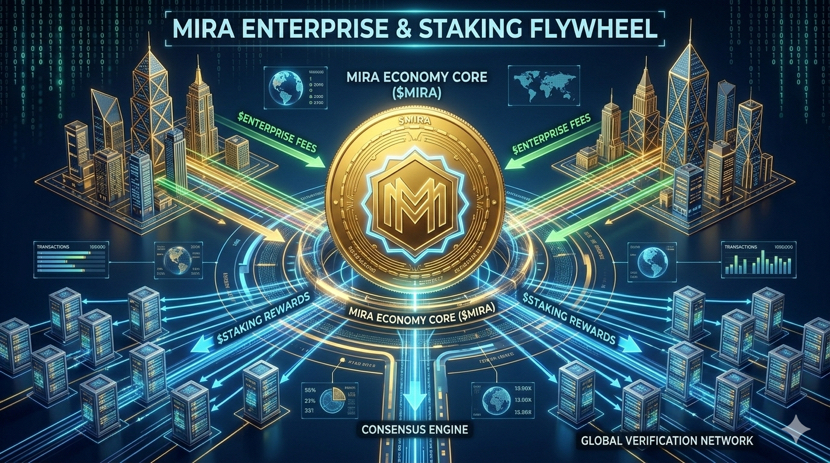
For a decentralized truth protocol to survive and scale, it must be supported by an economic engine that creates permanent, inelastic demand. The $MIRA token is the singular fuel that powers this global verification machine. Its value is derived from three core pillars of utility:
* Enterprise Utility: Large-scale organizations, from legal tech firms to medical research centers, must hold and spend MIRA tokens to access the protocol’s SDK. Every time an AI output is audited, MIRA is consumed as a network fee. As AI adoption grows, the demand for MIRA scales linearly.
* Economic Fidelity (Staking): To participate as a validator in the "Trust Layer," node operators must stake a significant amount of MIRA as a fidelity bond. This stake acts as insurance against malicious or lazy auditing. If a node provides false verification, its stake is slashed (destroyed), ensuring that the most profitable action for any node is always the pursuit of absolute truth.
* Supply Dynamics: As of March 2026, with a circulating supply of approximately 244 million tokens and a market cap hovering near $22 million, MIRA represents one of the few high-utility "infrastructure" plays in the crypto-AI sector. The upcoming Q2 roadmap includes a "buy-back and burn" mechanism funded by protocol fees, further tightening the supply as network usage increases.
Real-World Impact: Proving Value at Scale
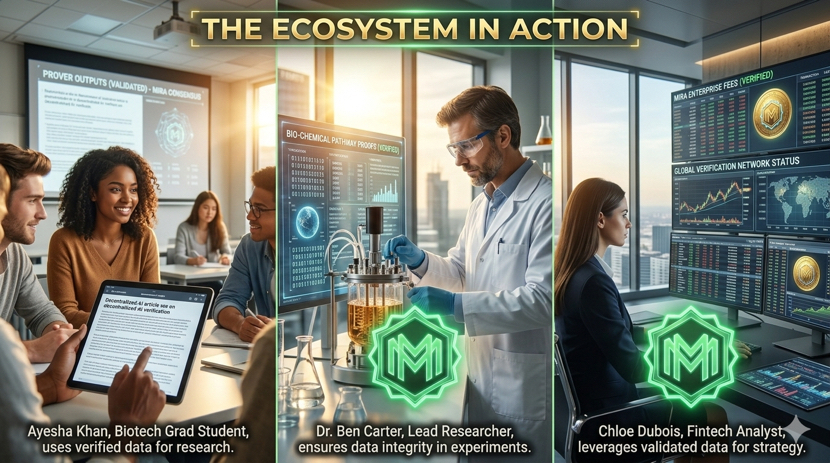
The power of Mira Network is no longer a theoretical concept; it is being proven daily by millions of users across a growing ecosystem of "Truth-First" applications:
* Klok (The Intelligence Hub): Klok has become the premier multi-LLM research application, serving over 4.5 million active users. By utilizing the Mira verification layer, Klok provides traders and researchers with audit-ready summaries of on-chain data, ensuring they aren't making decisions based on AI-generated hallucinations.
* Learnrite (Education Infrastructure): Education is perhaps the most sensitive sector for AI accuracy. Learnrite integrated the Mira SDK to transform its AI tutor from an experimental tool into a reliable educational companion. By leveraging Mira’s Auditor Nodes, Learnrite boosted its factual accuracy from 75% to a record-breaking 96%, allowing school districts to deploy it with full regulatory confidence.
* RWA Bridge: Mira has recently expanded into the Real-World Asset (RWA) space. By providing verified audit trails for tokenized property valuations and yield projections, Mira ensures that the bridge between traditional finance and decentralized ledgers is built on a foundation of cryptographic certainty rather than AI guesswork.
Conclusion: The Infrastructure Play of 2026
In the mid-2020s, the market focused on who could build the "smartest" AI. In 2026, the focus has shifted to who can build the most reliable one. Just as Chainlink became the inescapable standard for verifying price data during the DeFi boom, Mira Network is positioning itself as the standard for verifying "Intelligence" itself.
With the upcoming launch of App Version 2.0 and its growing list of institutional partners, MIRA is no longer just a token; it is the fundamental blueprint for a trustless, automated future. As AI continues to integrate into every facet of our lives, the most valuable commodity won't be the data itself, it will be the proof that the data is the truth.