
Okay so hear me out before you scroll past this.
A robot. With a wallet. Paying for its own electricity. Buying compute upgrades. Settling invoices without a single human approving the transaction.
Six months ago if someone told me that sentence in a coffee shop I would have smiled politely and changed the subject. Sounds like a fever dream someone had after watching too much sci-fi. But here's the uncomfortable truth — Fabric Foundation is already building exactly this. And when you understand why it needs to exist, the whole thing stops sounding crazy and starts sounding... inevitable.
Let's Back Up a Second
The robotics industry has a quiet problem that doesn't make headlines. Everyone focuses on the hardware breakthroughs — how fast they walk, how much they can lift, how well they see. Fair enough. That stuff is genuinely impressive.
But nobody asks — okay, robot completes a task. Now what? Who paid for the cloud compute it used during that task? Who settled the fee with the charging station it used between shifts? Who verified that the task was actually completed before releasing payment to the operator?
Right now? Humans. Spreadsheets. Manual invoicing. Corporate agreements signed months in advance. The "intelligent machine" goes home at the end of its shift and waits for a finance team to process its paperwork.
Fabric Foundation finds that deeply inefficient. So do I honestly.
The Wallet Changes Everything
Fabric Foundation gives robots something they've never had — autonomous economic identity. Through the FABRIC protocol, every robot on the network gets an on-chain identity and a wallet. That wallet holds $ROBO. And with that wallet, the robot can transact.
Need faster compute for a complex task? The robot pays for it. Charging station used during a break? Settled automatically. Task completed and verified through Fabric Foundation's Proof of Robotic Work system? Payment releases. No human in the loop. No delay. No paperwork.
This isn't just automation of labor. This is automation of the economics of labor. And Fabric Foundation is the first protocol seriously attempting to build this at infrastructure level.
When I first read through how the autonomous service procurement actually works inside Fabric Foundation, I had to reread it twice. Not because it was confusing — because I kept thinking "why hasn't anyone done this before."
Proof of Robotic Work — The Piece Most People Skip Over
Everyone talks about the wallet. Fewer people talk about what makes the wallet trustworthy.
Fabric Foundation built a verification layer called Proof of Robotic Work. The idea is straightforward but the implications are significant. Before any payment settles on the Fabric Foundation network, the work has to be verified. Real task. Real completion. Real world.
This matters enormously. Without verification, you just have robots claiming they did work and getting paid regardless. That's not a robot economy — that's a broken vending machine that dispenses money. Fabric Foundation understood this and built the verification layer into the protocol itself, not as an afterthought.
It also means that $ROBO flowing through the system represents actual work being done. In a space full of tokens backed by nothing but narrative, that distinction is worth sitting with for a moment.
Who's Already In
Fabric Foundation has hardware partners that aren't theoretical. UBTech, AgiBot, Fourier — these companies are manufacturing and deploying robots in real operational environments. They're not waiting for Fabric Foundation to mature before participating. They're already integrated.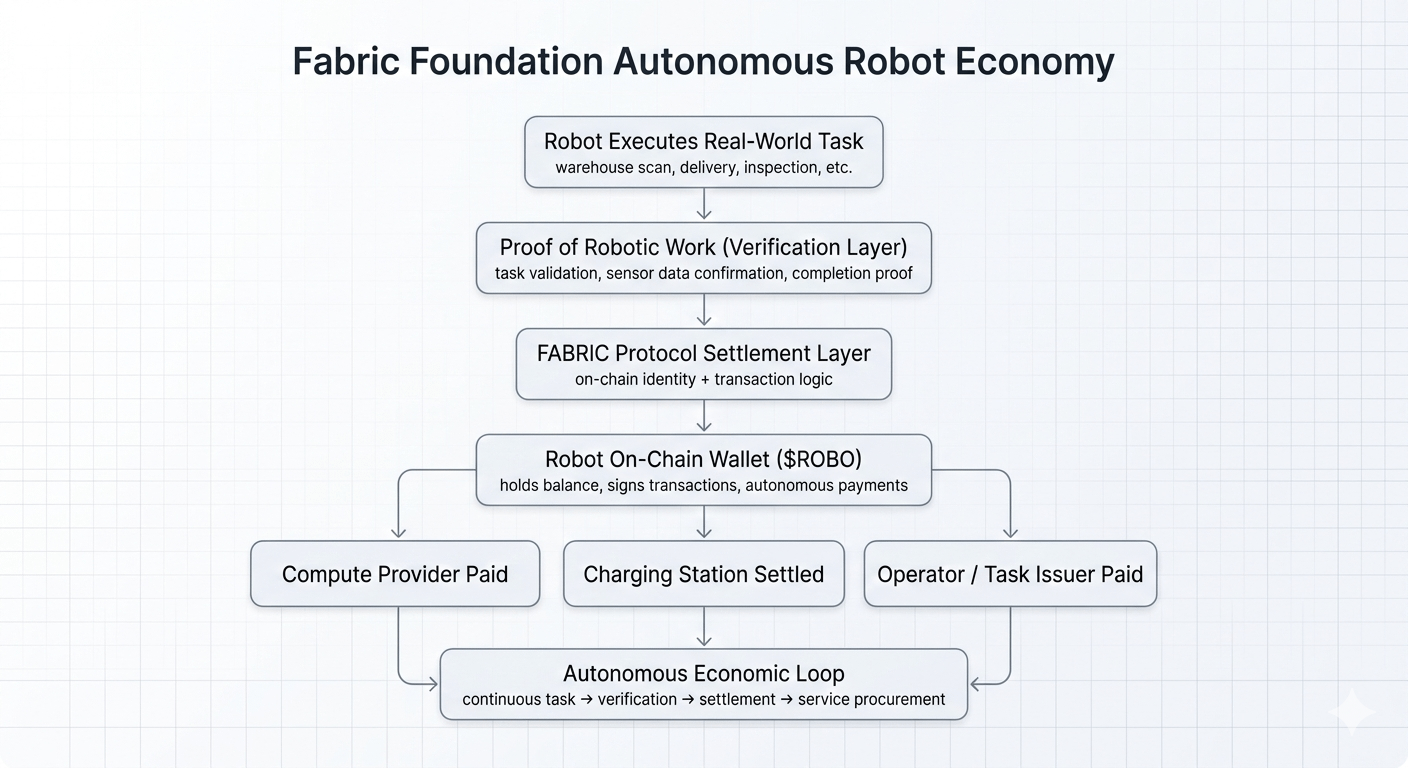
The $20 million raise led by Pantera Capital, with Coinbase Ventures and Ribbit Capital alongside — that's not a group of funds betting on a whitepaper. They looked at the hardware relationships, the protocol architecture, and the team behind OpenMind and made a conviction bet.
Here's What I Keep Coming Back To
Fabric Foundation isn't solving a crypto problem. It's solving a robotics problem that crypto happens to be uniquely positioned to fix. Decentralized identity, on-chain settlement, permissionless participation — these aren't buzzwords here. They're functional requirements for what Fabric Foundation is building.
$ROBO is the token that makes the whole machine run. And the machine — the actual robot economy that Fabric Foundation is assembling piece by piece — is more real than most people in this space have stopped to realize.
Robots with wallets sounded crazy to me once too. Now it sounds like infrastructure.
@Fabric Foundation #Robo $ROBO
