
Every robot that moves through the world generates data. This is not a peripheral feature of robotic systems, it is fundamental to how they operate. A delivery robot navigating a city street is continuously processing and recording its environment: the precise paths it takes, the obstacles it encounters, the weather conditions it operates in, the locations it visits, the people it passes. A robot operating in a healthcare facility captures patient interaction data, movement patterns through sensitive spaces, and operational information about medical equipment and procedures. A domestic robot working in a private home records the layout of living spaces, the routines of the people who live there, and the objects present in intimate personal environments.
This data is extraordinarily valuable. Navigation trajectories from thousands of delivery robots, aggregated and analysed, can train better autonomous driving systems. Operational data from industrial robots can optimise manufacturing processes in ways that would take human analysts years to identify. Healthcare robot data can contribute to medical research and improve treatment protocols. The economic value of this information, when properly aggregated, processed, and applied… may well exceed the value of the physical hardware that generates it.
Fabric Protocol recognises this and proposes to use blockchain infrastructure to record robot activity transparently, creating immutable logs of tasks and sensor outputs that can form the basis of verifiable data markets. On paper, this is an elegant solution to one of the central challenges of the data economy… the difficulty of establishing clear, verifiable provenance for data and creating trustworthy mechanisms for buying and selling it.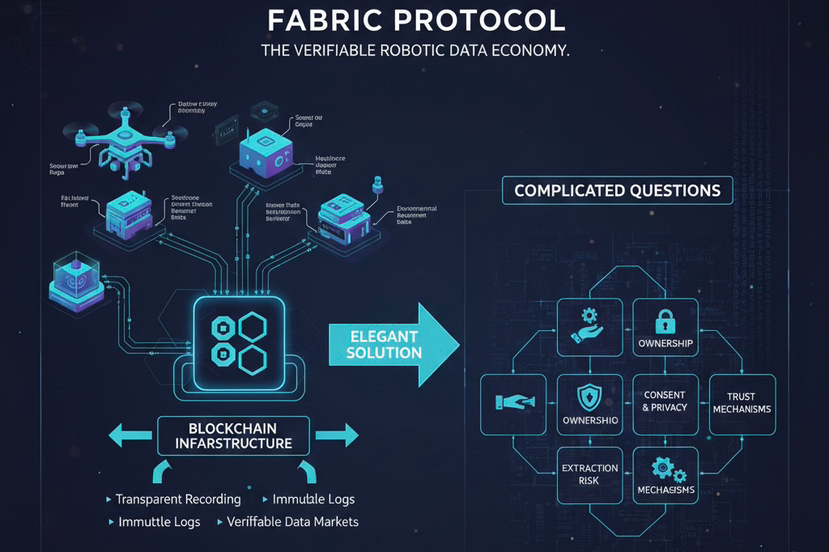
In practice, however, the proposal runs directly into a set of deeply complicated questions about ownership, consent, privacy, and the risk of building new forms of extraction on top of what looks like open infrastructure.
The ownership question is more contested than it might initially appear. In most legal jurisdictions, raw data generated by a device does not automatically belong to anyone in particular. The owner of the robot has a strong claim, certainly. But so might the people whose environments and behaviours the robot recorded. So might the operators of the spaces the robot moved through. So might the public, in cases where robots operate in public spaces using publicly funded infrastructure. Fabric's blockchain ledger records what happened and who the robot's registered owner is. It does not resolve the underlying question of who has legitimate rights over the data that robot collected.
This matters because data markets built on unclear ownership foundations are fragile and legally exposed. If regulators or courts subsequently determine that certain categories of robot-generated data belong to people other than the robot's registered owner or that collecting and commercialising such data requires explicit consent that was never obtained, the economic models built on those data markets could unravel rapidly.
The privacy dimension adds another layer of complexity. Europe's General Data Protection Regulation, which has become the de facto global standard for data privacy law, requires informed consent for the processing of personal data and grants individuals the right to request that their personal data be deleted. Blockchain's core architectural feature, the immutability of its records — sits in direct and fundamental tension with this requirement. Data recorded on-chain cannot be erased. It persists permanently, by design.
Technical workarounds exist. Data can be stored off-chain, with only a cryptographic hash of the data recorded on the blockchain — allowing the underlying data to be deleted while the record of its existence and integrity remains. Zero-knowledge proofs can enable verification of facts about data without revealing the underlying data itself. These approaches mitigate some of the tension between blockchain immutability and privacy law, but they add significant technical complexity and operational cost. They also require consistent, disciplined implementation across every participant in the network, a standard that decentralised systems have historically struggled to maintain uniformly.
There is also a deeper concern about the direction of travel. The history of data-driven platform businesses is not encouraging for those hoping that robot data markets will generate broadly distributed economic benefits. Social media platforms were built on the premise that users would create content and that advertising revenue would support the platform. Over time, the economic reality became clear: platforms captured the vast majority of the value generated by user content, while the users who created it received almost nothing in return. The platform owners became extraordinarily wealthy. The users received a free service.
A robot data economy without strong governance protections could easily replicate this dynamic. Large platforms with the technical capacity to aggregate and process robot data from many small operators could capture the majority of the value that data generates, paying small fees to the operators who generated it while extracting enormous value from the aggregated whole. This is precisely the pattern that has characterised the data economy in every domain it has touched, from social media to mapping to e-commerce.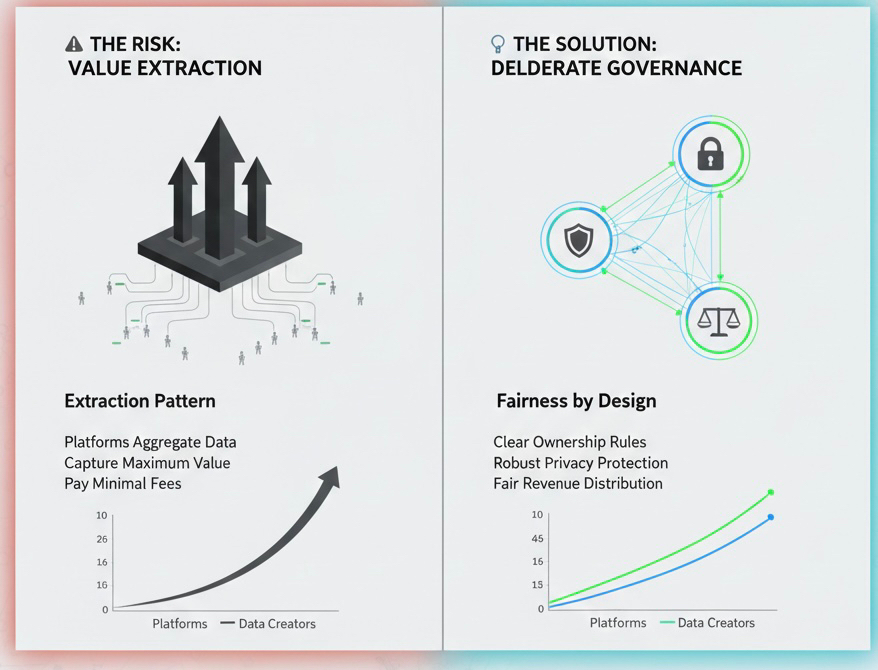
Preventing this outcome requires deliberate governance choices. It requires clear rules about who owns robot-generated data and under what circumstances it can be commercialised. It requires privacy protections that are technically robust and consistently enforced across the entire network. It requires revenue distribution mechanisms that ensure data creators… including robot operators, and arguably the people and communities whose environments and behaviours robots record, receive a fair share of the value their data generates.
Fabric Protocol has the potential to build something genuinely different from the extractive data platforms that have dominated the internet era. Whether it does will depend on whether its architects treat data governance as a central design priority rather than a compliance afterthought.