
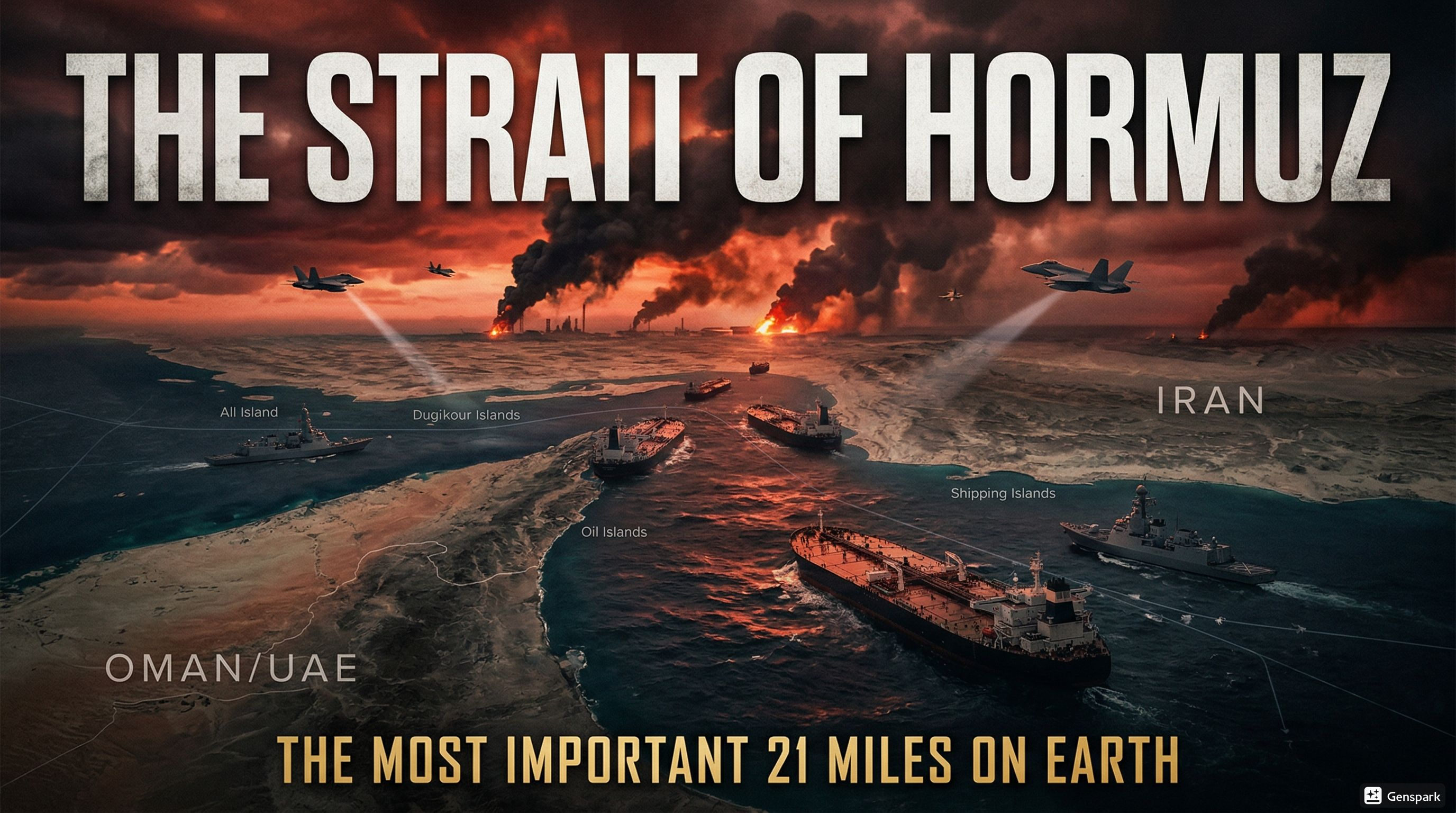
On February 28, 2026, the United States and Israel launched a large-scale military offensive against Iran, killing Supreme Leader Ali Khamenei and striking targets across Tehran and beyond. Within hours, the world's attention pivoted to a slender strip of water just 21 miles wide — the Strait of Hormuz.
What Is the Strait of Hormuz?
The Strait of Hormuz is the sole maritime passage connecting the Persian Gulf to the open ocean, nestled between Iran to the north and Oman to the south. Each day, an extraordinary share of the world's energy supply funnels through this narrow corridor — approximately 25% of global seaborne oil trade and 20% of the world's liquefied natural gas (LNG).
No viable alternative exists. The world's spare oil production capacity is concentrated in Gulf states, but without access through the Strait, these supplies cannot reach global markets. CNBC The few bypass pipelines operating in Saudi Arabia and the UAE can accommodate only a fraction of the crude that typically traverses the waterway.
What's Happening Right Now
Oil shipments through the Strait have largely ground to a halt following the US-Israeli strikes, with Iranian media reporting the waterway is "practically closed." Multiple tankers en route to Hormuz have reversed course, while others linger near the entrance, awaiting clarity.
Iran's Islamic Revolutionary Guard Corps has reportedly sealed the Strait to maritime traffic, with vessels receiving explicit instructions that "no ship is allowed to pass." Wikipedia This represents an unprecedented development — the first sustained closure in the Strait's history, which remained navigable through decades of regional conflicts and threats.
Why It Matters to the Global Economy
The statistics are staggering. More than 14 million barrels per day flowed through the Strait in 2025 — representing one-third of the world's total seaborne crude exports. Approximately three-quarters of these barrels were destined for China, India, Japan, and South Korea. China alone relies on the Strait for half of its crude imports.
An extended closure could catapult oil prices beyond $100 per barrel CNBC — and that may be a conservative projection. Energy analysts warn of a far more dire scenario. According to energy analyst Robert McNally, "A prolonged closure of the Strait of Hormuz is a guaranteed global recession."
Prices would need to climb high enough to force an economic contraction that curbs demand, what one analyst described as "the mother of all bidding wars" as nations compete to secure dwindling supplies.
All LNG — essential for heating homes and generating electricity across Europe and Asia — must transit the Strait by ship. Unlike oil, LNG cannot be rerouted or substituted if the passage closes.
The Bigger Picture
Iran has long regarded the Strait as its ultimate bargaining chip. Over the past two decades, Tehran has repeatedly threatened to close the waterway and possesses the military capability to make transit extraordinarily hazardous, including shore-based anti-ship missiles, naval mines, and fast attack craft.
This crisis differs fundamentally from previous confrontations. The assassination of Iran's supreme leader and the magnitude of the military operation leave Iran's response — and its willingness to weaponize the Strait — deeply uncertain.
For the global economy, that uncertainty alone is sufficient to send tremors through energy markets, supply chains, and the cost of living for billions of people worldwide. The Strait of Hormuz has always been vital. Today, it may be the most consequential 21 miles on Earth.
Situation as of March 1, 2026. Events continue to unfold. $BTC
#StraitOfHormuz #GlobalEconomy #OilPrices #Iran #Geopolitics #EnergyCrisis
