
I keep coming to one uncomfortable question. If robots start earning money, who checks that they actually did the work?
This question seemed like a concern a year ago. It doesn't seem like that now. Companies are spending a lot on AI more than $150 billion in 2025. This tells us that they are not just testing AI on a scale. They are investing money in it. Robotics funding also went over $12 billion in the year. Most of this money is going into areas like logistics making things and starting to automate services. When this much money is being spent it means robots are being put to use not just tested.
When I first looked at Fabric Foundation, what struck me wasn’t the robotics narrative. It was the accounting layer underneath it. Fabric Protocol is building a public network that coordinates data, computation, and governance for general-purpose robots. On the surface, that sounds like infrastructure. Underneath, it is about trust.
Imagine a warehouse robot optimizing delivery routes. On the surface, it moves packages. On the surface it just moves boxes around.. Its actually using data making decisions based on probabilities and talking to other systems in the company. If this robot makes the delivery process 8 percent more efficient that could save millions of dollars each year. Who checks that this robot really did improve efficiency by 8 percent? A dashboard can show the numbers.. That's not the same as verifying them. A centralized dashboard can report it. But verification is not the same as reporting.
Fabric inserts a ledger between action and reward. Verifiable computing allows the network to check whether a computational task occurred as claimed. In plain terms, it creates a receipt for machine work. That receipt can then anchor incentives. $ROBO becomes the unit that connects contribution to compensation and governance weight.
That structure matters more than it sounds. Now investors are being careful with their money in crypto markets. Bitcoin is still the player making up almost 50 percent of the market. This means investors are being cautious and sticking with what they think is safe. Tokens without clear utility struggle to hold momentum. Meanwhile, AI-related assets attract attention, but attention alone does not sustain value. What sustains value is repeatable demand.
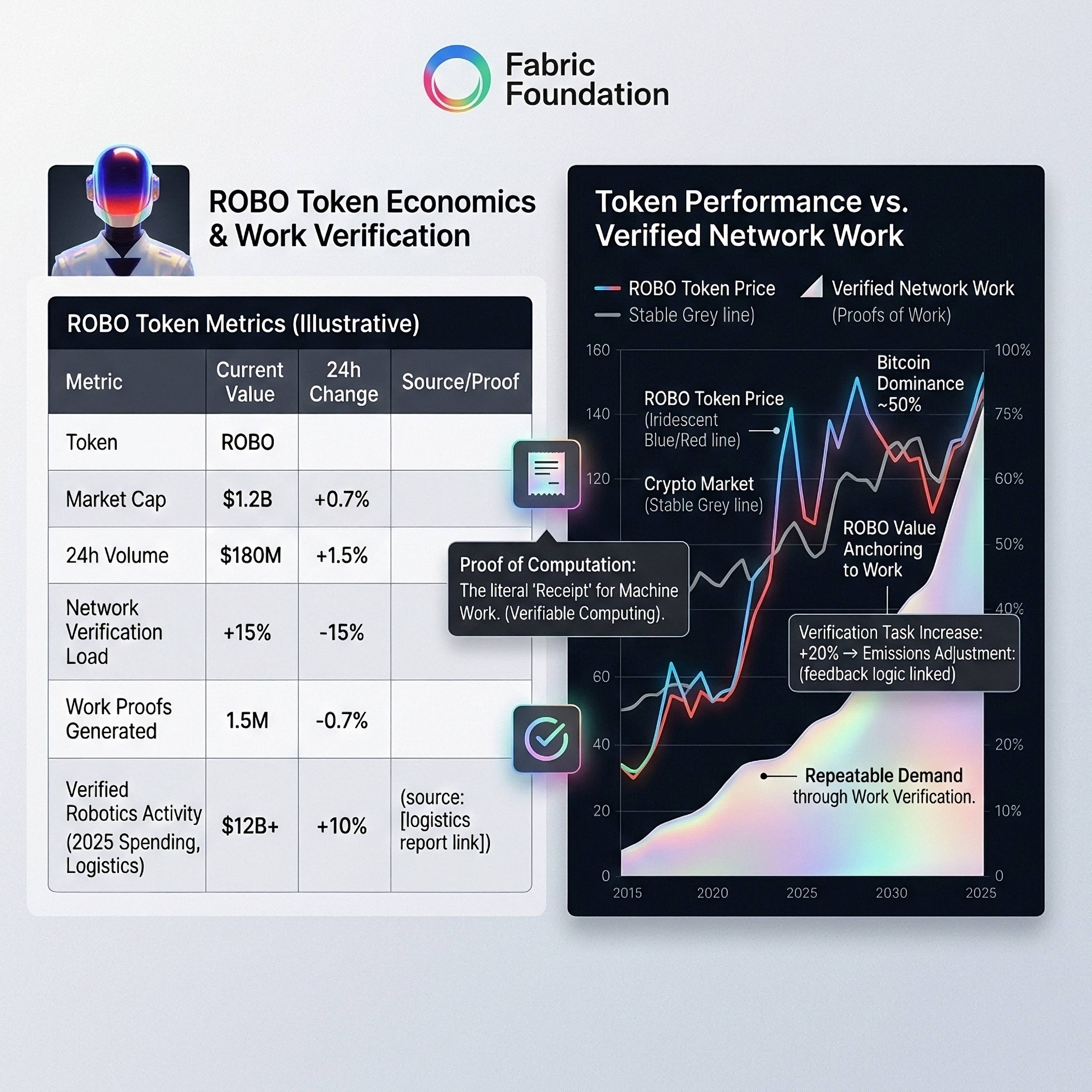
Fabric’s design tries to create that demand through contribution. If emissions respond to network participation rather than operating on a fixed inflation schedule, then supply expansion is tied to measurable activity. For example, if network verification tasks increase by 20 percent, emissions can adjust proportionally rather than flooding the market. The number itself is less important than the feedback logic behind it. It suggests an attempt to anchor token supply to actual computational work.
Of course, this introduces complexity. Verifiable computing is not trivial. On the surface, a computation is executed. Underneath, proofs must be generated and validated. That process consumes resources and adds latency. The benefit is accountability. The cost is overhead. Whether that tradeoff is worth it depends on scale. If robots are managing high-value operations, the cost of verification may be small relative to the risk of unchecked automation.
There is another layer here. Governance. General-purpose robots evolve. They update models, integrate new data streams, and potentially operate across jurisdictions. A static rulebook does not survive that environment. Fabric positions governance as modular, meaning token holders and participants can adjust parameters over time. On the surface, that is flexibility. Underneath, it is an admission that autonomous systems will create edge cases we cannot predict.
Critics will argue that large robotics firms will simply build closed systems. That is a fair point. Corporate control can feel safer. But interoperability pressure builds quietly. When multiple vendors deploy machines in shared environments such as ports, hospitals, or smart cities, coordination standards reduce friction. A neutral economic layer can lower integration costs and distribute verification responsibilities. Whether corporations embrace that remains to be seen, but early signs suggest cross-platform coordination is becoming a topic in AI policy circles.
Meanwhile, @Fabric Foundation trades in a market where volatility is normal. If price action runs far ahead of network usage, speculation can distort incentives. That risk is real. We have seen tokens in previous cycles inflate rapidly only to retrace 70 percent or more when narrative momentum fades. Fabric’s emission control attempts to soften that dynamic, yet no design fully eliminates market psychology. Stability must be earned through consistent usage, not promised through token mechanics.
What makes this angle different from generic AI token narratives is the focus on verification as the economic core. Most projects emphasize intelligence. Smarter models. Faster inference. Larger datasets. Fabric emphasizes proof. Proof that computation occurred. Proof that contributions deserve reward. That shift changes how we think about machine participation in markets.
If robots begin transacting directly, which early agent frameworks already experiment with, the need for verifiable identity and contribution expands. If a robot negotiates contracts, for supplies without a way to track what its doing that introduces a big risk. A system that uses a ledger can help manage that risk. It doesn't make it disappear. It makes it easier to track and understand. It creates a steady foundation beneath volatile technological change.
This pattern mirrors broader crypto evolution. In 2017, the focus was token creation.
In 2020 people started moving their money into decentralized finance systems that managed billions of dollars. Now they're looking into systems that help coordinate AI and automation. Each phase builds closer to real economic integration. If this holds, the projects that survive will be those that embed themselves quietly into infrastructure rather than chasing visibility alone.
The upside for lies in becoming that quiet layer. If verifiable machine work becomes standard practice, demand for coordination tokens could scale alongside robotic deployment. The downside is adoption lag. Infrastructure often moves slower than speculation. Markets may price in expectations years before usage materializes.
Still, when I look at the direction of AI investment, the question feels less hypothetical. As automation touches higher-value sectors, verification shifts from optional to necessary. The moment machines start earning directly, proof of work becomes literal again.
And that is the observation I cannot ignore. In a world rushing to build smarter robots, the real power may belong to whoever builds the receipts they cannot operate without.