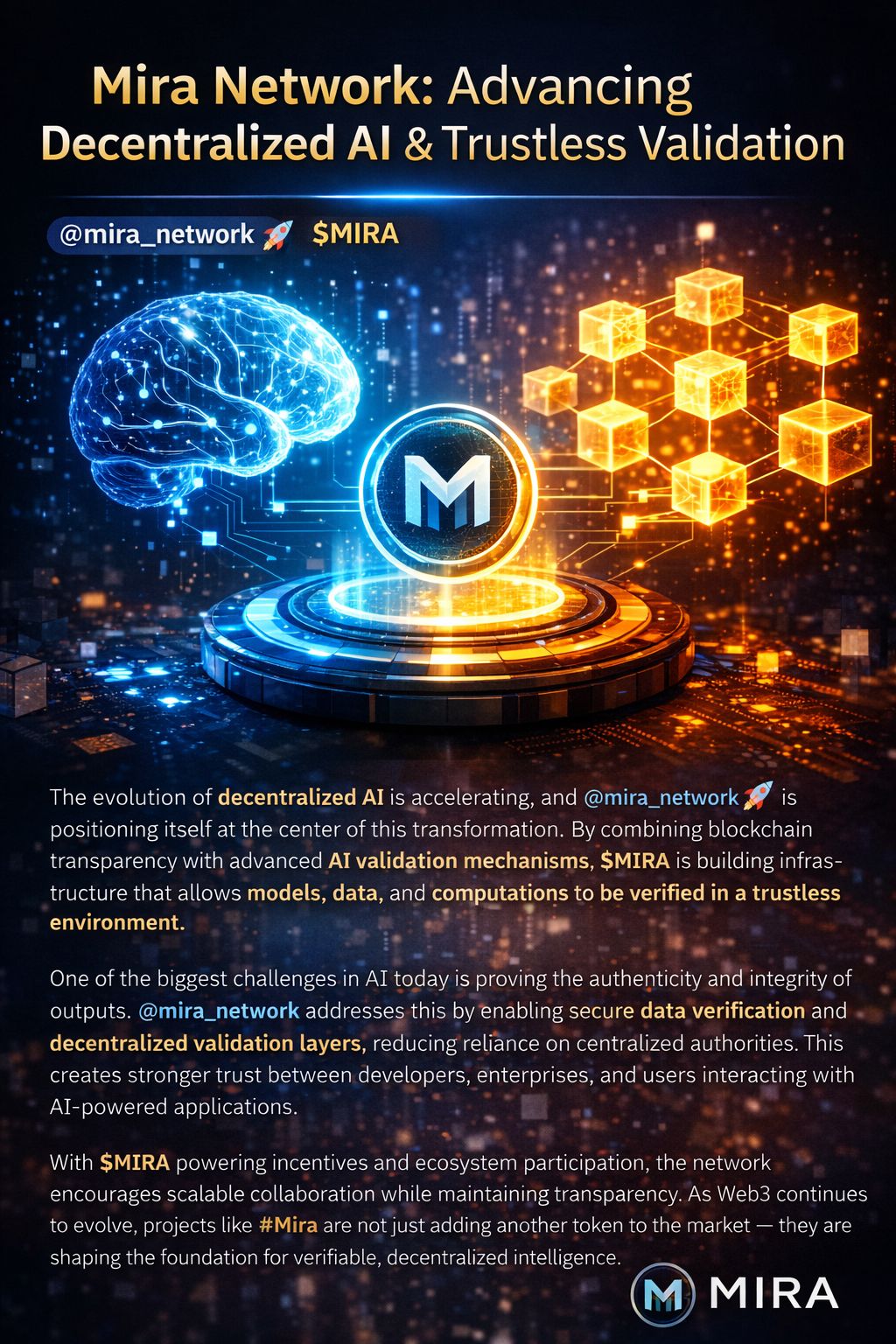
The rapid expansion of Artificial Intelligence has brought us to a crossroads. While models are more "creative" than ever, they remain fundamentally probabilistic, leading to the well-known issues of hallucinations and inherent bias. For AI to be integrated into high-stakes sectors like finance, legal, and medicine, we need more than just "better" models—we need a verifiable trust layer.
This is where @Mira - Trust Layer of AI _network is making a significant impact. Unlike centralized AI providers that require users to "blindly trust" their outputs, Mira is building a decentralized infrastructure specifically designed for AI validation.
The Mechanism of Trust
The core innovation of the Mira Network lies in its Multi-Model Consensus. Instead of relying on a single authority, the protocol:
Decomposes complex AI outputs into "atomic claims."
Distributes these claims to a decentralized network of verifier nodes.
Aggregates the results through a consensus mechanism to ensure the output is factually sound and unbiased.
The Role of $MIRA
The $MIRA token serves as the economic engine of this ecosystem. It isn't just a medium of exchange; it’s a security tool. Node operators must stake $MIRA to participate in the verification process. This "skin in the game" ensures that providing false or lazy validations results in financial penalties (slashing), while honest work is rewarded.
As we move toward a future populated by autonomous AI agents, the demand for a transparent, blockchain-backed "Truth Engine" will only grow. Projects like #Mira are setting the standard for how humans and machines will interact in a trustless, decentralized world.