
The Growing Trust Problem in Artificial Intelligence
Artificial intelligence is transforming how we search, trade, learn, and communicate. From chatbots to predictive analytics, AI systems are becoming part of daily digital life. But while AI is powerful, it is not always reliable.
One of the biggest concerns is hallucination. This happens when an AI confidently generates information that sounds correct but is actually wrong. In critical environments like finance, healthcare, or legal systems, small mistakes can lead to big consequences.
Another challenge is bias. AI models learn from data, and if the data contains bias, the output can reflect it. That creates uncertainty about fairness and accuracy.
For AI to operate autonomously in sensitive use cases, trust must move beyond assumptions. We need systems that verify intelligence rather than simply presenting it.
This is where Mira Network introduces a different perspective.
Understanding the Basics: What Mira Network Actually Does
Mira Network is designed to solve AI reliability challenges using blockchain-based verification. Instead of trusting a single AI model, Mira transforms outputs into structured, verifiable claims.
Imagine AI writing a long research summary. Rather than accepting the entire answer at face value, Mira breaks it into smaller statements. Each statement becomes a claim that can be checked independently.
These claims are distributed across a decentralized network of independent AI models. Think of it like having multiple examiners grade the same paper instead of just one teacher.
If consensus is reached among independent validators, the output gains credibility. This system reduces reliance on centralized control and replaces it with cryptographic verification.
The goal is simple: turn uncertain AI outputs into trusted digital intelligence.
How Blockchain Enables Trustless Intelligence
Blockchain technology is often associated with digital assets, but its real innovation is trustless consensus. It allows independent participants to agree on information without needing a central authority.
Mira Network applies this principle to AI verification. When AI generates content, that content is converted into claims. These claims are validated by multiple nodes within the network.
Each validator has economic incentives aligned with accuracy. If a participant validates correctly, they are rewarded. If they behave dishonestly, there are consequences built into the protocol.
This creates a system where trust comes from mathematics and incentives rather than reputation alone. It is similar to how blockchain secures transactions by requiring network agreement before confirmation.
By combining AI with blockchain consensus, Mira builds a bridge between intelligence generation and verifiable truth.
Breaking Down Complex AI Outputs
AI often produces complex, layered responses. A single answer may include facts, interpretations, and predictions. Verifying the entire output as one block would be inefficient.
Mira solves this by decomposing outputs into granular components. Each component becomes a claim that can be independently evaluated. For example, if an AI describes market trends, each data point can be validated separately.
This modular approach improves transparency. Users can see which parts are verified and how consensus was achieved. It creates clarity rather than blind acceptance.
Think of it like assembling a puzzle. Instead of trusting the final picture immediately, each piece is checked before being placed.
This process strengthens confidence in the overall result without slowing innovation.
Why This Matters for Web3 and Beyond
Web3 is built on principles of decentralization, transparency, and community governance. However, as AI becomes integrated into decentralized applications, reliability becomes critical.
If AI tools are used in decentralized finance, governance proposals, or data analysis, accuracy matters deeply. Incorrect intelligence could affect user decisions or protocol operations.
Mira Network aligns AI systems with Web3 values. By using decentralized validation, it ensures that outputs are accountable to the network rather than a single authority.
This model also opens doors for broader adoption of AI in sensitive sectors. Verified intelligence can support research, automation, and analytics without compromising trust.
The convergence of AI and blockchain is not just technical innovation. It is a shift toward responsible digital infrastructure.
Economic Incentives and Network Integrity
A key feature of Mira Network is its incentive design. Participants who validate AI outputs are economically aligned with honest behavior.
In traditional systems, verification may rely on centralized moderation teams. In decentralized networks, incentives encourage distributed accountability.
This mechanism is similar to how blockchain validators secure networks by staking value. Accuracy becomes part of the economic structure, not just a social expectation.
When incentives reward truthfulness and penalize manipulation, the system naturally strengthens over time. That alignment is what gives trustless intelligence its durability.
Such models demonstrate how cryptographic systems can reinforce ethical AI deployment without relying on blind trust.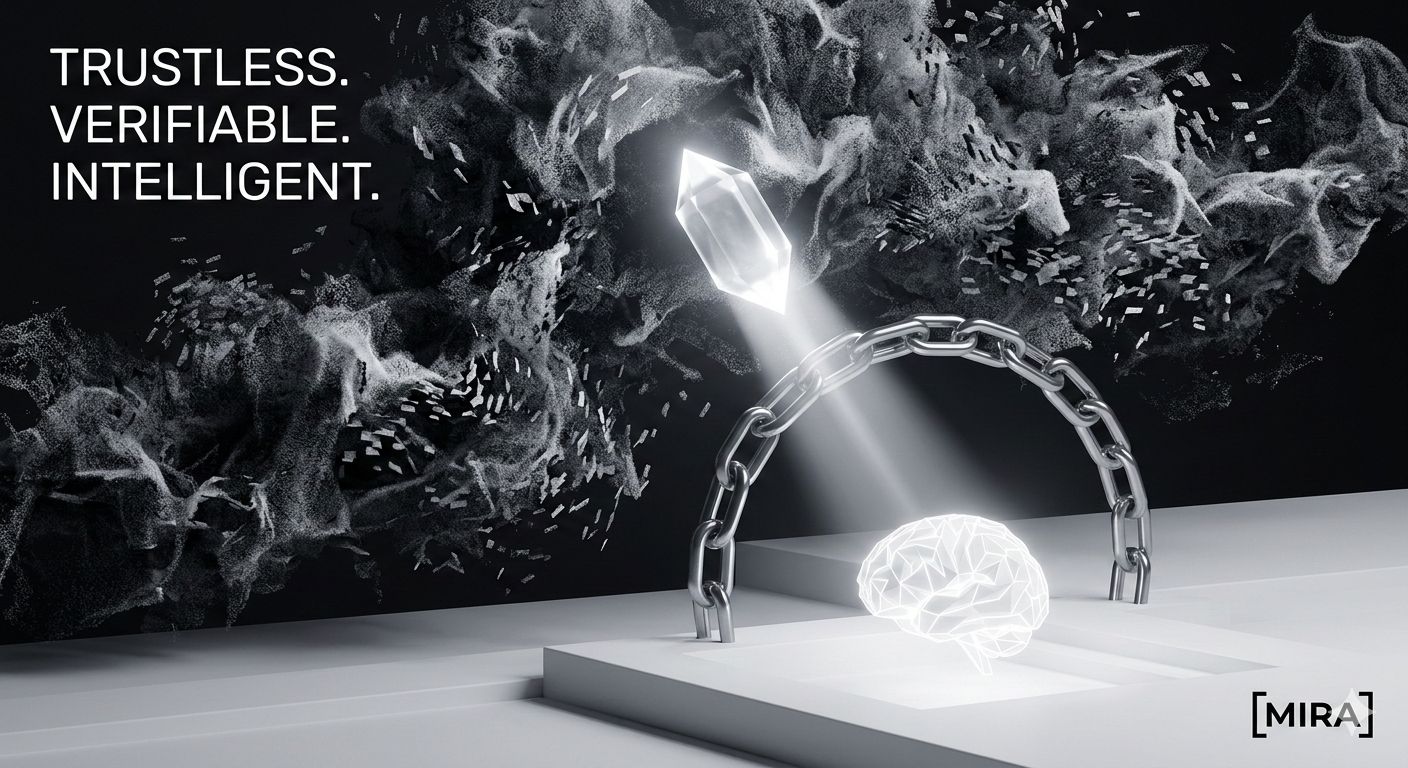
Real-World Analogies to Understand the Model
To simplify the concept, imagine a news article being fact-checked by a team instead of one journalist. Each fact is reviewed independently before publication. The final article carries more credibility because multiple reviewers confirmed the details.
Mira Network applies a similar philosophy to AI-generated outputs. Multiple independent validators examine claims before consensus is reached.
Another analogy is a sports match with multiple referees and instant replay. Decisions are confirmed through collective agreement rather than a single viewpoint.
By distributing verification, the risk of single-point failure decreases significantly. That is the core idea behind decentralization.
When AI intelligence passes through structured validation, it becomes more resilient and dependable.
Building the Future of Responsible AI
The conversation around AI is shifting from capability to accountability. It is no longer enough for AI to be fast and creative. It must also be reliable and transparent.
Mira Network represents a step toward that responsible future. By integrating blockchain consensus with AI outputs, it reduces uncertainty while maintaining innovation.
This approach does not eliminate all risks, but it significantly improves verification standards. It transforms AI from a black box into a more transparent process.
As Web3 continues to evolve, the demand for trustworthy intelligence will grow. Systems that combine decentralized consensus with AI verification could play a major role in shaping that future.
When technology proves its integrity through transparent validation, confidence follows naturally.
Trust is not claimed, it is demonstrated—and verified intelligence is the bridge connecting AI innovation with a stronger, more accountable Web3 ecosystem.