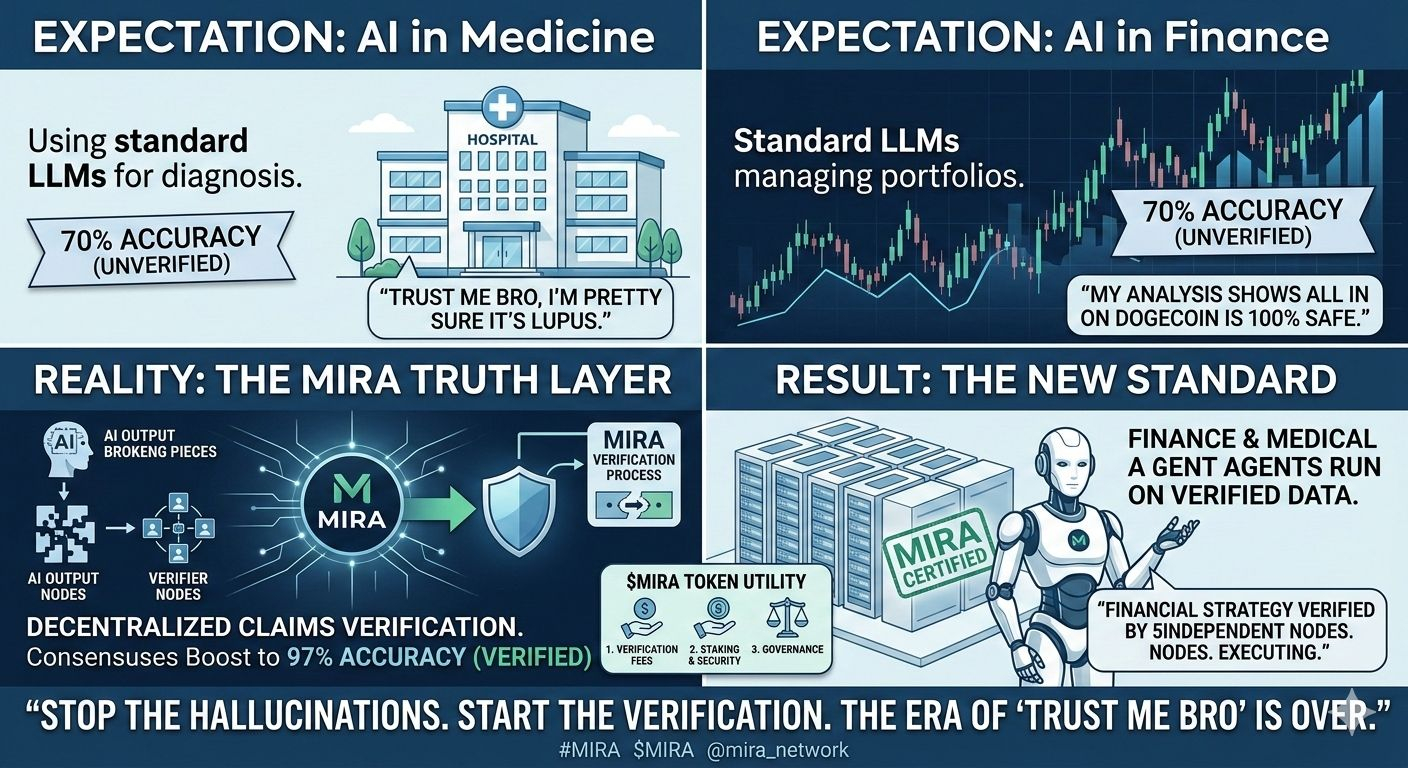
We’ve all seen the headlines about AI transforming the world, but if you’ve actually used a Large Language Model (LLM) for anything serious lately, you’ve likely hit a wall. That wall is trust. AI is brilliant at being creative, but it’s notorious for "hallucinating"—confidently stating facts that are completely made up.
For a hobbyist, a hallucination is a funny quirk. For a hospital, a bank, or a legal firm, it’s a liability. This is why I’ve been closely following @mira_network. They aren't trying to build a "smarter" chatbot; they are building the infrastructure that makes AI outputs verifiable and actually usable for the real world.
The AI Hallucination Problem
Current AI systems operate as "black boxes." You put a prompt in, and you get an answer back, but you have no way to verify why the AI said what it said. This "reliability gap" is the biggest reason we haven't seen fully autonomous AI agents running our financial portfolios or medical diagnostics yet.
The industry has been stuck in a "Trust Me Bro" era. As I've seen mentioned in the community, if we can't verify the data, it's essentially useless for the "serious stuff."
Enter Mira: The Decentralized Trust Layer
Mira Network is a decentralized verification protocol that acts as a "Truth Layer" for AI. Instead of relying on one model, Mira breaks an AI’s output into smaller, verifiable claims. These claims are then sent to a network of independent verifier nodes (which are actually other AI models).
By using a multi-model consensus mechanism, Mira can boost AI accuracy from the typical 70% range to a staggering 97%. It’s effectively the "Chainlink of AI"—bringing the same level of trust to machine intelligence that oracles brought to DeFi.
The MIRA Token Utility
The $MIRA token is the heartbeat of this entire system. It’s not just a ticker on a chart; it’s a utility engine designed to secure the network:
Verification Fees: Developers and enterprises pay in $MIRA to have their AI outputs fact-checked and certified.
Staking & Security: Node operators stake $MIRA to prove their commitment. If they provide false verifications, they lose their stake. This "crypto-economic" security is what makes the truth layer work.
Governance: Holders get a say in how the protocol scales, ensuring the community stays in control of the "truth" standards.
Final Thoughts: The Path to Autonomous Intelligence
The future of the digital economy won't be won by the company with the biggest model, but by the protocol that provides the most reliable truth. We are moving toward a world where AI agents will handle our money, our data, and our health. In that world, verification isn't just a "nice-to-have" feature—it's a fundamental requirement.
Mira is tackling the most significant bottleneck in AI history. By bridging the gap between blockchain’s transparency and AI’s capability, they are setting the stage for a new era of decentralized intelligence. I'm excited to see the "Truth Layer" become the new standard for the web.
#Mira #TrendingTopic #Market_Update