In September 2025, the cryptocurrency exchange Binance officially listed a new blockchain project called Mira (ticker: MIRA) — generating considerable buzz in the crypto community for blending artificial intelligence (AI) and decentralized technology. The token was launched with trading support including the popular MIRA/USDT pair.
What Is $MIRA ?
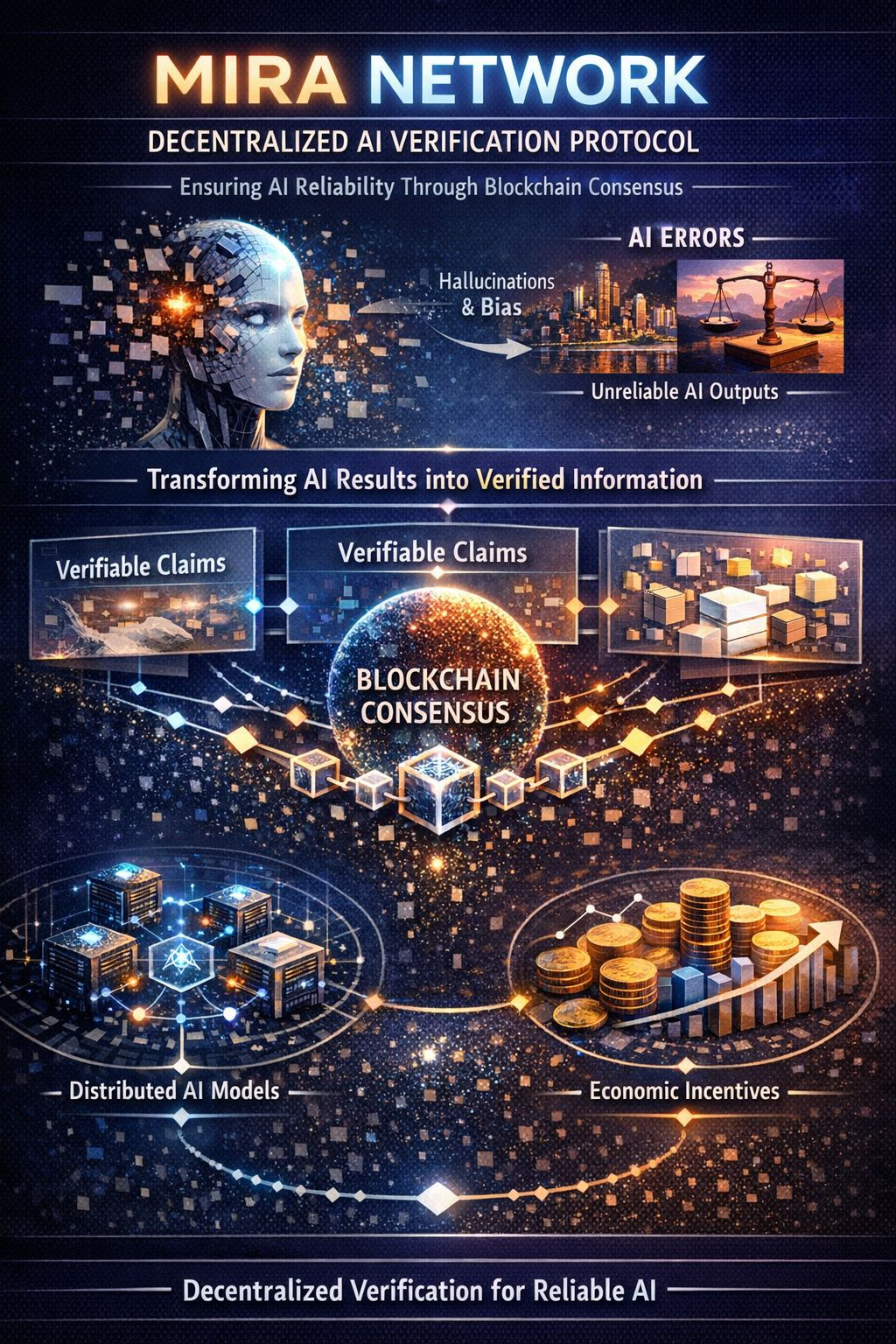
Mira is a decentralized verification network designed to solve one of the biggest challenges in today’s AI systems: trust and accuracy. Unlike conventional AI models that often depend heavily on human moderation, Mira aims to create a trust layer for AI outputs by using blockchain mechanisms that verify claims at scale across a network of independent verifiers.
At its core, Mira breaks down AI outputs into simpler, verifiable statements, called claims, and distributes them among independent verifiers. These participants check each claim, and the results are aggregated to produce trustworthy, decentralized validation of AI responses — reducing hallucinations and biases.
How #Mira Works
Mira’s innovative verification system revolves around three key components:
1. Binarization: AI outputs are split into discrete statements for individual verification.
2. Distributed Verification: Independent nodes check claims to prevent centralized manipulation.
3. Proof of Verification: A consensus system combining economic incentives ensures honest participation — with rewards for accuracy and penalties for dishonest behavior.
This process is designed to make AI results more reliable, transparent, and resistant to bias, which can unlock safer use of AI in fields like education, research, healthcare, and more.
The MIRA Token Explained
The $MIRA token is the native utility token of the Mira Network, built as an ERC-20 token on the Base Network (a Layer-2 chain). It plays several roles within the ecosystem:
API Access: Users pay for AI services and API requests with MIRA, receiving priority access and discounted rates.
Staking: Participants can stake MIRA to secure the network and earn rewards.
Governance: Token holders help decide on upgrades, emission rates, and other governance decisions.
The token has a maximum supply of 1 billion MIRA, with a portion allocated for ecosystem incentives, early supporters, node rewards, and development.
Binance Listing & Trading
Binance listed MIRA on September 26, 2025, with trading available across multiple pairs including MIRA/USDT, MIRA/USDC, MIRA/BNB, MIRA/FDUSD, and MIRA/TRY. The exchange also opened responsibilities like margin borrowing, perpetual contracts, and earning products to boost liquidity and trading options.
As part of its launch campaign, Binance included MIRA in its HODLer Airdrops program, rewarding users who had staked BNB in eligible Binance products with a total of 20 million MIRA tokens — enhancing community engagement and bootstrapping early adoption.
Why It Matters
Mira marks one of the first prominent projects to combine AI trust mechanisms with blockchain infrastructure at scale. While many crypto projects focus on decentralized finance (DeFi), decentralized identity, or NFTs, Mira’s core proposition — making AI outputs verifiably reliable — sets it apart and appeals to both tech developers and blockchain enthusiasts alike.
By integrating with Binance — one of the world’s largest crypto exchanges — MIRA benefits from wide accessibility, deep liquidity, and extensive trading infrastructure, making it easier for both retail and institutional investors to participate.
Conclusion
In a crypto landscape often dominated by speculation and memecoins, Mira (MIRA) presents a more technology-driven narrative by targeting the reliability gap in AI using decentralized verification. Its listing on Binance with the MIRA/USDT pair has attracted significant attention, positioning it as one of the noteworthy intersections between blockchain and artificial intelligence for 2025 and beyond.