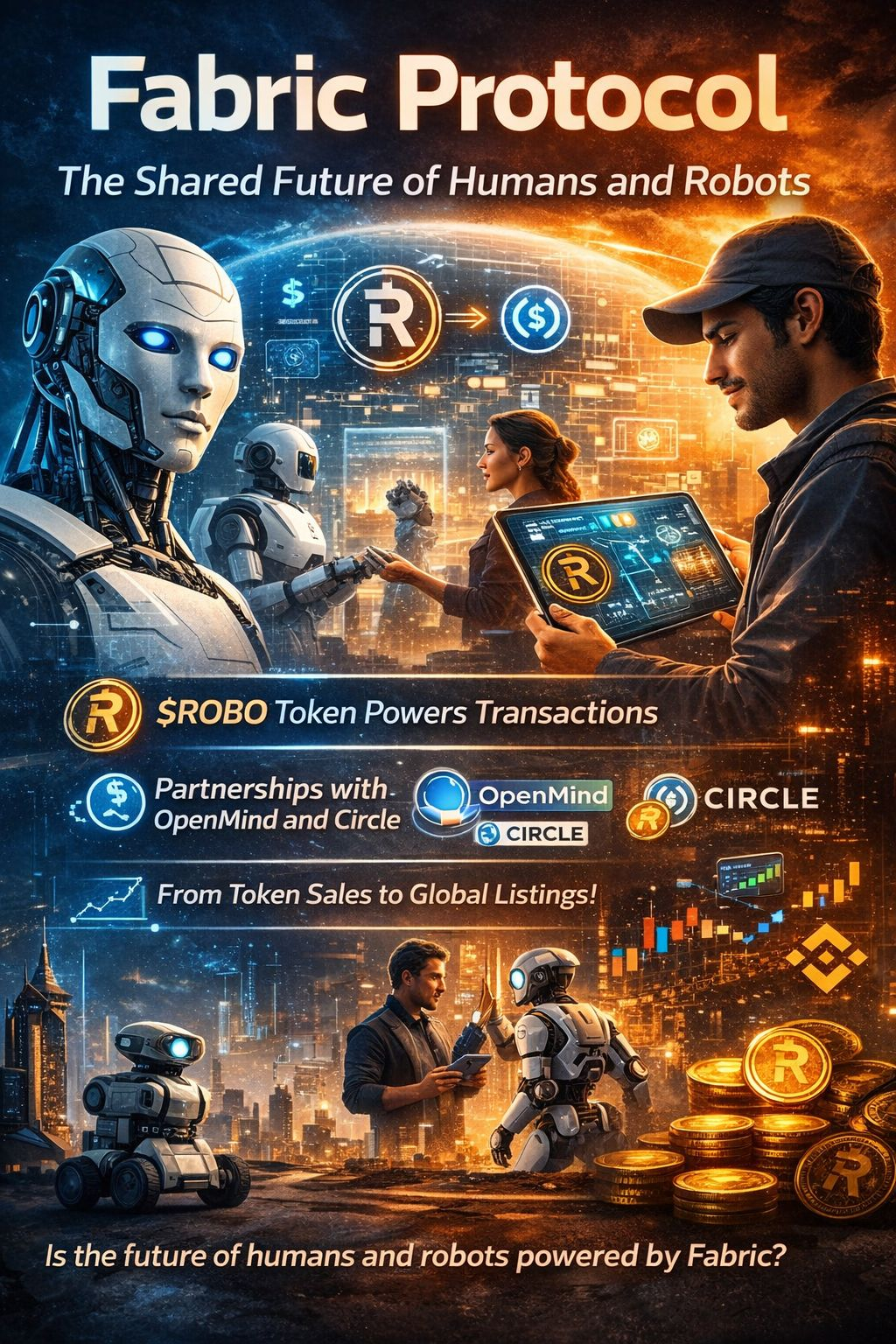
In a world racing toward intelligent machines and autonomous systems, Fabric Protocol is positioning itself as the invisible coordination layer that could define how humans and robots collaborate safely and efficiently. Backed by the non-profit Fabric Foundation, the project is not just another blockchain experiment. It is an ambitious attempt to build the economic, governance, and computational infrastructure for general-purpose robots — machines that can operate, earn, pay, verify, and evolve within a transparent digital framework.
At its core, Fabric Protocol connects data, computation, identity, and regulation through a public ledger. Instead of robots operating in isolated systems controlled by single corporations, Fabric envisions an open network where machines can verify actions, coordinate tasks, and transact autonomously. The idea is simple but powerful: if robots are going to participate in our economy, they need trusted infrastructure, just like humans do.
A major milestone for the project came with the introduction and exchange listing of its native token, $ROBO. The token now trades on platforms such as Gate and Binance Alpha, where both spot and perpetual markets have been launched. Early promotional campaigns, including token distributions for eligible participants, brought fresh attention to the ecosystem. Built initially on Base, an Ethereum Layer-2 network, $ROBO benefits from compatibility with widely used wallets and existing decentralized applications.
But $ROBO is more than just a tradable asset. It serves as the fuel for the network. Transaction fees, identity verification processes, governance participation, and coordination mechanisms are all powered by it. Users who want to participate in decision-making or network functions must stake the token, giving it both utility and governance weight. The total supply is set at 10 billion tokens, with allocations distributed across ecosystem growth, investors, team members, foundation reserves, community incentives, liquidity, and a small public sale portion.
Beyond token economics, the broader vision is where things get interesting. The Fabric Foundation has collaborated with OpenMind and Circle to explore financial rails for autonomous agents, including integration with USDC for robot-driven payments. This opens the door to a future where robots could autonomously pay for electricity, purchase services, or compensate other machines for data and computation. The concept of machines handling micro-transactions in real time is no longer theoretical; it is being engineered step by step.
OpenMind Labs, founded by respected AI researchers including Stanford professor Jan Liphardt and robotics expert Boyuan Chen, is playing a key role in development. Their involvement signals that Fabric is not purely speculative but rooted in serious technical research around embodied AI and decentralized coordination systems.
Community activity has also intensified in recent months. Public token sales, launchpad events, and allocation announcements have drawn attention from crypto investors and AI enthusiasts alike. Social media channels show growing engagement as supporters discuss governance proposals, market performance, and ecosystem expansion plans.
Fabric Protocol stands at the intersection of blockchain, robotics, and artificial intelligence. While many projects focus only on digital finance or AI models, Fabric attempts to bridge physical machines with decentralized economic infrastructure. It is a bold and complex mission. If successful, it could lay the groundwork for a world where robots are not just tools, but accountable, economically active participants in society.
The coming months will be critical. Exchange liquidity, ecosystem partnerships, governance activity, and real-world robotic integrations will determine whether Fabric becomes foundational infrastructure or remains a visionary blueprint. But one thing is clear: the conversation about how machines fit into our economic and regulatory systems has begun, and Fabric Protocol wants to lead it.