
The Missing Layer in the Robot Economy: Why ROBO Is About Governance, Not Gadgets
When I first looked at Fabric Foundation, I expected another robotics narrative. Better hardware. Faster inference. Smarter agents. That’s where most conversations stop. But what struck me wasn’t the machines. It was the quiet infrastructure underneath them.
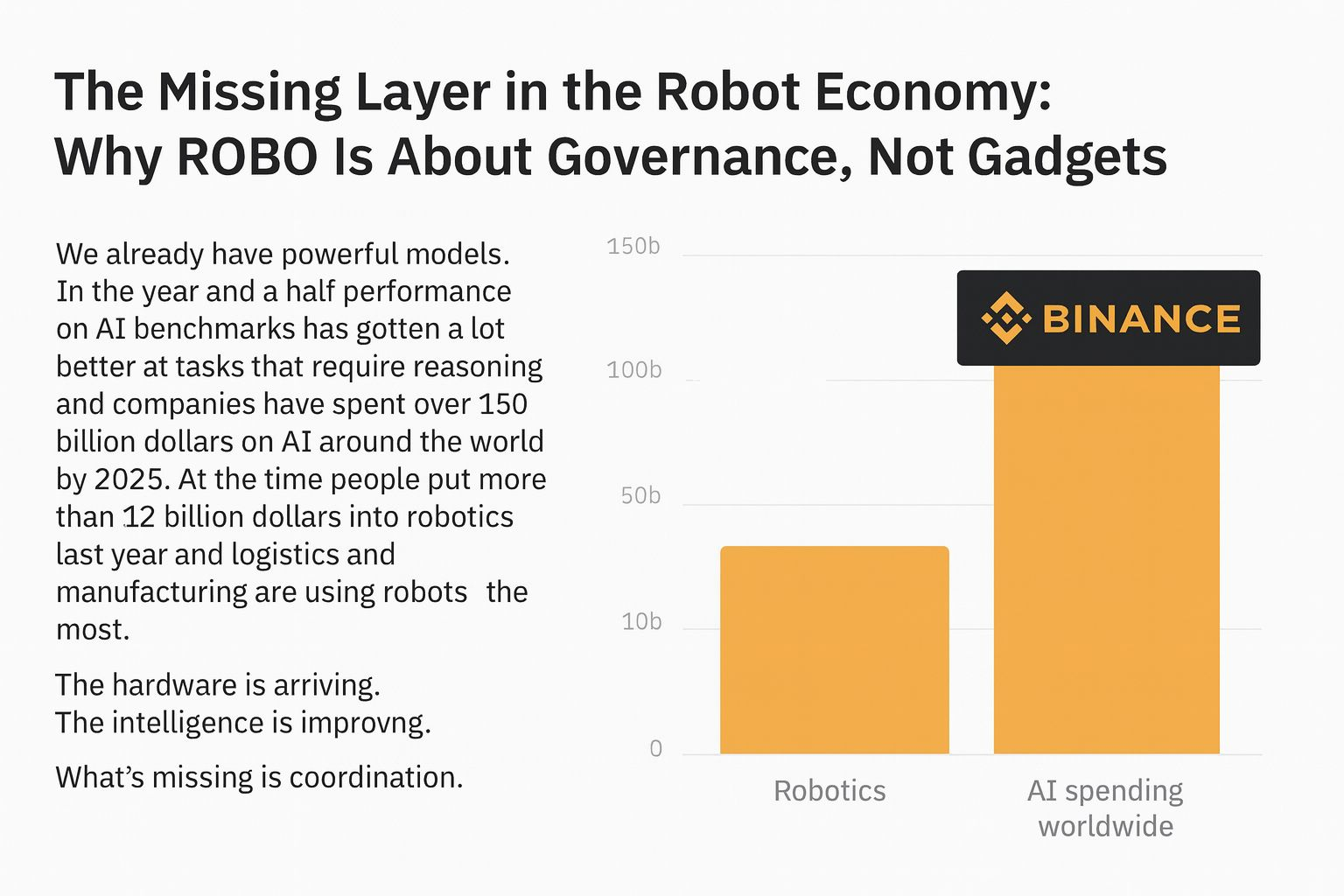
We already have powerful models. In the year and a half the performance of AI benchmarks has gotten a lot better at tasks that require reasoning and companies have spent over 150 billion dollars on AI around the world by 2025. At the time people put more than 12 billion dollars into robotics last year and logistics and manufacturing are using robots the most. The hardware is arriving. The intelligence is improving. What’s missing is coordination.
That gap is where Fabric Protocol positions itself.
On the surface, Fabric describes itself as a global open network supported by a non-profit foundation. It coordinates data, computation and regulation through a public ledger. That sounds abstract. So let’s translate it.
Imagine a robot that can do things working in a warehouse. This robot can look at data make choices talk to people and maybe even handle money. The surface layer is obvious: sensors, models, motors. Underneath that, however, sits a more fragile question. Who verifies what it computed? Who records what it did? Who governs how it evolves? And who gets rewarded or penalized when something goes wrong?
Fabric inserts a verifiable economic layer into that interaction. Instead of trusting a closed corporate system, computation can be logged, validated, and coordinated across participants. That ledger is not just record-keeping. It is incentive alignment.
@Fabric Foundation functions inside that alignment mechanism. Not as a speculative asset alone, but as the coordination token that binds contribution, governance and economic activity. When you read about adaptive emissions or evolutionary reward layers in the whitepaper, it can sound technical. Underneath, it’s about balancing supply with actual network demand.
If emissions increase when participation expands and tighten when activity slows, the system is trying to behave like a feedback loop rather than a faucet. That matters. In crypto, uncontrolled emissions have historically crushed value. Between 2021 and 2023 many tokens that had inflation lost more than 80 percent of their value because the rewards were not based on what they could really do. Fabric’s model attempts to link issuance to verifiable contribution instead.
That is the theory. The question is whether it holds under pressure.
Now the market is being very picky. Bitcoin is close to being 50 percent of the market people are being careful with their money and money is moving around quickly. The tokens that do well in this environment are the ones that make money or have a good story about what they will do in the long term especially when it comes to infrastructure. A coordination layer for robots sits closer to infrastructure than speculation, but only if adoption follows.
And that adoption depends on something subtle. General-purpose robots are not single-purpose machines. They evolve. Fabric’s design around modular governance suggests that as robots gain new capabilities, the network can adjust rules, rewards and verification mechanisms. On the surface, that’s flexibility. Underneath, it is risk containment. If this holds, it means the system can respond to unexpected behaviors rather than hard-forking every time complexity increases.
There are obvious counterarguments. One is that robotics companies may prefer closed ecosystems. Corporations historically guard data and infrastructure tightly. Why would they open coordination to a public network?
The answer may lie in scale. As robots start working in places like warehouses, public services or cities it becomes more important that they can work with other systems. Shared standards reduce friction. A neutral coordination layer can lower integration costs. Whether companies embrace that remains to be seen, but early signs suggest that agent-native infrastructure is becoming a discussion point across AI forums, not just crypto circles.
Another risk is token speculation overwhelming utility. It tades on Binance and trading activity can amplify visibility. But if price action decouples too far from network usage, volatility can distort incentives. That’s a tension every utility token faces. The adaptive emission design attempts to dampen that by tying rewards to measurable contribution. The effectiveness of that mechanism will only be proven over time.
Meanwhile, the OpenMind portal signals something else. Community participation isn’t limited to passive holding. Identity, contribution, and reputation feed into the broader ecosystem narrative. That layering creates texture. On the surface, users register and engage. Underneath, the network gathers data about participation quality. That can feed governance weight or future incentives.
When you connect these layers, a pattern appears. Fabric is not trying to build better robots. It is building a foundation for how robots coordinate economically with humans. That is a slower ambition. It does not produce instant viral headlines. But foundations matter precisely because they are quiet.
In 2015 not many people cared about how Ethereum was governed. Ten years later decentralized finance is worth tens of billions of dollars and tokens that help govern protocols are very important. Early infrastructure looks boring until scale arrives. If robots become embedded in daily economic life over the next decade, the question of how they are governed and rewarded will not be optional.
Right now, $ROBO sits at the intersection of AI enthusiasm and crypto discipline. Markets are watching AI narratives closely, but they are also punishing empty claims. That environment forces projects to demonstrate substance. Fabric’s bet is that verifiable computing plus economic incentives create a steady base layer for agent collaboration.
Whether that bet pays off depends on execution and adoption. It also depends on whether the broader market recognizes that coordination is more valuable than novelty. Many tokens promise features. Few attempt to design the rules by which autonomous systems earn trust.
If the robot economy expands the way current investment trends suggest, then governance will not be an afterthought. This will be the key to deciding which systems can grow safely and which ones will have problems.
And what is really important to notice is that the future of robotics might not be about who builds the most intelligent machine but, about who creates the rules that these machines follow.