Numbers rarely tell the whole story, but in the world of autonomous machines, these specific figures define the final boundary of trust. Today, February 27, 2026, as we witness the launch of the ROBOUSDT Perpetual Contract on Binance Futures with up to 20x leverage, many traders are staring at that ten billion total supply and wondering if it is just another heavy bag waiting to happen. Well, if you have been around the block as long as I have, you know that the "FDV is a meme" crowd usually misses the structural reality of why an ecosystem chooses its scale. A global economy of robots requires a granular, liquid medium for millions of micro-transactions, and the @Fabric Foundation is betting that $ROBO will be the unit of account for that mechanical labor.
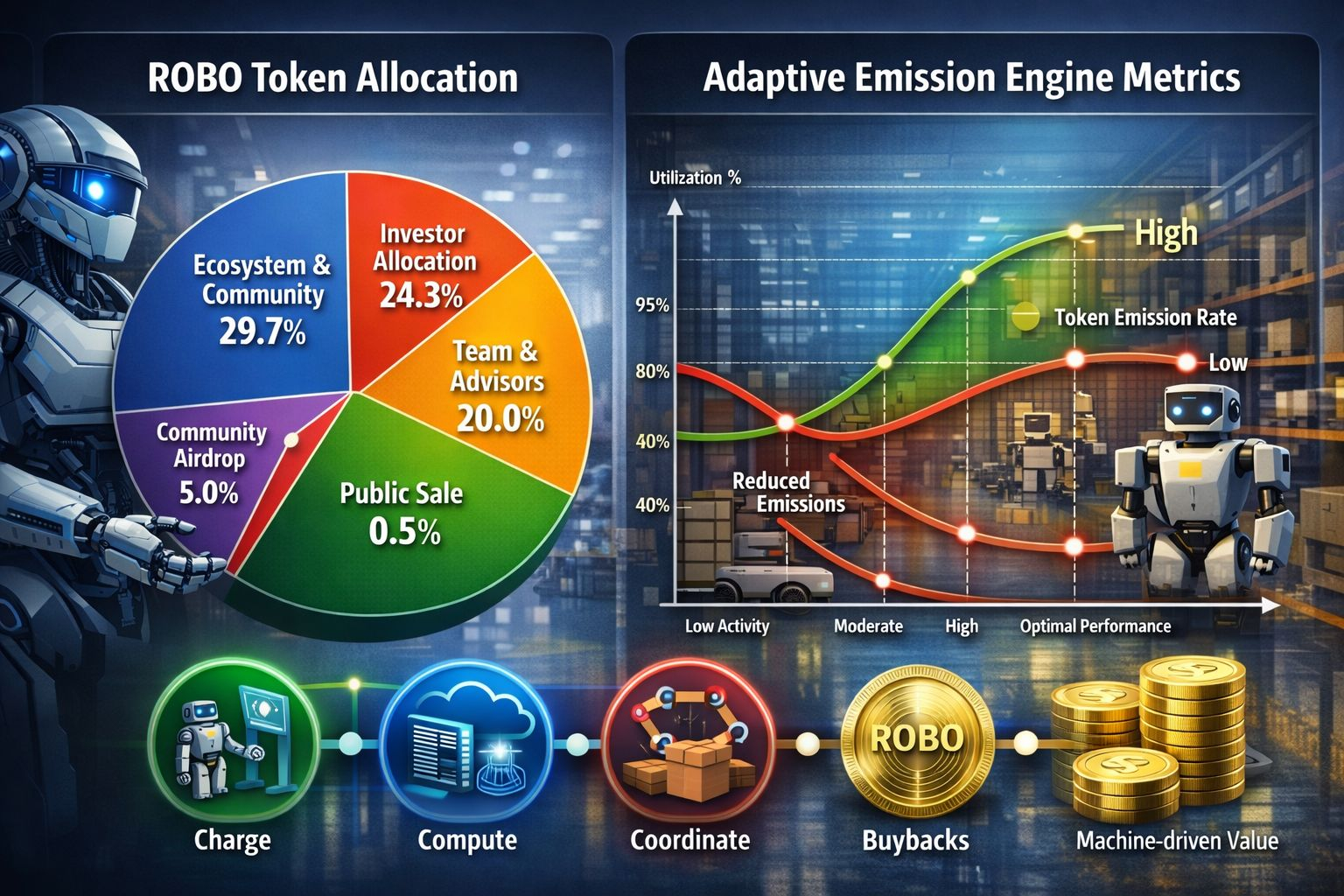
When you peel back the layers of the tokenomics, you see a distribution designed for the long game rather than a quick pump. The largest slice of the pie, roughly 29.7 percent, is reserved for the ecosystem and community, but it isn't just handed out like candy. Hmmm... no, it’s governed by something called the Adaptive Emission Engine. This is a discrete-time feedback controller that adjusts how many tokens are minted based on actual network utilization and service quality. If the robots aren't working or the quality of their work drops below the 95 percent threshold, the emissions slow down. It’s a supply-side circuit breaker that we haven't seen in the speculative AI coins of the last cycle.
Traders often fear the "investor dump," but the 24.3 percent allocated to investors and the 20 percent for the team and advisors come with a heavy dose of discipline. We are looking at a 12-month cliff followed by a 36-month linear vesting schedule. Considering the seed round was led by Pantera Capital back in August 2025, these participants are effectively locked out of meaningful liquidity until late 2026. Yes, that is a long time in crypto years, but it aligns the "big money" with the actual deployment of the OM1 operating system across hardware partners like UBTech and Fourier. It suggests that the people who funded this $20 million round aren't looking for an exit at the first green candle.
The circulating supply at the Token Generation Event was kept relatively lean, with the 5 percent community airdrop and the 0.5 percent public sale on Kaito Capital Launchpad being the primary sources of initial liquidity. We saw some volatility earlier this month as the registration portal closed on February 24th, but the "Proof of Robotic Work" model ensures that future supply only enters the market when there is actual machine-driven value to back it. Unlike traditional Proof-of-Stake where you earn just by holding, $ROBO rewards only flow to those performing verified work—whether that is data provisioning or hardware coordination. Passive holding generates zero emissions.
So, why do robots actually need a ten billion supply? Think about the utility. These machines have no bank accounts and no passports. They need a native settlement layer to pay for their own high-speed charging, cloud compute upgrades, or specialized insurance without a human middleman. The Fabric Protocol provides that on-chain identity. When a robot completes a task in a warehouse, the settlement happens in $ROBO, and a portion of that protocol revenue is used for open-market buybacks. This creates a structural demand sink that scales with real economic activity.
My personal perspective after years of watching these narratives is that we are moving away from "AI-themed" tokens and toward "Agentic Infrastructure." The transition from Base to a native Layer 1 chain is the next big hurdle, and it will be the ultimate test for this tokenomics model. If the foundation can maintain the 70 percent target utilization rate without over-inflating the supply, we might finally see a DePIN project that functions more like a utility company and less like a casino. Trust in this market is built on transparency and math, not hype. The Fabric Foundation has provided the math; now we wait to see the robots do the work. hmmm... yes, the scale is massive, but the mission of owning the robot economy requires nothing less.