
We are living through a moment that most people are not paying close enough attention to.
Right now, somewhere in a factory in Shenzhen, a humanoid robot is completing a physical task that no human assigned it. It received instructions from a network. It verified its own identity through cryptographic keys. It settled a payment on-chain. And it will soon share what it learned with thousands of other machines across the globe.
That is not science fiction. That is the vision Fabric Foundation is actively building, and it launched its token on Binance Alpha today, February 27, 2026.
Let’s talk about why this matters.
The Problem Nobody Was Solving
Robots have been getting smarter fast. Like, uncomfortably fast.
AI models are now scoring above 0.5 on Humanity’s Last Exam, a benchmark that was supposed to be unsolvable by machines. In just ten months, performance jumped fivefold. That is the pace we are dealing with.
But here is the thing most people miss: smarter robots means nothing if they cannot talk to each other. Right now, a Boston Dynamics robot and a UBTech humanoid are essentially strangers on the same planet. They run different software, store data in closed silos, cannot share skills, cannot pay each other for services, and cannot verify each other’s actions. Every major robot manufacturer has built its own walled garden.
Fabric solves what it calls the Isolation Problem, where different robot brands operate in closed loops, unable to communicate or transact with one another.
That is the gap Fabric Foundation stepped into.
What Fabric Foundation Actually Is
Fabric Foundation operates as an independent non-profit organization dedicated to building governance, economic, and coordination infrastructure to enable humans and intelligent machines to collaborate safely and efficiently.
Think of it like this: if AI is the brain and robot hardware is the body, Fabric is the nervous system that connects them to a shared economy. The foundation was established by OpenMind, a company founded by Stanford University professor Jan Liphardt, committed to building a universal operating system and decentralized collaboration network for intelligent machines.
The protocol has two core products working together:
OM1 Operating System is described as the Android for robotics. It is a hardware-agnostic OS that allows a single software application to run across humanoids, quadrupeds, and robotic arms, drastically reducing development costs. Right now a developer building a robot skill has to rebuild it for every different hardware type. OM1 makes that problem go away.
The FABRIC Protocol is the coordination and trust layer. It acts as a social network for machines. It enables robots to verify identities, share situational context, and exchange skills in real-time using on-chain registries.
Put them together and you get something genuinely unprecedented: a world where robots from companies like UBTech, AgiBot, and Fourier can work as a coordinated network rather than isolated tools.
Why Blockchain, Though?
This is the question that trips people up. Why does a robotics protocol need a public ledger?
The answer is accountability at scale.
When you have millions of machines operating autonomously in the physical world, handling real money, real data, and real tasks, you cannot rely on any single company to be the trusted middleman. That company could go bankrupt, get hacked, or simply choose to behave in its own interest instead of yours.
Fabric Foundation aims to align intelligent machines with human intent, making sure AI systems and autonomous machines act in ways that are understandable, predictable, and beneficial to people. It supports open standards, decentralized identity, machine-to-machine coordination, and governance frameworks so no single company or country controls the future of intelligent machines.
The blockchain is not just a payment rail here. It is a verification layer. Every task a robot completes, every piece of data it contributes, every skill it shares, gets recorded in a way that is tamper-proof and publicly auditable. This is what “verifiable computing” means in Fabric’s whitepaper, and it is what makes the whole system trustworthy without needing a central authority.
The $ROBO Token: How the Economy Works
Fabric’s native token is $ROBO, and its design is more thoughtful than most projects you will see.
Here is how the supply breaks down:
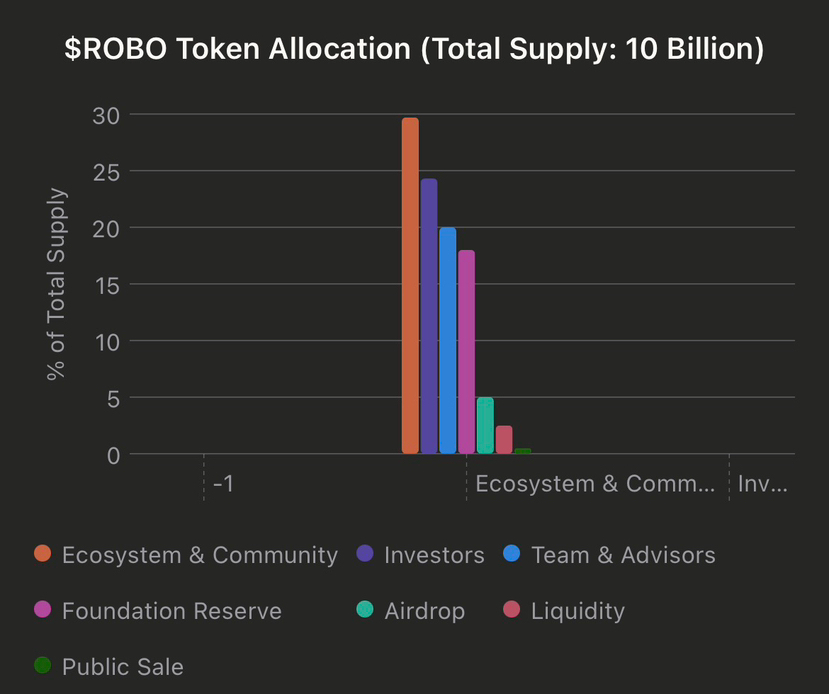
The largest single allocation goes to the ecosystem and community at 29.7%, which tells you something about the project’s priorities. Active participants who complete verified robot tasks, contribute data, supply compute, or develop skills earn $ROBO emissions proportional to their verified contribution score. Passive holders earn nothing.
That last part is important. This is not a token you buy and sit on. You have to contribute to the network to earn from it. Contribution scores also decay over time, which prevents early participants from front-running the system forever.
Investors hold 24.3% with a 1-year cliff followed by 36-month linear vesting. The Foundation Reserve controls 18% for long-term stewardship and research.
The vesting structure is designed to prevent anyone from dumping tokens early. The 12-month cliff for investors means there is no immediate sell pressure from the people who got in cheapest.
The Robotics Market Context
To understand why this project has real-world stakes, you need to understand the size of the market it is trying to organize
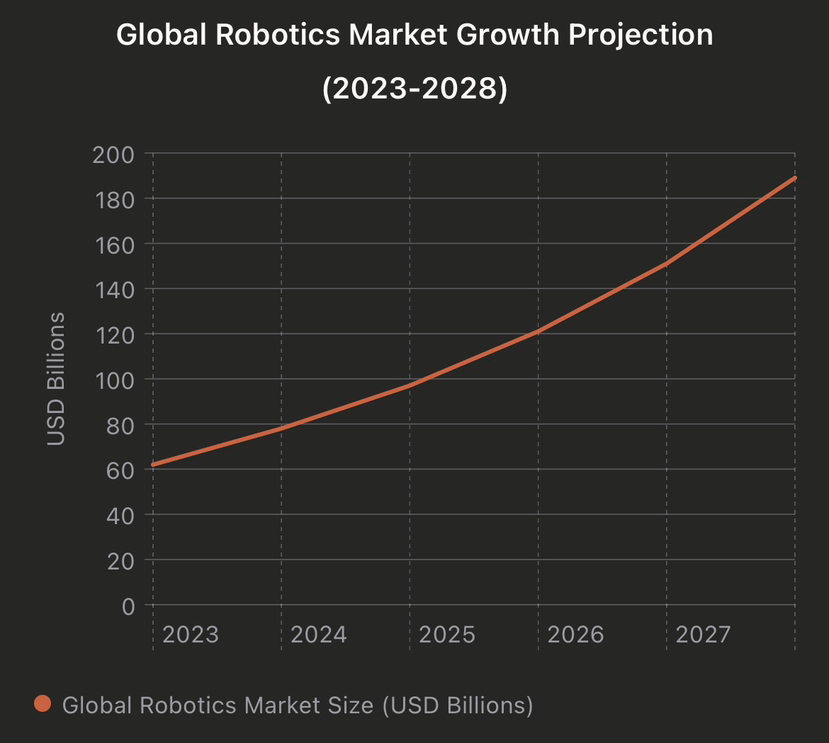
The global robotics market is projected to grow from roughly $62 billion in 2023 toward $189 billion by 2028. And that growth is mostly happening without any coordination layer between machines. It is like watching the internet grow before TCP/IP existed. Every company building their own protocol, every robot speaking a different language.
Fabric is betting that the coordination layer becomes the most valuable piece of the entire stack, the same way AWS became more valuable than most of the software running on it.
OpenMind + Circle: The “Economic Brain” Partnership
One of the most significant recent developments is what Fabric Foundation called an “economic brain” for machines.
OpenMind and Circle announced a strategic partnership integrating Circle’s USDC stablecoin with OpenMind’s x402 protocol module, jointly launching payment infrastructure tailored for autonomous agents and real-world embodied AI, enabling robots and AI agents to autonomously pay for energy, services, and data in the physical world.
Read that again. Robots paying for their own energy. Without a human approving the transaction.
The FABRIC Foundation stated that the payment infrastructure developed by OpenMind and Circle provides machines with an “economic brain,” while FABRIC oversees the end-to-end closed loop of “birth, production, operation, and evolution.”
This is the piece that makes Fabric more than a robotics project. It is the earliest version of an autonomous machine economy, where robots are not just tools but economic actors with wallets, identities, and the ability to transact.
The “Robot Birthplace” Vision
The Fabric Foundation has announced two key directions: First, “Robot Birthplace,” which leverages a crowdsourcing model to onboard liquidity providers and build a payment and settlement layer for embodied robots including humanoid robots, to improve capital efficiency and lower deployment barriers. Second, “Acceleration of Adoption,” which coordinates robot manufacturing, shared simulation environments, and standardized evaluation frameworks across the full lifecycle from training and data collection to evaluation and deployment.
The Robot Birthplace concept is essentially a crowdfunded infrastructure for getting robots into the world faster and cheaper. Right now, deploying a fleet of humanoid robots requires enormous upfront capital. Fabric wants to distribute that cost across liquidity providers who get paid for enabling deployments, similar to how DeFi protocols distribute yield to liquidity providers.
This is a real innovation in how robots get financed and deployed. It could genuinely lower the barrier for mid-sized companies to use advanced robotics, not just massive corporations.
The Roadmap: What Is Coming
Fabric’s published 2026 roadmap outlines a phased rollout: Q1 deploys initial robot identity and task settlement components; Q2 introduces contribution-based incentives tied to verified task execution; Q4 refines incentive mechanisms for large-scale deployment. Beyond 2026, the protocol targets a machine-native Fabric L1 blockchain, capturing economic value directly from robot activity at the infrastructure level, alongside a Robot Skill App Store open to developers worldwide.
The Fabric L1 is the long-term play. Right now the protocol runs on Base network (Ethereum L2), but building a chain specifically designed for machine-to-machine transactions could unlock performance characteristics that general-purpose blockchains cannot provide. Think microsecond transaction finality for real-time robot coordination, on-chain compute verification, and native machine identity at the protocol level.
The Robot Skill App Store is equally interesting. Developers will be able to publish skills (walking patterns, object recognition routines, manipulation techniques) and get paid every time a robot uses them. That creates a marketplace dynamic where the best robot capabilities get rewarded and spread across the entire network.
The Funding Story Backs It Up
Fabric raised $20 million in 2025 led by Pantera Capital with support from Coinbase Ventures.
Pantera Capital is not a fund that throws money at narratives. They have been one of the most selective and well-performing crypto funds since 2013. When they lead a $20M round into a robotics coordination protocol, that is a signal worth noticing. Coinbase Ventures co-investing adds further validation from the exchange side.
Binance Alpha will be the first platform to feature Fabric Protocol (ROBO) on February 27, with KuCoin, MEXC, and Bybit also set to support ROBO.
Getting listed on Binance Alpha on day one, alongside three other major exchanges simultaneously, is not something that happens for ordinary projects. It speaks to the level of institutional interest and community demand that Fabric has built.
The Honest Risk Assessment
Good writing does not hide the risks, so let’s be straight.
The long-term investment profile of $ROBO is characterized by the high-beta volatility typical of the AI and DePIN sectors. While the project’s mission to decentralize the robot economy is ambitious, it faces structural challenges, including a substantial portion of the supply (over 80%) currently being locked and subject to future vesting dilution.
That 80% locked supply will unlock over time. Each unlock event is a potential sell pressure moment. You need to understand the vesting schedule before making any investment decision.
The robotics coordination market is also still nascent. There is no guarantee that robot manufacturers will adopt an open standard over their proprietary solutions. Apple, after all, has never adopted an open hardware standard in its life.
But here is the counterpoint: the internet itself was built on open standards, not proprietary ones. TCP/IP, HTTP, SMTP. The companies that tried to build closed internet ecosystems in the 1990s (remember AOL?) ultimately lost to the open web. The history of technology infrastructure strongly favors open coordination protocols over walled gardens. Fabric is betting that robotics follows the same pattern.
Why This Matters Beyond the Token Price
Something bigger is happening here that goes beyond whether Robo pumps at launch.
We are at the beginning of a transition where machines stop being tools and start being participants. Fabric Foundation is one of the first serious attempts to make that transition happen in a way that is open, verifiable, and governed by a community rather than a single corporation.
The focus is on AI and robotics that operate in the physical world, including robots, agents, and autonomous systems, not just digital models. The goal is public-good infrastructure for AI and robotics that supports open standards so no single company or country controls the future of intelligent machines.
That mission matters. Because the alternative, a robot economy controlled by three or four tech giants, is a future with enormous concentration of power and zero accountability.
Fabric Foundation is offering a different path. One where the infrastructure is public, the governance is shared, and anyone in the world can contribute and earn from the growth of machine intelligence.
The Bottom Line
We are genuinely early here. The robot economy that Fabric is building toward is probably still five to ten years from full maturity. But the infrastructure being laid down right now, the identity layer, the payment rails, the coordination protocol, the skill marketplace, will be what that economy runs on.
The analogy to the early internet is not hype. It is the most accurate frame we have. In 1995, most people did not understand why TCP/IP mattered. By 2000, every serious business was running on it.
Fabric Foundation is attempting to write the TCP/IP for robots.
Whether or not you participate in the Robo launch today, the question is worth sitting with: who do you want building the infrastructure that intelligent machines run on? A single corporation, or an open network governed by its community?
That question will define the next era of the physical world.
Sources referenced: Fabric Foundation whitepaper (December 2025), BingX Research, MEXC Learn, CoinMarketCap, TechFlow, Hokanews, Pantera Capital portfolio announcements, Binance Alpha official listing page.