

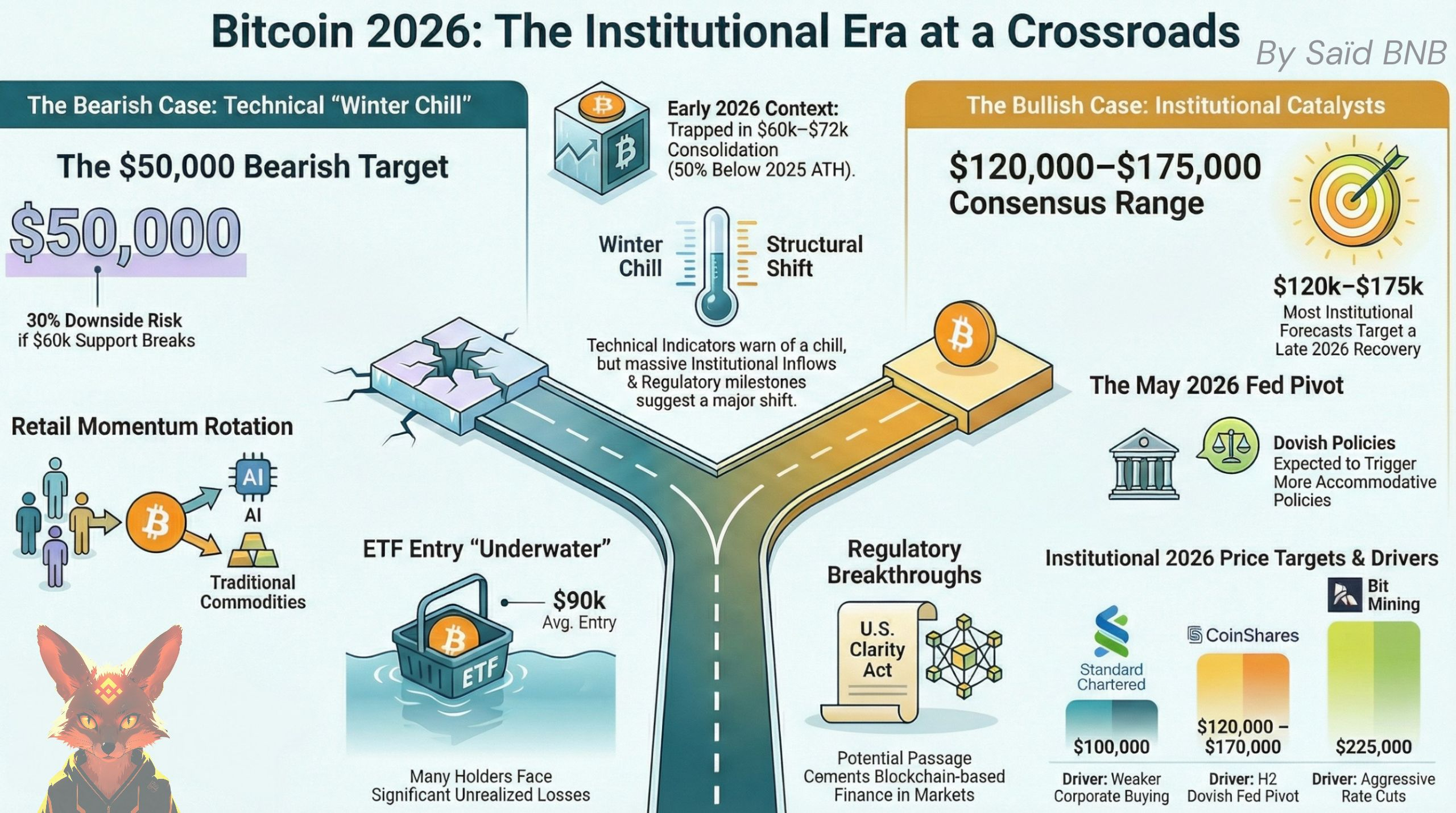
The opening of 2026 has been defined by a visceral divergence between retail sentiment and institutional action. While the "Crypto Fear & Greed Index" plummeted to a bone-chilling 11, signaling "Extreme Fear," a sudden 6% rally on February 25th served as a masterclass in liquidity discovery. To the uninitiated, Bitcoin appears caught in a "death spiral," trading nearly 50% below its October 2025 all-time high of $126,080.
However, as a strategist, I see something different: market mechanics are maturing. While the price has retraced, the "market plumbing"—the infrastructure of spot ETFs and regulated banking products—has never been more resilient. We are no longer in the fragile ecosystem of 2022; we are witnessing a structural reset where institutional "smart money" is quietly absorbing the supply left behind by a fleeing retail class.
The Ghost in the Machine: The Death of the "10 AM Smash"
For years, the "10 AM Eastern smash" was the most predictable and punishing pattern in crypto. Like clockwork, Bitcoin would face massive sell-side pressure shortly after the New York open, hunting retail liquidations. Recent viral allegations and the Axiom Misconduct Investigation suggest this wasn't mere market coincidence. A lawsuit filed by Terraform Labs against trading giant Jane Street alleges a sophisticated manipulation scheme that artificially suppressed prices for years.
The most damning evidence isn't in the legal filings, but in the charts. The "10 AM dump" effectively vanished the moment legal scrutiny intensified. On February 25th, the disappearance of this artificial ceiling provided the vacuum for a $323 million short squeeze, which acted as the mechanical engine for Bitcoin’s 6% surge.
"One firm reportedly made $24B in a single quarter while retail portfolios were bleeding. If this is even partially true, it changes how you look at every candle on the chart."
This engineered volatility suggests that much of the recent "fear" was manufactured to facilitate institutional accumulation at lower cost bases.
Institutional "Smart Money" vs. The Retail Exit
On February 25th, U.S. spot Bitcoin ETFs recorded a massive $506.5 million in net inflows—the largest single-day total in three weeks. BlackRock’s IBIT led the charge with $297.4 million, signaling that the "smart money" is buying the dip while the Fear & Greed Index is at its lowest.
The "Winter Chill" Phase We are currently in what Wincent’s Paul Howard calls a "winter chill" phase. The retail capital that historically fueled "moon shot" volatility has largely left the building, rotating instead into AI-driven equities and commodities. This rotation has created a temporary vacuum in price momentum, but it has also led to a shrinking tradable supply. As ETFs lock up coins, the liquid float is drying up.
The $100 Billion Lending Anchor Adding to this stability is the explosion of Bitcoin-backed lending. Maple Finance projects that Bitcoin-backed debt will exceed $100 billion in 2026. Sophisticated holders are no longer selling to realize gains; they are borrowing against their BTC to maintain exposure. This creates a virtuous cycle: selling pressure decreases, utility increases, and a permanent institutional floor is established.
The May 2026 Inflection Point: The Fed’s Dovish Pivot
The market is currently paralyzed in a "wait-and-see" consolidation between $60,000 and 72,000. The immediate volatility catalyst is a massive 10.5 billion options expiry this Friday, but the long-term pivot hinges on the Federal Reserve Chair transition in May 2026.
President Trump’s shortlist for Jerome Powell’s successor includes Kevin Hassett and Kevin Warsh. The "litmus test" for the role is an immediate commitment to rate cuts to address mounting funding market stress. With the Fed target range currently at 3.50–3.75% after 175 bps of cuts, markets are anticipating a move toward "accommodative liquidity." Until this political and monetary clarity arrives, Bitcoin is likely to oscillate, waiting for the signal to reprice risk assets decisively.
On-Chain Health: The 50% Premium Reality
Data from Coinbase and Glassnode reveals a counter-intuitive truth: despite the 50% crash from $126k, the average holder is still in a position of strength.
MVRV Ratio (1.5): Bitcoin is trading at a 50% premium relative to its "realized price" (the average on-chain cost basis). This identifies current levels as a "reaccumulation zone" rather than a death spiral.
Puell Multiple (0.9): This indicates miners are earning 10% less than their yearly average—a classic historical signal of a market bottom.
NUPL Shift: The Entity-Adjusted Net Unrealized Profit/Loss has shifted from "Belief" to "Anxiety." For institutions, "Anxiety" is a contrarian buy signal, marking the point where weak hands have been flushed and long-term value remains.
Mining at the Edge: Production Costs as a Price Floor
A critical structural barrier has emerged at $66,000, representing the average estimated miner production cost. Falling below this level is a phenomenon the market hasn't seen since the late 2022 FTX collapse.
Historically, Bitcoin does not stay below its production cost for long; it triggers "late-stage selling" from inefficient miners and aggressive "contrarian accumulation" from institutional buyers. This $66k zone acts as the ultimate fundamental floor, making the more extreme bearish forecasts of $40k look increasingly disconnected from the reality of network security costs.
A Different Kind of Bull
The Bitcoin market of 2026 is at a crossroads. We must weigh a "reality check" from Standard Chartered—who recently slashed their 2026 target to 100,000** citing ETF outflow pressure—against the bullish institutional projection of **175,000 from Maple Finance.
What is certain is that the 2026 "Reset" represents the year Bitcoin finally divorced retail hype to marry institutional debt and structured finance. The era of the four-year "boom-bust" cycle may finally be a relic of the past, replaced by a more stable, albeit slower, institutional climb.
Final Thought: In a market now anchored by spot ETFs and $100 billion in credit, the question is no longer "how low can it go," but rather: are you prepared for the moment the "winter chill" yields to the next institutional heatwave?
