
Artificial intelligence is everywhere. But there is a problem nobody wants to talk about. AI lies. Not intentionally, but it does. Researchers call it "hallucination." The rest of us call it a mess. Mira Network was built specifically to fix that — using blockchain consensus, cryptographic proofs, and a network of independent AI models that collectively decide what is actually true.
The Problem That Started Everything
Think about the last time you trusted an AI answer without checking it. Maybe it was a quick medical question, a legal term you wanted to understand, or a financial decision. The AI gave you a confident, detailed answer. It sounded right. But was it?
This is not a hypothetical concern. Modern large language models produce factually wrong information at rates that should alarm anyone deploying them in serious applications. The problem has a name: hallucination. It is the tendency of AI models to generate plausible-sounding output that is disconnected from reality. For a chatbot helping you pick a movie, that is annoying. For a healthcare assistant, a legal tool, or an autonomous financial agent, it could be devastating.
The entire edifice of the AI industry rests on a single model producing a single answer. No cross-checking. No audit trail. No consensus. Just one model, one output, and the user deciding whether to trust it. That is the gap Mira Network was designed to close.
What Mira Actually Does
Mira Network is a decentralized verification protocol. In plain language, it takes whatever an AI model outputs and runs it through a rigorous, multi-model consensus process before that output ever reaches the user. Think of it like a jury system for AI — instead of one judge deciding the verdict alone, many independent voices weigh in and a consensus emerges.
Here is how it works in practice. When an AI generates a response, Mira first breaks that response down into individual factual claims. A single paragraph might contain five or six separate claims. Each of those claims is then distributed across a network of independent verifier nodes — each running a different AI model with a different architecture, trained on different data. The nodes vote on whether each claim is accurate, false, or context-dependent.
If a supermajority of nodes agree the claim is valid, it passes. If there is significant disagreement, the claim gets flagged or rejected. The entire process generates a cryptographic certificate — an auditable, tamper-proof record of what was verified and how. No central authority calls the shots. Truth is determined collectively.
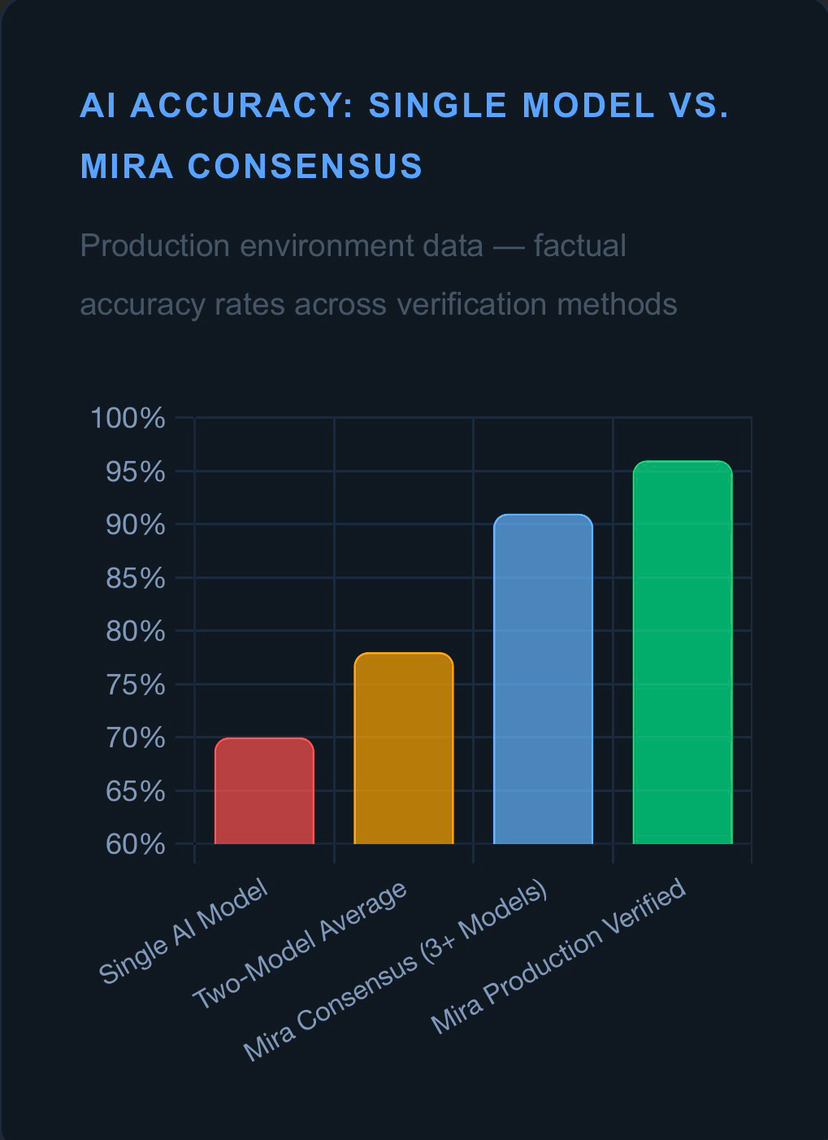
Decentralized verification improves factual reliability by having Mira filter AI outputs through a network of independent models, reducing hallucinations without retraining or centralized oversight.
Messari Research, May 2025
What makes this genuinely impressive is the scale it operates at. Mira currently processes over 3 billion tokens daily, serves more than 4 million users, and handles over 19 million weekly queries. These are not projections or roadmap numbers — they are live operational metrics from a working system.

The Team Behind It
Mira was founded by Ninad Naik, Sidhartha Doddipalli, and Karan Sirdesai. The founders come from backgrounds spanning AI research, blockchain infrastructure, and verification systems. Their core insight was deceptively simple but profound: the problem with AI is not that individual models are bad — it is that there is no trustless mechanism for checking their work.
The project is backed by serious money from serious people. In July 2024, Mira raised 9 million dollars in a seed round co-led by BITKRAFT Ventures and Framework Ventures. Participating investors included Accel, Mechanism Capital, Crucible, Folius Ventures, and the SALT Fund. Beyond institutional backing, the project counts Balaji Srinivasan, Sandeep Nailwal (co-founder of Polygon), and Alex Svanevik (CEO of Nansen) among its backers. These are names that take infrastructure bets seriously.
An additional 850,000 dollars was raised through two community node sale events in late 2024 and early 2025, which helped bootstrap the validator network from the ground up and created genuine grassroots buy-in from day one.
The $MIRA Token: How It All Fits Together
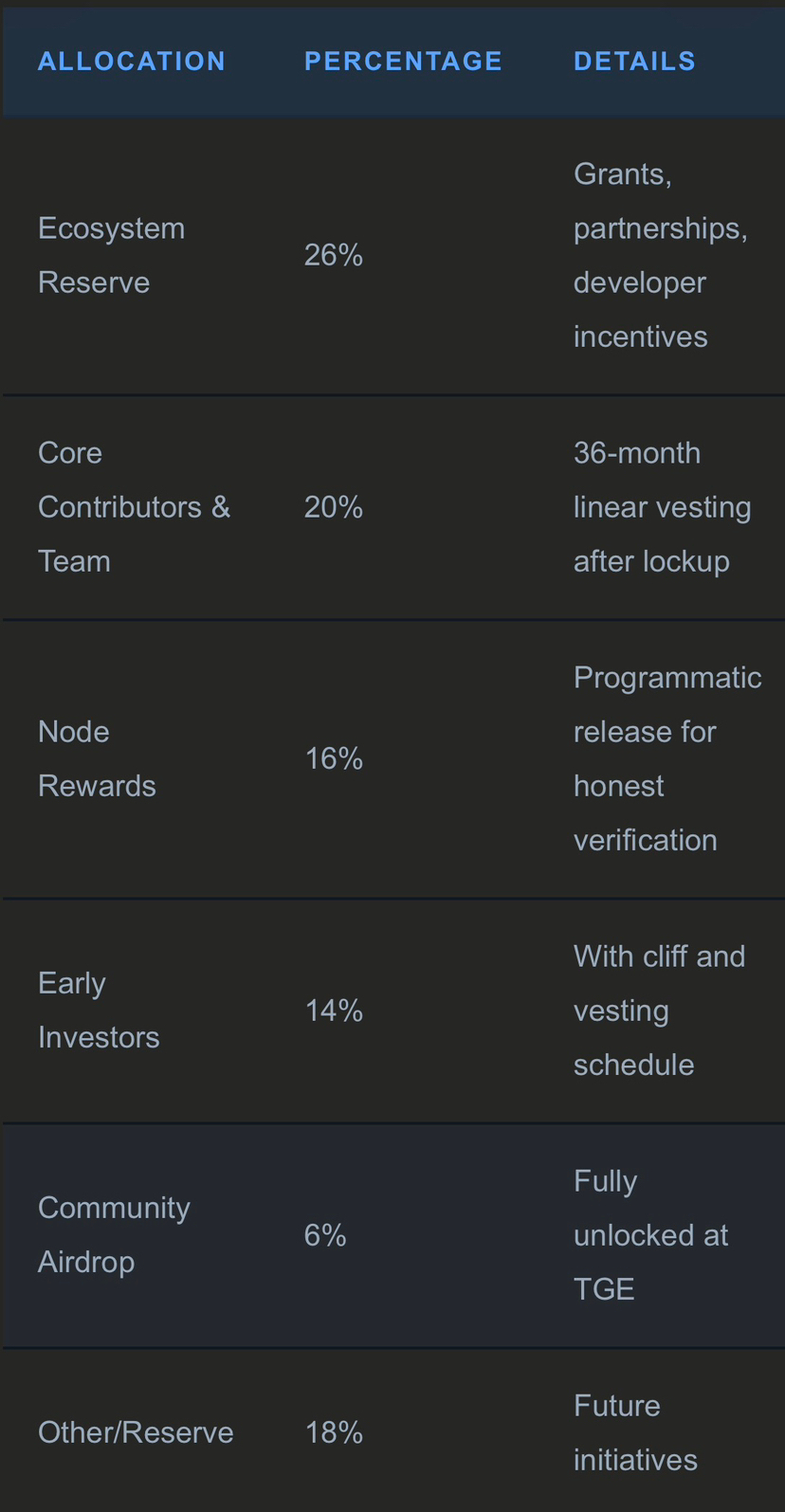
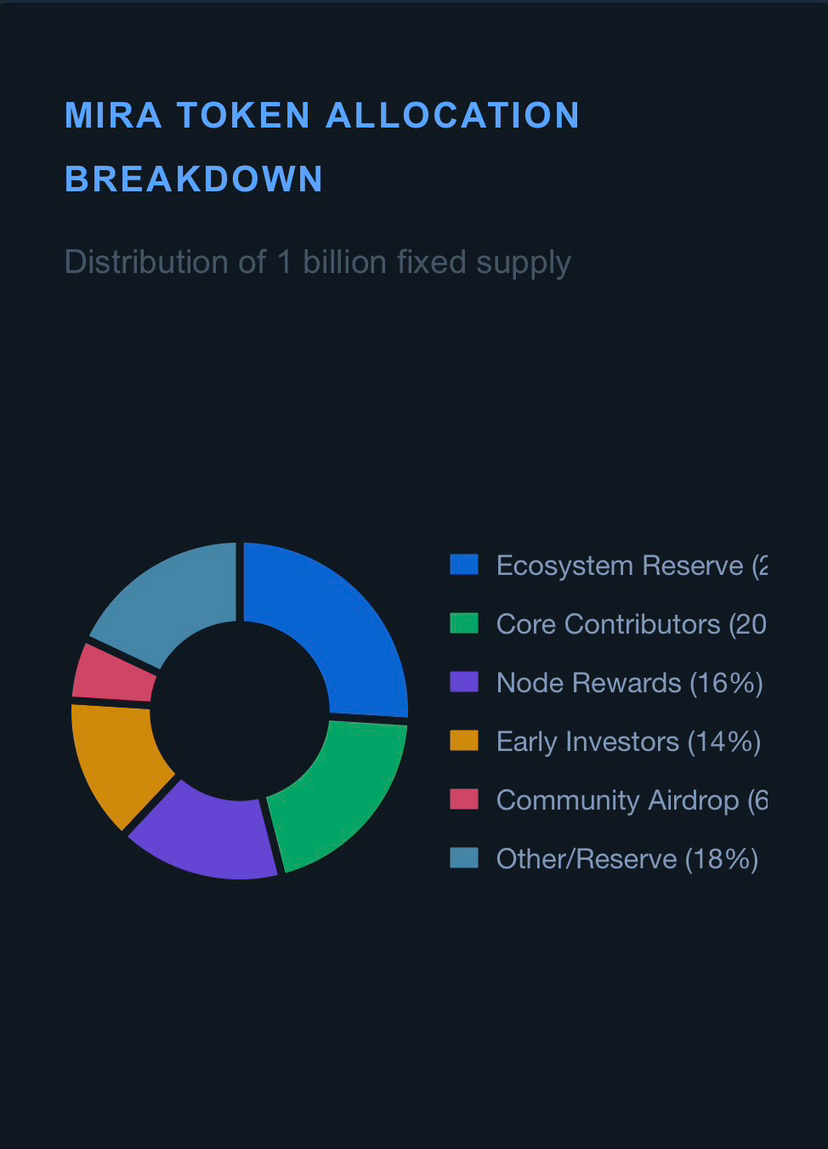
The native token of the Mira ecosystem is $MIRA, deployed on the Base blockchain as an ERC-20 token. Its total supply is fixed at 1 billion. The token serves multiple interconnected functions that make it central to how the network operates — not just an afterthought or a fundraising mechanism.
Node operators who participate in the verification network must stake MIRA tokens to be eligible. This creates real economic skin in the game. If a node behaves dishonestly — if it votes incorrectly or tries to manipulate outcomes — it faces slashing, meaning it loses a portion of its staked tokens. This is the same economic security model that secures Ethereum itself. It aligns the incentives of the verifiers with the accuracy of the network.
Binance recognized the project by listing MIRA in September 2025 as part of its HODLer Airdrops programme — the 45th project in that initiative. The listing opened trading pairs against USDT, USDC, BNB, FDUSD, and TRY, bringing the project to the attention of Binance's massive global user base.
Mira's Growth Journey
JUNE / JULY 2024
Seed round closes at $9 million, led by BITKRAFT Ventures and Framework Ventures. Foundation for global expansion is laid.
DECEMBER 2024
First Node Sale raises $250,000. Community validator network begins bootstrapping.
JANUARY 2025
Second Node Sale raises $600,000. Public testnet and next-generation API suite launched.
AUGUST 2025
Independent foundation established. $10 million Builder Fund launched to attract developers and ecosystem partners.
SEPTEMBER 2025
Binance lists MIRA as part of HODLer Airdrops (Project #45). Trading opens against USDT, USDC, BNB, and more.
OCTOBER–NOVEMBER 2025
x402 payment integration goes live. Partnership with Irys for global data backup and network stability improvements.
JANUARY 2026
Developer SDK actively promoted. Community expansion campaigns launched including educational hubs in Nigeria.
The Applications Are Already Live
A project that only exists on a whitepaper is easy to dismiss. Mira is different — it already has working consumer applications built on top of its verification infrastructure.
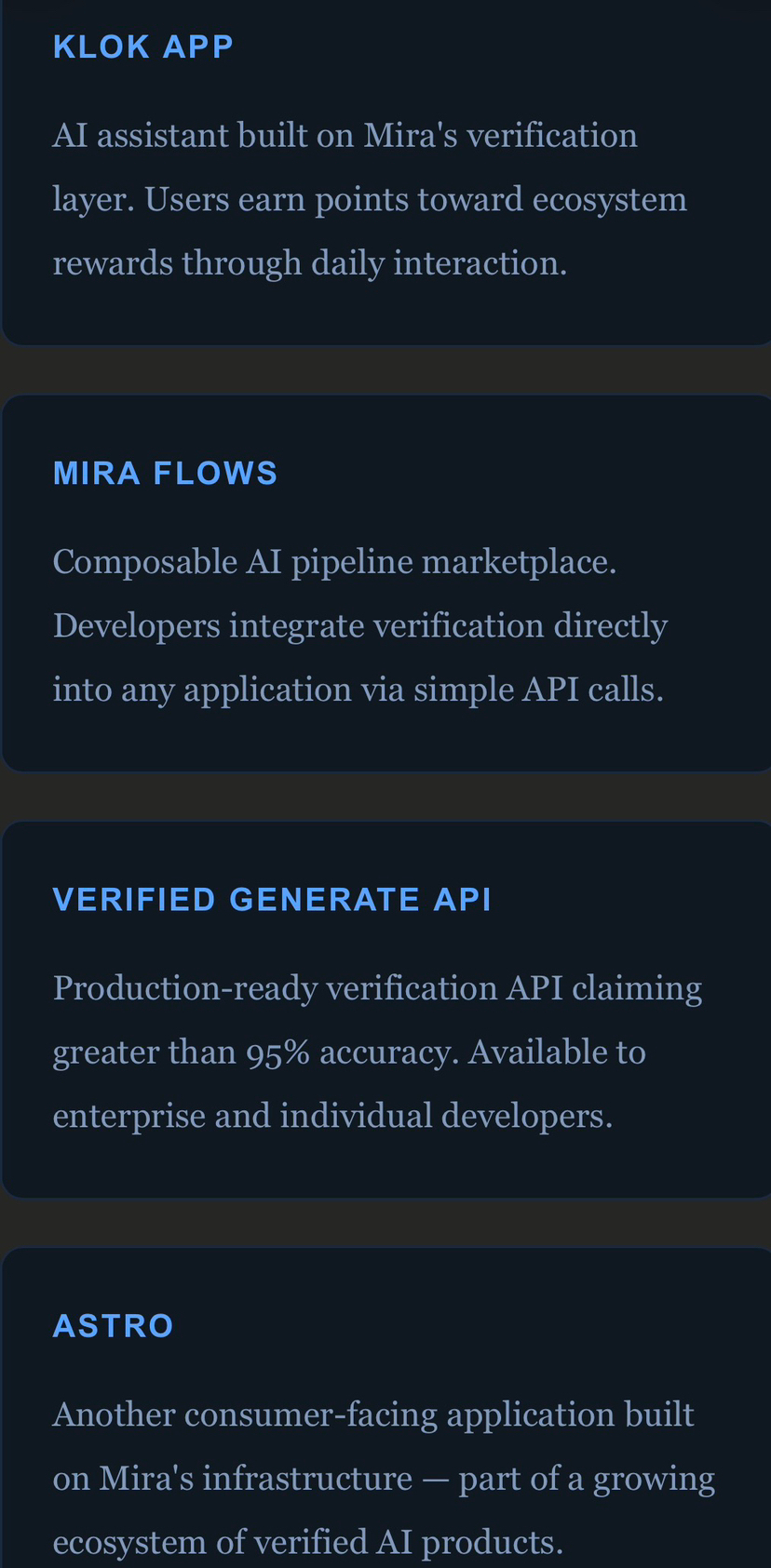
Klok is Mira's AI assistant application. Users interact with it daily, and in doing so, they are contributing to the network while also benefiting from verified AI outputs. Klok's daily active usage is a real demand driver for the verification layer underneath it. Astro is another application built on Mira's flows — a marketplace for composable AI verification pipelines that any developer can plug into their own product.
The Mira Flows marketplace essentially gives developers a turnkey solution. Instead of building verification from scratch, they integrate Mira's API and instantly inherit 96% factual accuracy rates, cryptographic audit trails, and decentralized consensus. The Verified Generate API is live and claims accuracy above 95%, meaning it is not just a proof of concept — it is production infrastructure.
Where This Fits in the Bigger Picture
We are living through a strange moment in technology. AI is being deployed everywhere, and yet trust in AI outputs is thin at best. Healthcare systems are experimenting with AI diagnostics. Legal firms are using AI for contract review. Financial institutions are running AI-driven risk assessments. Each of these use cases requires accuracy that current models, deployed alone, cannot reliably guarantee.
Mira's thesis is that infrastructure needs to catch up with capability. AI models have become extraordinarily capable. The missing piece is a verification layer that gives those capabilities institutional-grade trustworthiness. That is the market Mira is going after — not end users playing with chatbots, but the foundational layer that makes AI deployable in serious contexts.
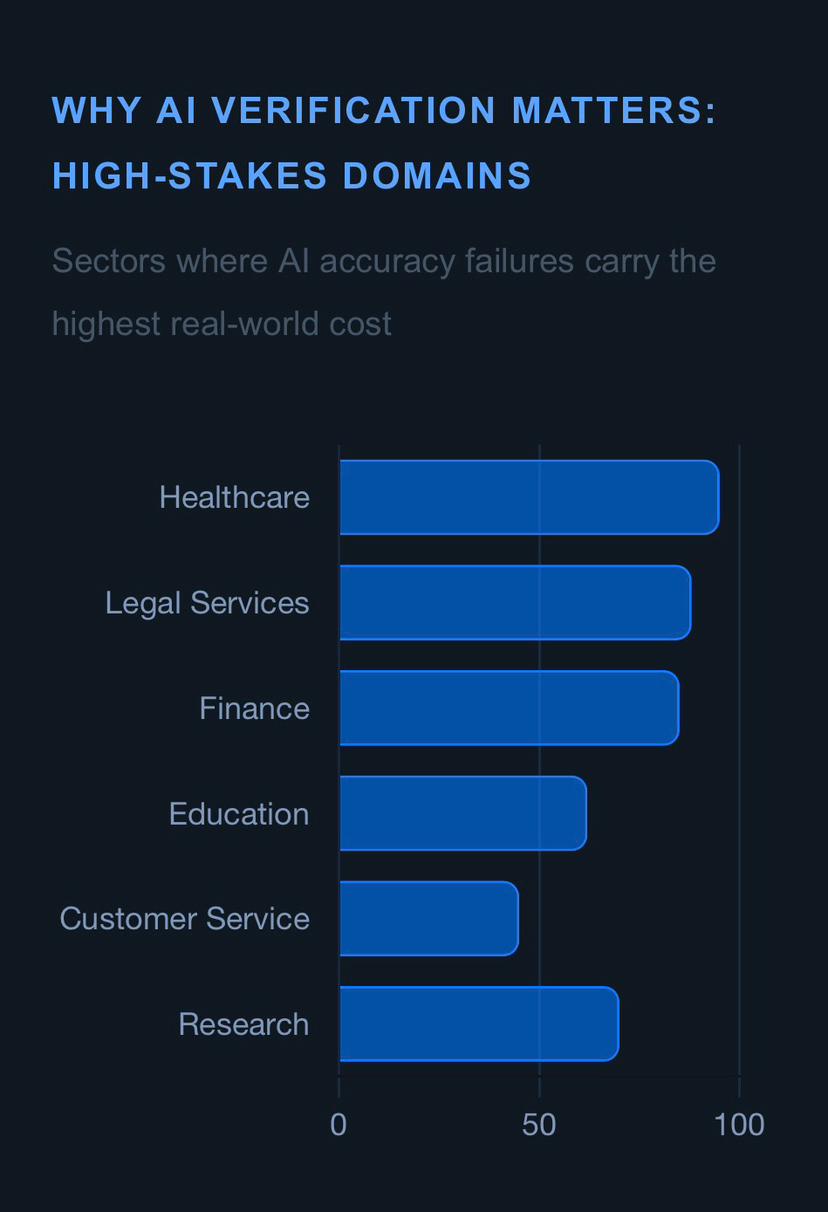
The market for AI infrastructure is enormous. Research firm estimates put the broader AI infrastructure market at hundreds of billions of dollars by the end of the decade. The verification niche specifically is wide open — there is essentially no decentralized competitor doing what Mira does at scale. The closest analogues are centralized solutions baked into individual AI companies, which by definition cannot offer the trustless, third-party verification that regulated industries actually need.
In August 2025, Mira launched a $10 million Builder Fund alongside an independent foundation. This signals a transition from a single-product company to a platform play — actively recruiting developers to build on its infrastructure the way Ethereum recruited builders in 2017. Partnership with Kaito, a leading AI analytics company, further extends Mira's reach into the professional AI community.
Honest Risks Worth Knowing
This article would be doing you a disservice if it only covered the positives. There are real challenges Mira faces and they are worth understanding clearly.
The token had a rough post-listing experience. Research from Memento in late 2025 found that 84.7% of 2025 token launches were trading below their Token Generation Event price. MIRA was cited among those that declined significantly from an initial fully diluted valuation of 1.4 billion dollars. For investors who got in at launch expecting quick gains, that was painful.
Token unlock schedules are also a consideration. With only 19.12% of supply in circulation at listing, roughly 80% of tokens are still locked. As those unlock over the following years, supply pressure increases unless demand grows at a proportional rate. These are standard tokenomics risks but they apply here.
The decentralized AI infrastructure sector is also early. There is regulatory uncertainty around AI verification in sectors like healthcare and finance — the very sectors Mira wants to serve. That could slow enterprise adoption in the near term.
Still, for patient believers in the thesis — that AI needs a trustless verification layer before it can be deployed autonomously in critical applications — Mira is arguably the most serious attempt to build that layer that currently exists.
What Comes Next
Mira's roadmap for 2025 and 2026 includes mainnet deployment, full governance features, an expanded verifier node network, and further product launches under the Klok and Astro families. The developer SDK, actively promoted in early 2026, is meant to simplify onboarding for builders who want to plug into the verification layer without running their own nodes.
Community expansion is also a clear priority. The Nigeria campaign is part of a broader initiative to bring the network's benefits to emerging markets where AI adoption is accelerating but institutional trust infrastructure is weakest — arguably the highest-impact places to deploy verified AI.
The x402 payment integration means developers can now pay for verification services in real time using on-chain payments, removing friction from the developer experience. The Irys partnership improves data redundancy and global network stability. These are incremental improvements, but each one removes a reason not to build on Mira.
Final Take
AI's future depends on trust. Not the vague, hopeful kind — but the cryptographically verifiable, economically incentivized, consensus-built kind. Mira Network is building that infrastructure. It already works at scale. The products are live. The investors are credible. The problem it solves is real and urgent.
Whether $MIRA becomes a major asset depends on adoption, developer traction, and how the broader AI and blockchain markets evolve. But the core thesis — that verified AI is not optional for serious applications — seems more inevitable every day.