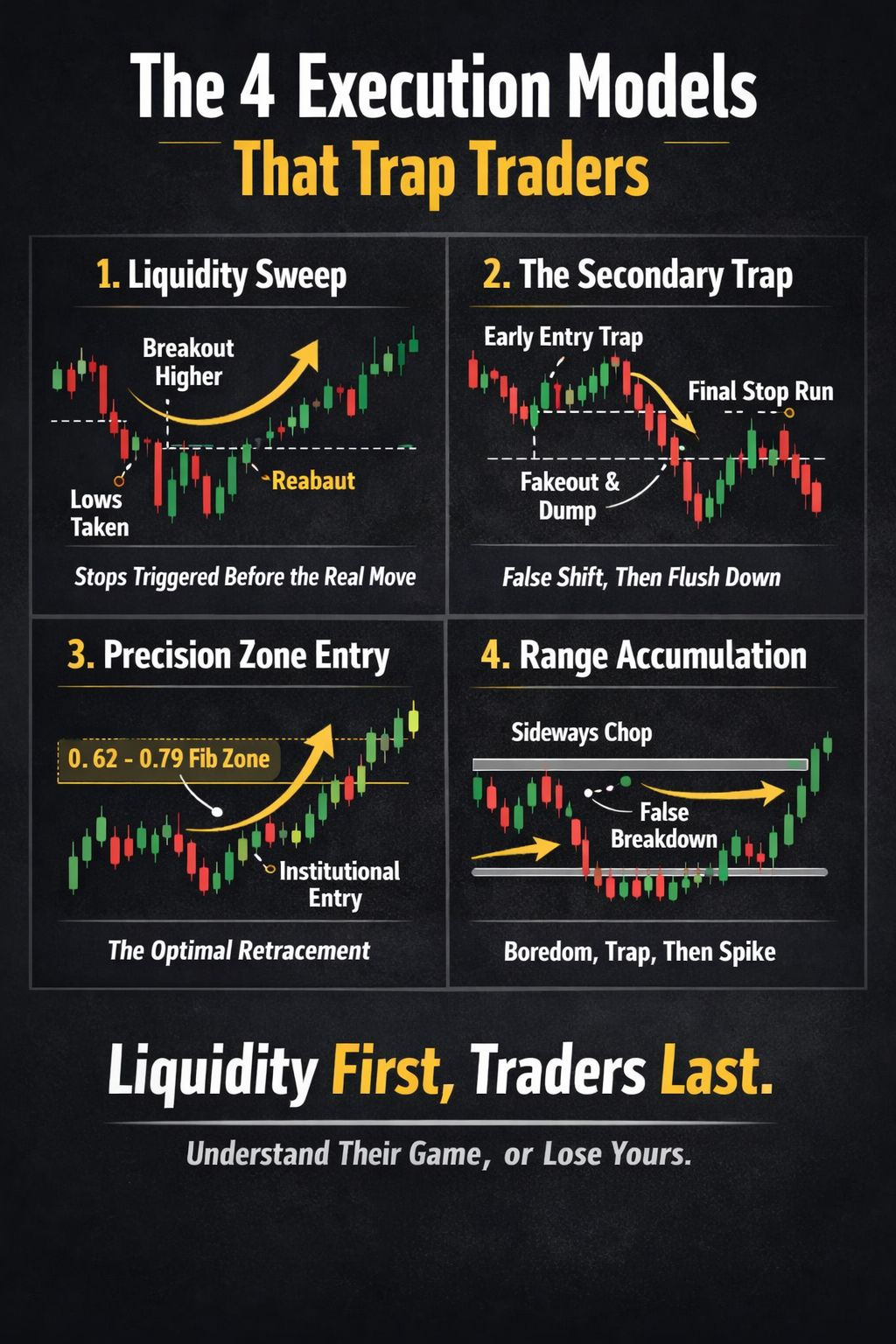
🚨 Why Most Traders Lose: 4 Execution Models You’re Not Taught
This market was not designed to reward impatience.
Most retail traders don’t lose because they’re “bad at trading” — they lose because they interact with price before liquidity is properly delivered.
Below are four execution models that consistently appear in price action. Once you recognize them, you stop reacting emotionally and start reading intent.
1. Liquidity Sweep Before Expansion (Model 1)
Markets rarely move without first collecting liquidity.
Before any meaningful directional move:
Prior highs or lows are taken
Stop losses are triggered
Early entries are forced out
This often occurs inside a higher-timeframe area of interest. Only after liquidity is removed does structure shift and imbalance form.
If you entered before the sweep, price didn’t “fail” you — it used you.
2. The Secondary Trap (Model 2)
Many traders recognize the first structure shift.
That’s why the market adds another layer.
After an initial move, price creates a clean internal setup that looks safe and logical. Traders enter confidently — and then price delivers one final stop run.
That last flush clears remaining liquidity before the real expansion begins.
The move you were waiting for starts after most participants are gone.
3. Precision Entry Zones (Model 3)
Large participants don’t chase price — they optimize entries.
Key expansions often originate from retracement zones between 0.62–0.79, especially when aligned with imbalance or inefficiency.
When price, structure, and displacement align in that zone, size can enter with controlled risk.
Anything outside that alignment is randomness, not opportunity.
4. Range Accumulation Trap (Model 4)
Not all accumulation looks aggressive.
Sometimes price stays compressed in a tight range, draining patience and confidence. Traders exit from boredom, not invalidation.
Then:
A false breakout occurs
Higher-timeframe liquidity is swept
Price snaps back into the range
That return is not support or resistance — it’s reloading before expansion.
Final Thought
Price is not random, and it’s not emotional.
Every candle exists to encourage poor timing from those who don’t understand liquidity.
These are not “setups.” They are delivery mechanisms.
Study structure. Study liquidity.
Indicators follow price — they don’t explain it.
If this helped, save it and revisit it when price doesn’t do what you expect.
#PriceAction #MarketStructure #Liquidity #TradingEducation #AriaNaka