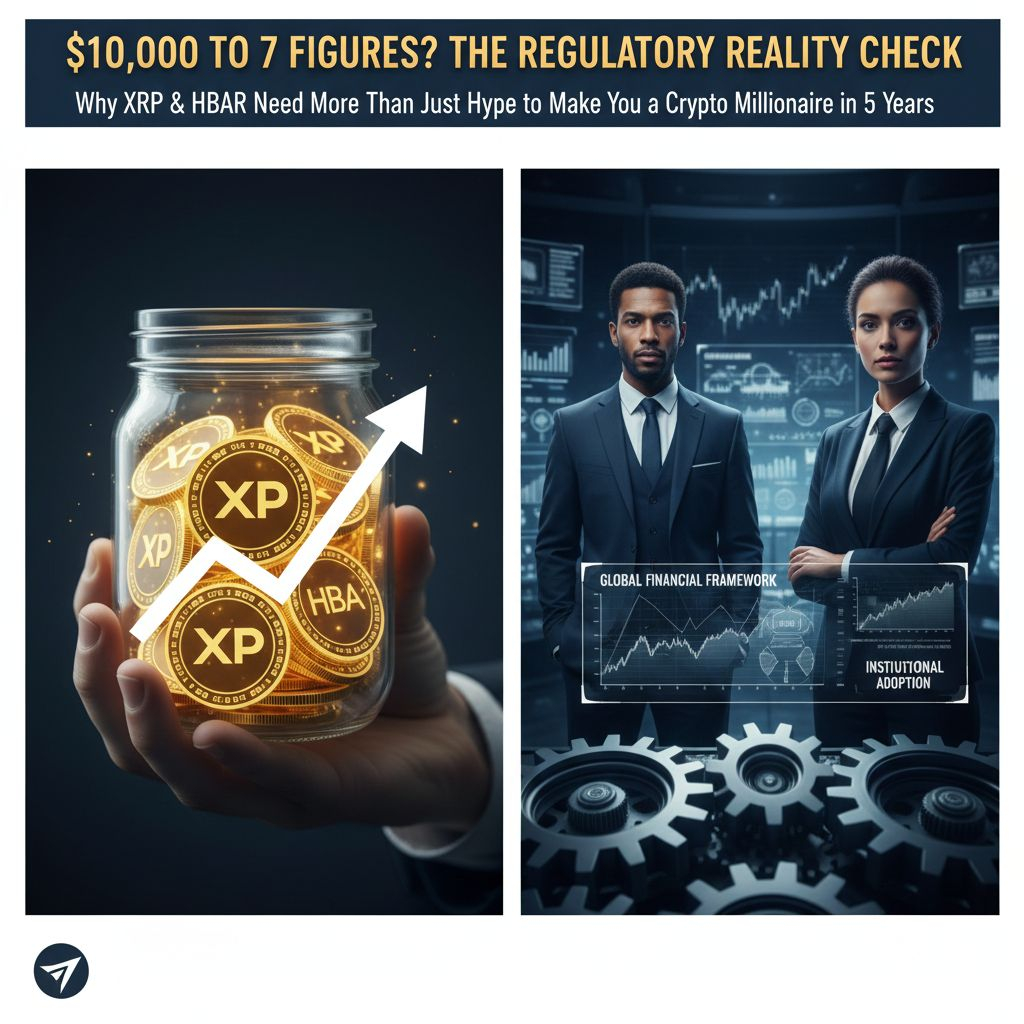
We all know why we’re here. Whether you’re a Ripple proponent or a Hedera "HBARbarian," the motivation is the same: profit. It’s easy to run the "napkin math." You look at your stack—maybe it’s 10,000 $XRP XRP or 10,000 HBAR—and you start dreaming about that seven-figure exit strategy within the next five years. But as the landscape shifts from retail hype to institutional integration, we have to ask a difficult question: Is that millionaire dream grounded in reality, or is it based on a fundamental misunderstanding of how the new financial system works?
The Shift from Speculation to Regulation
The days of digital assets being the "Wild West" are ending. Global regulators are no longer ignoring the space; they are defining it. Frameworks from the Bank for International Settlements (BIS) and the Basel Committee (specifically under Basel III) are now dictating how banks can classify and hold digital assets.
This is a double-edged sword:
The Good: Institutional allocation is finally possible.
The Reality Check: Institutions don’t buy based on Twitter (X) hype. They move capital based on regulatory permission, liquidity efficiency, and settlement advantages.
When an asset becomes a "bank-grade" tool, its price action changes. It stops behaving like a volatile tech stock and starts behaving like financial infrastructure.
XRP: Solving the $27 Trillion Problem
Ripple’s thesis for XRP has always been clear: Liquidity. Currently, trillions of dollars are trapped in Nostro/Vostro accounts—pre-funded accounts that banks must keep in foreign jurisdictions to facilitate cross-border payments. That is "dead capital." XRP is designed to be the bridge asset that frees up that liquidity
The Price Reality: For $10,000 worth of XRP to become $1,000,000, the token price would need to hit $100. While XRP is designed to handle massive value, its growth depends entirely on how deeply it is integrated into the actual plumbing of global settlement, not just retail speculation.
HBAR: The Backbone of Enterprise Infrastructure
While XRP targets the flow of money, Hedera (HBAR) is positioning itself as the layer for everything else. Governed by a council of global giants (like Google, IBM, and Dell), Hedera isn't just a "coin"; it’s an enterprise coordination tool
HBAR focuses on:
Supply Chain Tracking: Real-time transparency for global logistics.
Tokenization: Bringing RWA (Real World Assets) on-chain.
Data Integrity: Secure, verifiable enterprise communication.
Because Hedera is embedded in the data layer of corporations, its value accrual follows a different path than a payment currency. It relies on high-volume, low-cost transactions. For HBAR to reach millionaire-maker levels, the sheer volume of enterprise adoption must be astronomical.
The "Liquidity Concentration" Factor
One of the most overlooked aspects of the 5-year outlook is liquidity concentration. As these assets move into regulated custody and bank-grade storage, they aren't "burned," but they do move out of active circulation.
When supply moves into strategic institutional reserves, the "open market" price might not react the way retail investors expect. Holding 10,000 tokens today is an early-mover advantage, but as the pathways for institutional allocation narrow, the window for explosive, 100x retail gains may begin to close.
The Bottom Line
Could a $10,000 investment in XRP or HBAR make you a millionaire? It's not impossible, but it isn't the "guaranteed" math many influencers suggest.
The outcome won't be driven by a viral trend; it will be driven by structural integration. If these assets become the "pipes" of the global financial system, they will be immensely valuable—but that value will be shaped by balance sheet treatment and compliance, not just a "moon" mission.#Xrp🔥🔥