
A real talk guide for new traders who are tired of "blazing fast" blockchains that still lag
What Actually Is Fogo?
every new chain claims to be "the fastest." You've heard it a million times. But Fogo is doing something genuinely weird and interesting—they built an entire Layer 1 around Firedancer, which is basically a complete rewrite of Solana's guts by the smart folks at Jump Crypto.
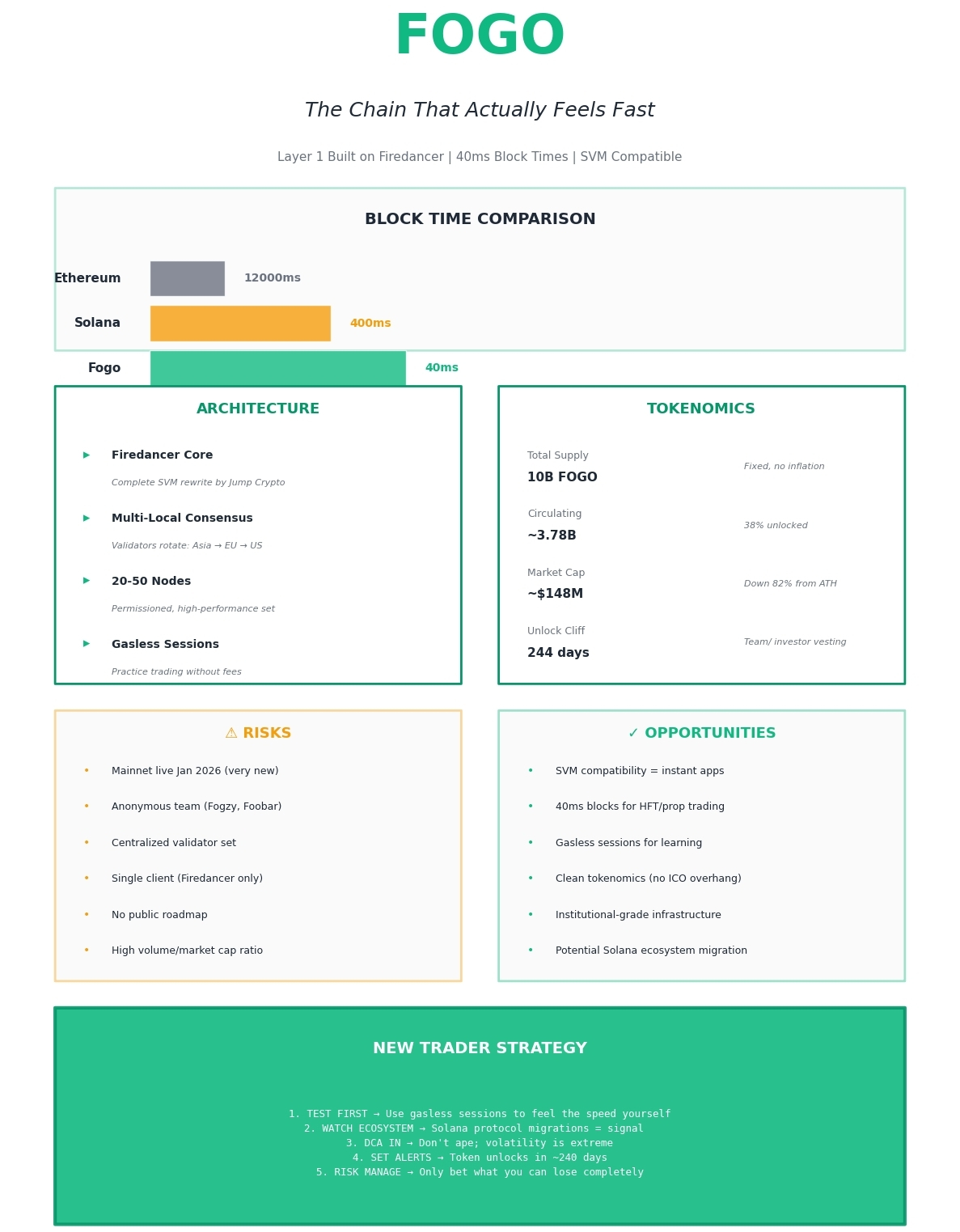
The headline number? 40 millisecond block times. That's not a typo. While you're waiting for Ethereum to crank out another block (12 seconds... feels like forever when you're trying to exit a position), Fogo has already confirmed 300 transactions. Solana's fast at 400ms. Fogo makes Solana feel sluggish .
But here's what actually matters: they didn't just copy Solana and tweak some parameters. They made some genuinely different architectural choices that are worth understanding before you ape in
The Weird Stuff That Makes Fogo Different
Validators That Literally Move Around the World
This is wild. Fogo runs a "follow the sun" system where the validator set physically shifts across three zones—Asia, Europe, North America—based on where the trading action is happening .
Why? Because physics. Light takes time to travel. If you're trading during the London open but your transaction has to bounce off a validator in Singapore, you're already slower than the guy whose trade hits a server in Frankfurt. Fogo rotates validator priority to minimize that physical distance.
It's a trade-off—they're sacrificing some decentralization (you need permission to validate right now, and there's only 20-50 nodes) for pure execution speed . But if you're trying to build the on-chain equivalent of a NASDAQ matching engine, that trade-off makes sense.
Gasless "Sessions" for Actually Learning
They built something called Fogo Sessions that lets you interact with the chain without a wallet or gas fees .
For new traders, this is huge. You know how painful it is to practice on Ethereum? Every failed transaction costs you 5-50 in gas. On Fogo, you can actually experiment—test strategies, try out the interface, make mistakes—without bleeding money. It's like a paper trading account, but with real market conditions.
Native DEX Built Into the Protocol
Most chains just host third-party exchanges. Fogo is planning to enshrine their own DEX at the protocol level, with liquidity providers literally colocated with validators .
Translation: if this works, the slippage you get on Fogo could be meaningfully better than anywhere else. For high-frequency traders, that's everything. For regular degens, it means tighter spreads and less getting frontrun by MEV bots.
The Token: What You're Actually Buying
FOGO is the native token. Here's the real deal on the numbers:
- 10 billion total supply, fixed forever. No surprise inflation
- About 3.78 billion circulating right now—so roughly 38% is already in the market
- Team and investor tokens are locked for 244 days with a 2-year vest after that
The funding story is actually pretty clean. They raised 5.5M from serious folks (Distributed Global, among others) back in December, then another 8M from the community via Cobie's Echo platform in January . The public sale was tiny—just 2% of supply at a fixed price—so you don't have the massive ICO overhang that kills most new tokens . That volume you're seeing? 1.26 billion daily against a 148 million market cap is... aggressive . That ratio suggests a lot of whale activity and potential wash trading, not organic retail flow. If you're entering now, you're swimming with sharks.
Also, the price action has been brutal—down 82% from its all-time high as of late February . The sentiment indicators are bearish across every timeframe. That could mean it's bottomed out and cheap, or it could mean it keeps bleeding. Classic crypto dilemma.
Why Developers Might Actually Care (And Why You Should Too)
Here's the sneaky-smart part: Fogo is fully compatible with Solana's virtual machine (SVM) .
What this means in practice:
- Any protocol built on Solana—Jupiter, Drift, Kamino, whatever—can port over basically overnight
- Your Phantom wallet works immediately. No new downloads, no seed phrase migrations
- Developers don't need to learn new tools. Anchor, Seahorse, all the Solana dev stack just works
This matters to you as a trader because ecosystem growth isn't bottlenecked. New chains usually die because they can't get apps built. Fogo could have Jupiter and Raydium running on day one if the incentives align. Watch for migration announcements from big Solana protocols—that's when things get interesting.
Real Talk The Risks Nobody Wants to Tweet
Let's be honest about the downsides because nobody else will:
It's brand new. Mainnet went live January 2026 . That's barely enough time to find the bugs, let alone prove stability. Remember when Solana used to go down every other week? Early high-performance chains have growing pains.
Centralization trade-offs. Twenty to fifty permissioned validators is not decentralized in the way crypto purists want . If you're ideologically committed to maximum decentralization, this isn't your chain. If you just want your trades to execute without congestion, you might not care.
Single client risk. They only run Firedancer—no other validator client options. One critical bug, and the whole chain could halt. No diversity, no fallback .
The team is anonymous. "Fogzy" and "Foobar" are the public faces. They've got legit crypto experience (Foobar especially), but there's no doxxed leadership . In a bear market, anonymous teams sometimes... disappear.
No public roadmap. The official site literally says "no public roadmap" . You're investing blind into whatever they decide to build next.
How to Actually Approach This As a New Trader
Don't just buy the token and hope. That's not research, that's lottery tickets.
Actually use the chain. Go to the testnet. Execute some trades. See if it actually feels as fast as they claim. If you can't perceive the difference between Fogo and Solana, then the speed advantage doesn't matter for your use case.
Watch the unlock calendar. In 240 days, a bunch of team and investor tokens start unlocking. That's potential sell pressure. Mark your calendar.
Set up alerts for ecosystem announcements. When a major Solana DeFi protocol announces they're launching on Fogo, that's your signal that the "SVM compatibility" thesis is playing out. Don't buy the rumor—buy the confirmation, or better yet, use the product.
Risk management is boring but essential. If you're entering here, consider dollar-cost averaging rather than one big buy. The volatility on a new L1 token can be insane. Don't bet more than you can afford to lose completely—this is a speculative early-stage project, not a blue chip.
Fogo isn't just "Solana but faster." It's a bet that performance-optimized, slightly more centralized infrastructure will capture the next wave of serious on-chain trading—prop firms, market makers, maybe even tokenized traditional finance.
The tech is genuinely interesting. The tokenomics are relatively clean for a new launch. But it's early, it's risky, and the price has already been beaten down hard from the hype peak.
If you're curious, don't just ape. Go feel the speed yourself. That's the only due diligence that actually matters.