
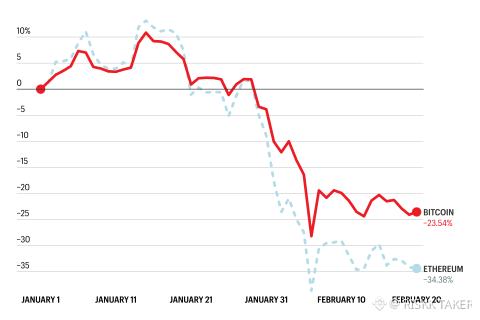
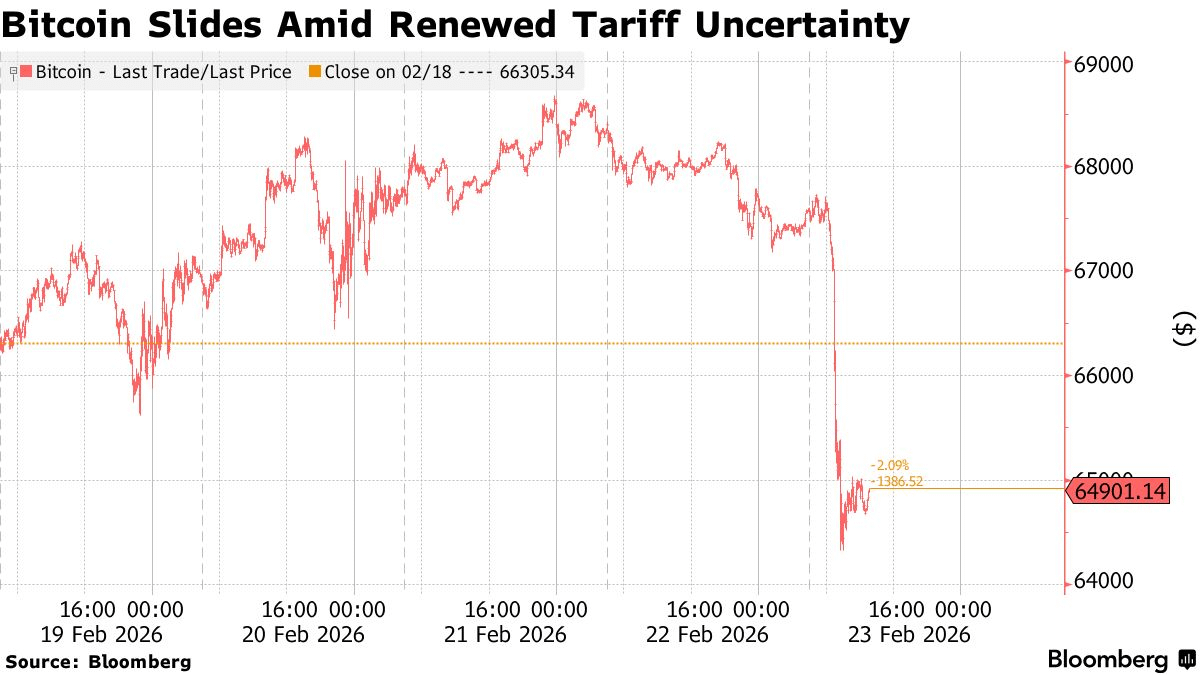
You know that Monday-morning feeling when you open your portfolio app and your stomach drops? Yeah, crypto holders are living it right now. As I write this on February 23, 2026, Bitcoin has just clawed its way back above $66,000 after briefly kissing $64,300 earlier today, down as much as 5% in a single wild Asia session. Ethereum got hit even harder, sliding toward $1,900. For the year so far? Bitcoin is down roughly 24-25%, Ethereum closer to 34%. That's not just a bad month. According to data going back more than a decade, it's the worst start to any year on record for both of them.
And the trigger this time? Not some exchange hack, not a celebrity rug-pull, not even the usual crypto drama. It's old-school macro chaos: President Trump's latest tariff moves. Let me walk you through exactly how we got here, why it hurts so much right now, and, most importantly, why I'm sitting here surprisingly calm instead of panic-selling.
Picture the scene from the past few days. Late last week, the U.S. Supreme Court slapped down much of Trump's earlier tariff strategy, ruling he couldn't just wave the magic "emergency powers" wand under the International Emergency Economic Powers Act. Markets breathed a tiny sigh of relief... for about five minutes. Trump didn't back down.
He pivoted fast, announcing a new temporary 10% import duty on pretty much everything coming into the U.S., set to kick in February 24 under a different law (Section 122 of the 1974 Trade Act). Then, over the weekend, he cranked it up to 15% on Truth Social, calling it the "fully allowed" level. It's only supposed to last 150 days, with some carve-outs for critical stuff like energy and certain cars, but the uncertainty? That's the killer.
Tariffs, at their core, are taxes on imported goods. The idea is to protect American workers and factories by making foreign stuff more expensive. In theory, that encourages companies to make things here. In practice, especially when you slap them on the entire world, it spooks everyone. Global supply chains get messy. Companies face higher costs. Retaliation from trading partners looms. Inflation fears creep back in, which could mean the Fed stays hawkish longer.
All of that screams "risk-off" to investors. And right now, crypto has become very much a risk asset, sitting right next to tech stocks and growth plays in portfolios. That's the big shift since 2024. Remember when $BTC used to move on its own weird rhythm-halvings, memes, adoption stories? These days, with spot ETFs sucking in billions from pension funds and corporations, and big institutions treating it like digital gold (or at least digital silver), it dances to the same tune as the S&P 500.
When Wall Street gets nervous about trade wars and potential slowdowns, everything speculative gets the boot. We've seen over $400 million in long positions liquidated in the last 24 hours alone. Sentiment readings are back in "extreme fear" territory. Even a $61 million Bitcoin whale got wrecked on one exchange.
But here's where it gets interesting, and why this doesn't feel like the 2022 crypto winter or the 2018 bloodbath. Those crashes had clear villains: FTX imploding, Terra Luna exploding, endless leverage unwinding in a completely unregulated Wild West. This one? It's almost... clean. No single crypto scandal. Just macro noise. And underneath the surface, the foundation of the entire industry has never been stronger.
Let's talk about what's quietly happening in Washington that most headlines are missing while they scream about the price chart. The SEC has a new chair: Paul Atkins. If you've followed crypto regulation even a little, you know this is huge. Atkins isn't coming in with the old "regulation by enforcement" playbook that had projects terrified of random lawsuits. He's launched "Project Crypto" basically the SEC's big push to finally make sense of this space.
In speeches and congressional testimony just in the last week or two, he's laid out a roadmap for 2026 that includes clear guidance on when a token stops being a security (think mature networks that are actually decentralized), innovation exemptions so builders can test tokenized securities on decentralized platforms without getting crushed by red tape, new rules for how broker-dealers can custody stablecoins, and even ideas for "super-app" platforms that let you trade crypto, stake, and do traditional stocks all under one clear license.
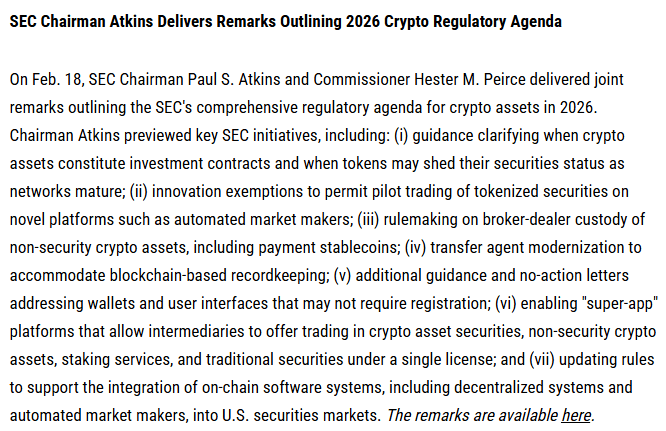
He's coordinating with the CFTC. He's dropping or settling a bunch of old cases against big players like Binance and Coinbase. He's talking about making the U.S. the "crypto capital of the world," echoing Trump's own pro-crypto stance. This isn't vague hope, it's concrete policy movement happening right now, while the price is bleeding. For years we've begged for regulatory clarity. It finally feels like it's arriving, and it's arriving under a framework that actually understands blockchain instead of treating it like 1990s penny stocks.
Now layer on the real innovation that's been building regardless of price action: real-world assets, or RWAs. This is the part that gets me genuinely excited. Instead of just trading cartoon monkeys or yield-farming tokens that go to zero, we're seeing trillions of dollars' worth of traditional stuff—U.S. Treasuries, real estate, invoices, even carbon credits, getting tokenized on blockchains. BlackRock and others have already launched tokenized funds that trade on-chain. Platforms are letting you borrow against fractional ownership of actual buildings or bonds. Stablecoins are becoming the internet's dollar for payments. DeFi isn't just for degens anymore; it's turning into programmable, borderless finance that traditional banks are starting to plug into.Even in this downturn, the underlying activity hasn't collapsed.
Yes, there have been ETF outflows recently, but that's short-term deleveraging after last year's insane run-up. The long-term trend of institutions treating crypto as a portfolio diversifier hasn't reversed. Bitcoin ETFs are still here. Solana and Ethereum ecosystems keep shipping upgrades. AI is starting to weave into on-chain tools for smarter trading, security, and even decentralized compute. The narrative has quietly shifted from "number go up" speculation to actual utility that solves real problems.Look back at history for a second. Bitcoin has had terrible starts to years before, 2014, 2015, 2018—and it didn't just recover; it came back stronger every single time because the technology and adoption kept marching forward while weak hands got shaken out. The same thing happened after the 2022 bear market. People who sold the bottom regretted it for years.
I'm not saying buy the dip blindly or that we won't see $60k Bitcoin again this month. Tariffs could drag on, retaliation could escalate, and risk assets could stay under pressure for weeks. But when the dust settles—and it always does, the pieces on the board look way better than they did even six months ago. Regulatory tailwinds instead of headwinds. Real money and real assets flowing on-chain. A maturing industry that's finally growing up. So if you're sitting there right now with a red portfolio, take a breath. This isn't the end of crypto. It feels more like the messy adolescence before it steps fully into the mainstream. The tariffs are loud and scary today.
The quiet regulatory revolution and the tokenization of the real world? Those are the things that are going to matter in 2026 and beyond.
What do you think, holding through the noise, or waiting for clearer skies? Drop your thoughts below. And whatever you do, don't let one volatile Monday define your whole thesis. Crypto's been through worse, and it's always found a way to surprise us.