
Here's something that keeps me up at night in the time it takes most blockchains to confirm a single transaction, a Citadel trading engine in Tokyo has already priced your order against three different liquidity pools, adjusted for settlement risk, and moved on to the next thousand opportunities.
That 360-millisecond gap? It's not just latency. It's money. Lots of it.
I spent the last few weeks digging into Fogo—a Layer 1 that launched January 13 with a genuinely different premise. Not "we'll be faster eventually." But rather: we built this specifically so people who trade for a living don't hate using it.
The Founding Story: When Wall Street Quits to Build Something Better
Most crypto projects are founded by developers who learned trading along the way. Fogo flips that. The founding team lived institutional trading first .
Doug Colkitt spent nearly a decade as a high-frequency trader at Citadel Securities, focused on Japanese equities. If you've never traded Japanese markets, here's what you should know: they're ruthlessly efficient, latency-sensitive, and dominated by players who measure success in microseconds. His observation? "360 milliseconds is enough for prices to move, orders to be picked off, or strategies to fail." That insight became Fogo's north star .
Robert Sagurton came from Jump Crypto as Global Head of Digital Asset Sales. Before that: JPMorgan, State Street, Deutsche Bank. His role as Fogo Foundation Director isn't ceremonial—it's about bridging traditional finance and on-chain markets in ways that actually work .
Michael Cahill runs Douro Labs, the primary contributor to Pyth Network. Translation: he ensures Fogo has institutional-grade price feeds natively integrated, not bolted on as an afterthought .
Here's what stands out: this isn't a team learning about trading as they go. They were the traders. They felt the friction of using general-purpose blockchains for professional strategies. And they built Fogo to eliminate that friction.
The Technical Architecture: Why Milliseconds Actually Matter
Let me share something I've learned covering this space: TPS is a vanity metric. Latency is what actually determines whether you can trade profitably.
The 40ms Difference
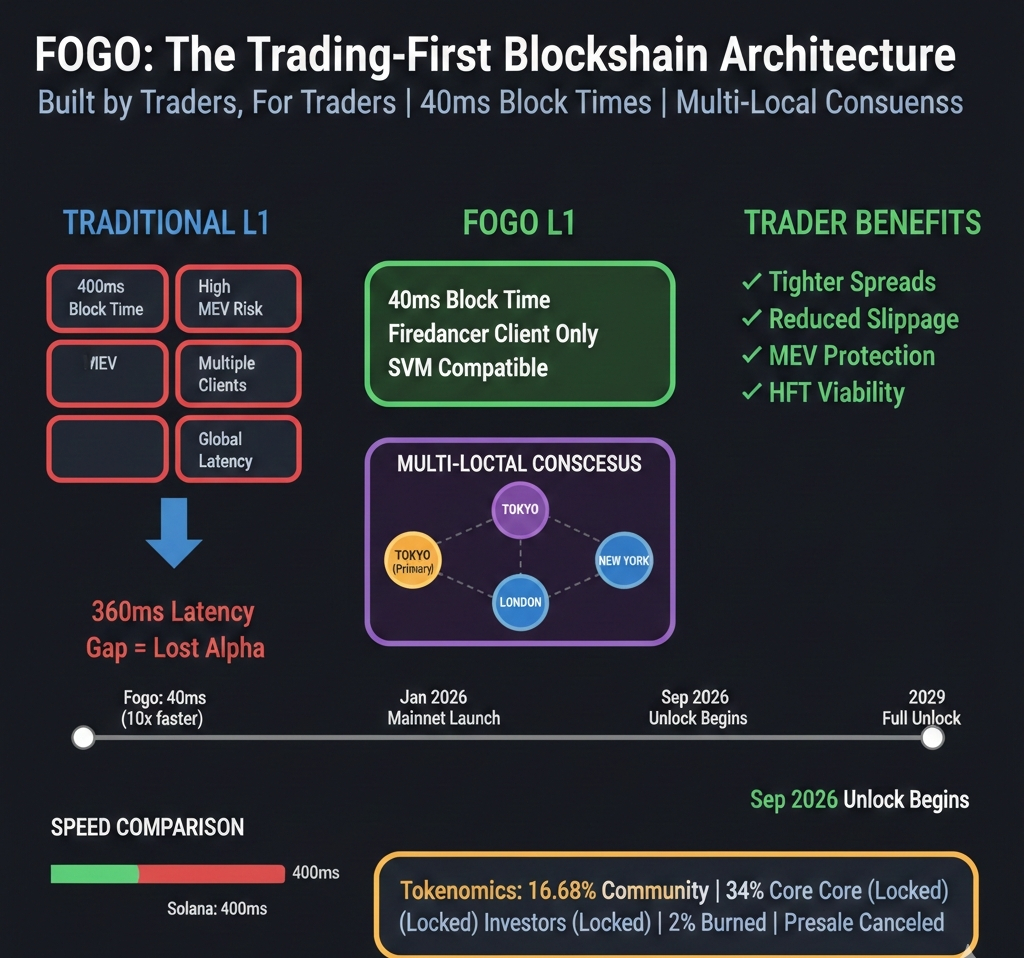
Fogo targets 40-millisecond block times. To put that in perspective, Solana—already considered fast—averages around 400ms . That's an order of magnitude difference. Here's what that means in practice:
What's Happening On a Standard L1 On Fogo Why Traders Care
Block time 400ms 40ms Your order sits in mempool 10x less time
MEV exposure Hundreds of ms Under 40ms Harder for bots to front-run you
Price quotes Delayed Near-instant Tighter spreads, better execution
When block times drop from 400ms to 40ms, market makers can quote tighter spreads because the risk of getting "picked off" by stale quotes drops dramatically . For high-frequency strategies, this isn't incremental—it's the difference between viable and impossible.
Firedancer: One Client to Rule Them All
Solana runs multiple validator clients. This adds complexity. Because the network can only run as fast as the slowest client, Solana is effectively capped at Agave's speed .
Fogo runs only Jump Crypto's Firedancer client—and runs it in its "cleanest, most optimized form" . This single-client approach means:
· Parallel execution using modern CPU cores
· Full SVM compatibility so Solana dApps can port without rewrites
· Hardware-level optimization for high-performance infrastructure
Multi-Local Consensus: Physics Still Matters
Here's a truth blockchains often ignore: data travels at the speed of light. Geographic distance introduces latency. You can't code your way around physics.
Fogo's response is "Multi-Local Consensus"—strategically colocating validators in Tokyo, London, and New York, with a primary cluster in Tokyo . This "follow-the-sun" model ensures the active validator set is physically close to trading activity during market hours.
The trade-off is explicit: Fogo prioritizes performance over geographic decentralization. For a chain designed for professional trading, that's a conscious choice, not an oversight .
Tokenomics: The Presale They Walked Away From
Here's a story that caught my attention.
In early 2026, weeks before mainnet launch, Fogo had a $20 million presale lined up at a $1 billion fully diluted valuation. Standard practice. Easy money .
They canceled it.
What Actually Happened
The community pushed back on valuation. Instead of ignoring the feedback, the team:
1. Killed the presale entirely
2. Airdropped that 2% allocation to the community
3. Burned an additional 2% of core contributor tokens as goodwill
Foundation Director Robert Sagurton explained it bluntly: "The team is interested in exploring more effective ways to reward early users and distribute the product without institutional sales" .
In a space where teams routinely extract maximum value upfront, this stood out.
Pre-mainnet, Fogo ran a Flames points program rewarding testnet participation. Approximately 22,300 addresses received airdrops at mainnet, averaging ~6,700 FOGO per wallet . The goal: reward genuine contributors, not mercenary capital.
The September 2026 Question
The first real test comes in September 2026, when unlocks begin for core contributors and institutional investors . Between now and then, Fogo needs to demonstrate enough demand growth to absorb that supply. Not impossible, but worth watching.
FOGO listed on Binance, KuCoin, Gate.io, and Bybit on January 15, 2026, with Binance's "Seed Tag" warning about early-stage volatility . The token dropped about 12% on its first trading day—typical "sell the news" behavior as airdrop recipients took profits
Let me be direct about what concerns me.
Validator centralization trade-off: The curated set enables 40ms performance but sacrifices full permissionless decentralization . Watch how the set expands over time.
Token unlock pressure: Starting September 2026, core contributor and investor unlocks introduce potential selling pressure. The market needs to absorb ~46% of supply over four years .
Adoption risk: Speed claims on testnet are one thing. Real-world load with actual capital is another .
Competition: Solana keeps optimizing. Sui and Aptos have war chests. Monad promises high performance with Ethereum compatibility.
Market conditions: With the Crypto Fear & Greed Index sitting at 12 ("Extreme Fear"), macro conditions remain challenging .
What I Think
Here's my take after digging through this:
Fogo represents a bet that blockchain specialization matters—that just as traditional finance has dedicated exchanges, clearinghouses, and settlement layers, crypto will evolve toward purpose-built infrastructure.
For trading applications, where milliseconds determine profitability, a chain optimized for low latency makes intuitive sense. The question isn't whether Fogo is fast—it clearly is. The question is whether the addressable market is large enough to support a dedicated L1, or whether general-purpose chains will optimize sufficiently to capture these use cases.