
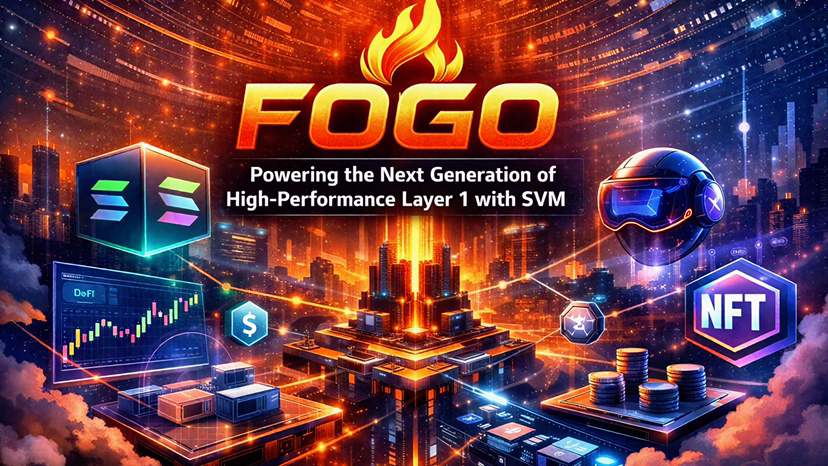
 When people talk about blockchain performance, they usually mention speed, fees, or scalability. But what really matters underneath all of that is infrastructure. And that’s where @Fogo Official ( $FOGO ) becomes interesting — especially with its focus on SVM architecture.
SVM stands for Solana Virtual Machine. Instead of building from scratch, projects that use SVM infrastructure benefit from a high-performance execution environment designed for parallel processing. In simple terms, it allows the network to handle many transactions at once instead of one by one.
For FOGO, this matters.
Speed and efficiency are not just technical features — they directly affect user experience. If transactions confirm quickly and fees remain low, developers are more likely to build, and users are more likely to stay.
What makes SVM attractive is its performance-first design. Parallel execution increases throughput while keeping latency low. That means decentralized applications can operate closer to Web2-level responsiveness — something the crypto space has struggled to achieve consistently.
For $FOGO , adopting SVM infrastructure could signal a serious intent to compete in the high-performance blockchain space. It suggests a focus on scalability, developer compatibility, and ecosystem growth rather than short-term hype.
But infrastructure alone isn’t enough.
The real test is whether FOGO can attract developers who actually build meaningful applications on top of this SVM base. Tools, documentation, incentives, and community support will decide how strong the ecosystem becomes.
If FOGO successfully combines SVM speed with strong ecosystem execution, it could position itself as more than just another token — it could become a performance-driven blockchain environment.
At the end of the day, infrastructure is invisible to most users — but it determines everything.
And if SVM is the engine, the question becomes:
How fast can #fogo drive from here? 🚀