
Let's talk about the real problem with crypto trading. You know that moment when you hit "buy" on a decentralized exchange, watch the price move against you for three seconds, then get filled at a worse price than you expected? That's not a bug. That's just how most blockchains work. They're built for everything—NFTs, memecoins, lending protocols, whatever—so they're not optimized for the one thing that matters when you're trying to execute a trade: speed.
Fogo looked at this mess and decided to build something different. Not another general-purpose chain promising to do everything for everyone. Just a blazing fast Layer 1 that uses the Solana Virtual Machine but strips away everything that slows traders down.
The team behind this thing isn't messing around. They've got people from Jump Crypto, Wintermute, and Solana itself—folks who actually understand how markets work because they've built and traded on them. They raised $11 million from heavyweight investors like Electric Capital and Mirana Ventures, but more interestingly, they scrapped their planned public sale and just airdropped tokens to people who actually used the network during testing. That says something about priorities.
Here's what makes Fogo technically interesting. They run only one validator client called Firedancer, which eliminates the performance lottery you get on other chains where some validators are optimized and others aren't. They also made a controversial choice: they put their active validators in just three locations—Tokyo, London, and New York. These rotate throughout the day so the network never sleeps, but they're positioned right next to major financial centers.
Purists will scream about centralization, and they're not wrong. But Fogo isn't pretending to be the most decentralized chain ever. It's deliberately trading some decentralization for performance that actually competes with centralized exchanges. For serious market makers and trading firms, that's a trade worth making.
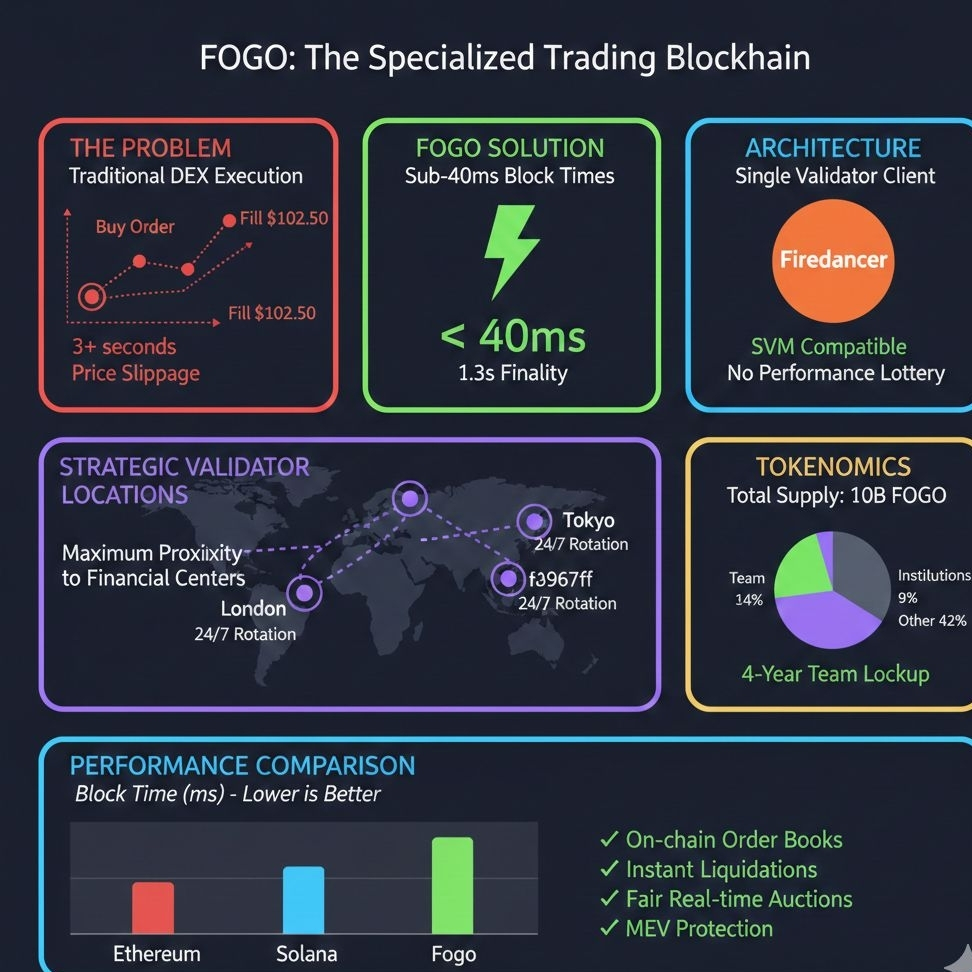
The numbers are genuinely impressive. Sub-40 millisecond block times. About 1.3 seconds to finality. That means when you submit a trade, it executes fast enough that you're not getting picked off by bots watching the mempool. On-chain order books become actually usable. Liquidations happen instantly instead of creating cascading failures. Real-time auctions work fairly because everyone gets the same information at the same time.
The $FOGO token itself has a 10 billion supply with sensible distribution. The team gets 34 percent locked up for four years, so they're incentivized to build long-term. The community gets over 15 percent through that airdrop and other programs. Institutional investors hold less than 9 percent, which is refreshingly low compared to most projects that sell half their tokens to VCs before retail ever sees them.
What I find most interesting is how they're handling the Solana relationship. Rather than trying to kill Solana, Fogo is positioning itself as a specialized alternative. Full compatibility means developers can port existing Solana apps over easily. The bet is that some applications—specifically trading-focused ones—will migrate for better performance while Solana keeps everything else.
Of course, this could all fail spectacularly. The validator concentration creates real regulatory and operational risks. Competition from Solana's own scaling efforts or other SVM chains could fragment the market. And institutional capital is notoriously slow to move on-chain regardless of how good the technology gets.
But #Fogo represents something important: a blockchain that admits it can't be everything to everyone, and instead tries to be genuinely excellent at one specific thing. In a space full of projects promising to revolutionize finance, gaming, social media, and AI simultaneously, there's something refreshing about a team that just wants to make trading work better.
Whether that focus translates into adoption remains the open question. The technology is there. The team credentials are legitimate. The token distribution is fairer than most. Now Fogo has to convince actual traders and institutions that the performance gains are worth migrating to a new, relatively unproven network. For an industry tired of compromises between speed and self-custody, that pitch might finally resonate.