
Everyone is worried about the next bull run, the next narrative, and the next airdrop meta.
But I can't help but think that we've fundamentally misunderstood what it means to build in Web3, and that misunderstanding is why 95% of projects that raised in 2021-2022 are now zombies.
The paradox is this:
The industry spent years convincing itself that decentralization was the product.
It's not. It never was.
Decentralization is infrastructure.
The product is what makes someone's life measurably better today, not in some distant future where everyone suddenly cares about trustlessness.
I've spent the last 8 months helping founders raise capital — small rounds, mostly seed and pre-seed, getting projects to that critical $25K-$50K mark where they can actually build something real.
And I can tell you this: The founders who get funded in 2026 are not the ones pitching decentralization.
They're pitching revenue.
They're pitching users who pay.
They're pitching products that would work even if blockchain didn't exist, but are 10x better because it does.
(By the way, if that last sentence made you uncomfortable, you're exactly who this is written for.)
What Stupid Thinking Looks Like in Web3
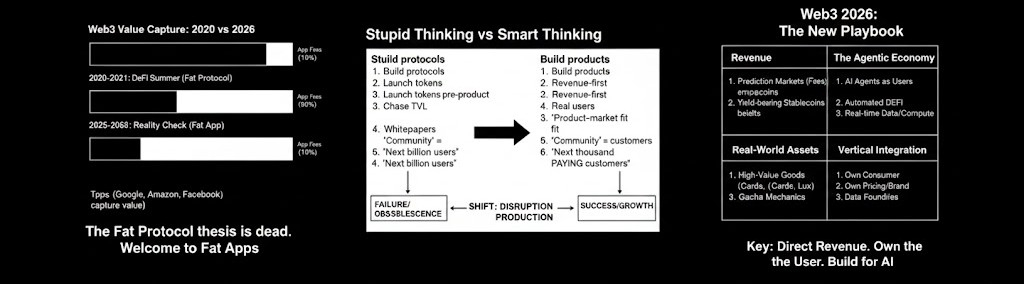
Stupid thinking in Web3 looks like this:
Building protocols because the infrastructure isn't there yet (it is)
Launching governance tokens before you have anything to govern
Optimizing for TVL instead of actual product usage
Believing that your whitepaper will convince anyone of anything
Thinking that community means people who speculate on your token
Stupid thinking says: We're building for the next billion users.
Genius thinking says: We're building for the next thousand paying customers, and here's exactly who they are and what they'll pay us.
The shift from stupid to genius thinking happens when you realize that Web3 in 2026 is not about disruption.
It's about production.
The infrastructure phase is over.
The let's rebuild everything on-chain phase is over.
What remains is the much harder, much more valuable work: Building products that generate revenue and solve problems people actually have.
The Evolution of Web3 Value Capture — A Historical Pattern
Let me show you something that changed how I think about this space entirely.
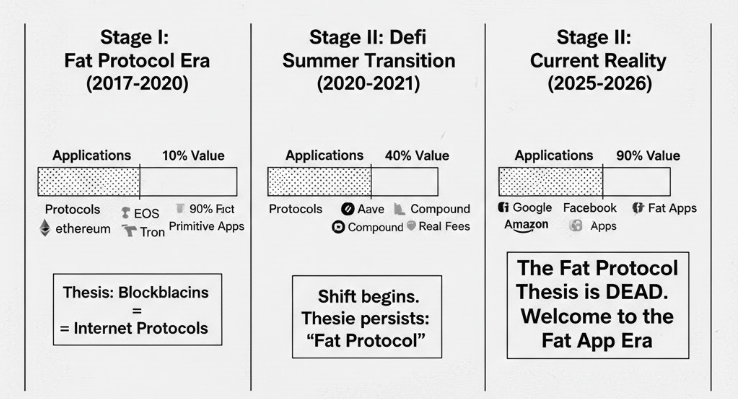
Stage I: The Fat Protocol Era (2017-2020)
Value accrued to Layer 1s. Ethereum, EOS, Tron - these were the winners.
Applications were primitive.
The thesis was simple: Blockchains would be like the internet - open protocols capturing massive value.
Stage II: The DeFi Summer Transition (2020-2021)
Value started shifting to applications.
Uniswap, Aave, Compound - these generated real fees, real usage, real revenue.
But investors still thought in terms of protocols.
The "Fat Protocol" thesis persisted even as evidence mounted against it.
Stage III: The Current Reality (2025-2026)
Applications now generate 90% of all fees.
Protocols capture less than 10%.
The Fat Protocol thesis is dead.
Welcome to the Fat App era.
This isn't just a market cycle thing. This is a fundamental evolution in how value works in digital economies.
The same pattern played out with the internet: protocols (TCP/IP, HTTP) captured almost no value, while applications (Google, Facebook, Amazon) captured everything.
We're watching the same movie play out in Web3, just on a compressed timeline.
The Four Dimensions of Web3 Product-Market Fit in 2026
Here's what actually matters when you're building now. Not "might matter" or "could matter" — what demonstrably, measurably matters based on what's working right now.
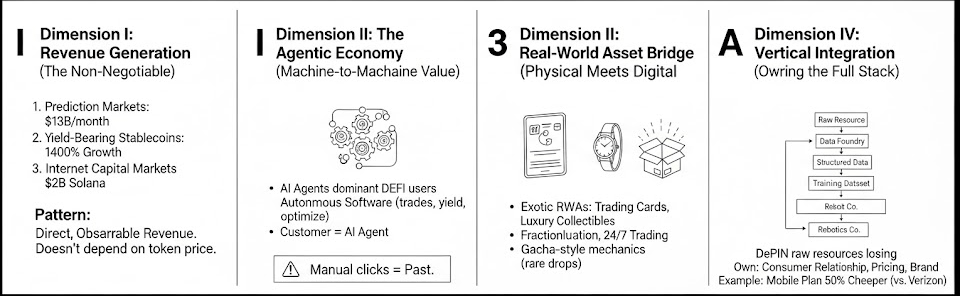
Dimension I: Revenue Generation (The Non-Negotiable)
Prediction markets crossed $13 billion in monthly volume by late 2025.
Why?
Because they generate revenue from every transaction.
Real revenue. Not TVL.
Not token price appreciation.
Actual fees that flow to the protocol and token holders.
2. Yield-bearing stablecoins grew 1400% in 2025.
Why?
Because they solve a real problem: Every dollar sitting in a wallet should be earning yield.
Users understand this instantly.
No education required.
3. Internet Capital Market launchpads on Solana are heading toward $2 billion market cap.
Why?
Because they direct capital to revenue-generating businesses, not just speculative memecoins.
Pattern recognition:
The winners all have direct, observable revenue that doesn't depend on the token price going up.
Dimension II: The Agentic Economy (Machine-to-Machine Value)
This is where things get interesting and where most founders are sleeping.
AI agents are becoming the dominant users of DeFi.
Not humans. Agents.
Autonomous software that executes trades, manages yield, optimizes portfolios, and pays for services instantly using protocols like x402.
Think about what this means: Your customer in 2026 might not be a person at all. It might be an AI agent that needs to rent GPU compute for 3 minutes, or buy real-time data for a trading decision, or optimize a yield strategy across 47 protocols simultaneously.
The agentic economy is not science fiction.
It's happening now.
And if your product requires a human to manually click buttons, you're building for the past.
Dimension III: Real-World Asset Bridge (Physical Meets Digital)
Exotic RWAs like trading cards, luxury collectibles, and physical goods with proven secondary markets are clearing $600 million in 2025.
Why?
Because people understand these assets.
They've been collecting Pokémon cards since they were kids.
Now those cards can be fractionalized, traded 24/7, and used as collateral for loans.
This is not about tokenizing Treasury bonds (boring, commoditized). This is about tokenizing high-value goods that people actually care about and creating new use cases that weren't possible before.
The founders winning here are using Gacha-style mechanics - randomized pack openings, rare drops, collection mechanics that tap into the same psychology that made physical collectibles a multi-billion dollar market.
Dimension IV: Vertical Integration (Owning the Full Stack)
DePIN projects that just sell raw resources (bandwidth, storage, compute) are losing to vertically integrated products that deliver finished consumer services.
Example: Don't sell me raw mobile data capacity. Sell me a mobile data plan that's 50% cheaper than Verizon because you're aggregating capacity from a decentralized network.
Own the consumer relationship.
Own the pricing.
Own the brand.
The same pattern holds across categories.
Decentralized data foundries that just collect dashcam footage for training sets are commodity businesses.
But a vertically integrated product that collects the data, cleans it, structures it, and delivers it as a finished training dataset to robotics companies - that's a real business with real margins.
We Missed Something Important (Why Fundraising Changed)
Here's what nobody told you when you started this fundraising journey:
The investor thesis shifted completely in late 2024, and most founders are still pitching like it's 2021.
Old thesis (Fat Protocol): We're building infrastructure that will be used by thousands of applications. Value will accrue to our L1/L2/protocol.
New thesis (Fat App): We have a product that generates $X in monthly revenue from Y users, growing at Z% month-over-month. Here's our unit economics. Here's our user acquisition cost. Here's our retention curve.
I've watched founders with revolutionary technology get passed over by investors who then funded much simpler products with proven revenue.
This isn't because investors are dumb.
It's because the market proved that applications capture value, not protocols.
Your fundraising strategy must reflect this reality:
Tokenomics 2.0 means showing explicit value capture mechanisms - buybacks, burns, fee-sharing. Not governance tokens with vague future utility.
The Show Me the Money Test means having an answer to: How do you make money in the next 6 months? If your answer involves your token going up in price, you fail.
Vertical Integration Proof means demonstrating you own the user relationship, not just a piece of infrastructure someone else monetizes.
(I promise this is relevant: Over 8 months of fundraising work, every successful raise, every single one - had these three elements. Every failed pitch was missing at least one.)
The Web3 Builder's Stack for 2026
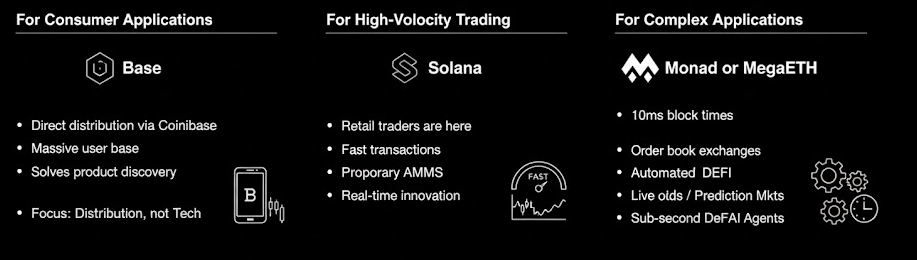
If I were starting today, here's exactly what I'd build and where:
For Consumer Applications: Base
Direct distribution through Coinbase's user base. This is not about technology - it's about distribution.
The best product that nobody can find is worthless. Base solves the distribution problem.
For High-Velocity Trading: Solana
Retail traders are on Solana. Period.
If your product involves fast transactions, proprietary AMMs, or retail-native innovation, this is your home.
For Complex Applications: Monad or MegaETH
If you need 10-millisecond block times for real-time applications - order book exchanges, prediction markets with live odds, DeFAI agents executing sub-second strategies - these high-performance chains enable products that are literally impossible elsewhere.
But here's the crucial part:
The chain matters much less than the product.
If your pitch starts with which blockchain you're on, you've already lost.
The Identity Shift: From Protocol Maximalist to Product Builder
This is where we get to the real shift - the one that happens inside you as a founder.
You have to stop identifying as someone who builds on blockchain and start identifying as someone who builds products that generate revenue for users and investors.
The difference is not semantic.
It's existential.
Protocol maximalists optimize for purity: decentralization, censorship resistance, trustlessness.
These are valuable properties. But they're not products.
They're product attributes.
Product builders optimize for value creation:
Does this save users money?
Make them money?
Save them time?
Give them capabilities they didn't have before?
When you make this shift, everything changes:
Your pitch deck focuses on revenue, not technology
Your roadmap prioritizes features users ask for, not protocol improvements
Your hiring focuses on distribution and sales, not just developers
Your metrics are user retention and revenue growth, not TVL and token price
This doesn't mean you abandon decentralization.
It means you recognize that decentralization is how you deliver superior value - faster, cheaper, more transparently, not the value itself.
What This Means for You Right Now
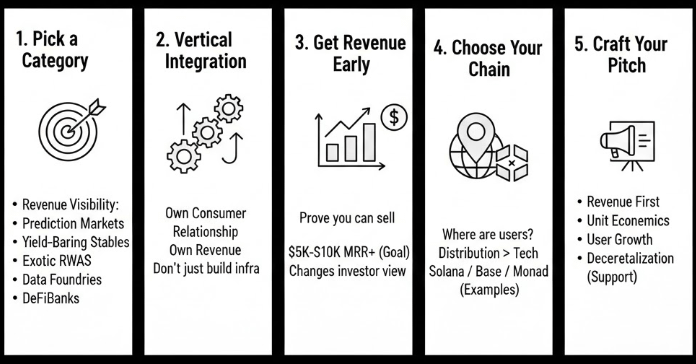
If you're building in 2026, here's your action framework:
First:
Pick a proven category with revenue visibility - prediction markets, yield-bearing stables, Internet Capital Markets, DeFAI infrastructure, exotic RWAs, data foundries, or DefiBanks.
These aren't the only options, but they're the ones with demonstrated product-market fit.
Second:
Build vertical integration into your model from day one.
Don't just provide infrastructure - own the consumer relationship and the revenue that comes with it.
Third:
Get revenue before you raise serious capital.
Even $5K-$10K monthly recurring revenue completely changes how investors see you.
It proves you can sell, not just build.
Fourth:
Choose your chain based on where your users are, not which chain has the best technology.
Distribution beats tech specs every single time.
Fifth:
Build your pitch around revenue, unit economics, and user growth.
Keep the decentralization benefits in there, but as supporting evidence, not the main thesis.
The Real Game
The real game in Web3 in 2026 is this: Can you build a product that generates revenue and improves lives while being measurably better because it's on-chain?
Not better in theory. Better in practice.
Better in ways users can feel immediately.
The founders who figure this out
Those who stop optimizing for decentralization and start optimizing for value creation will build the enduring applications that finally bring Web3 into the mainstream.
Everyone else will keep building infrastructure that nobody uses, raising governance tokens that govern nothing, and wondering why users choose Robinhood over their perfectly decentralized alternative.
The choice is yours.
The market has already decided which path leads to success.