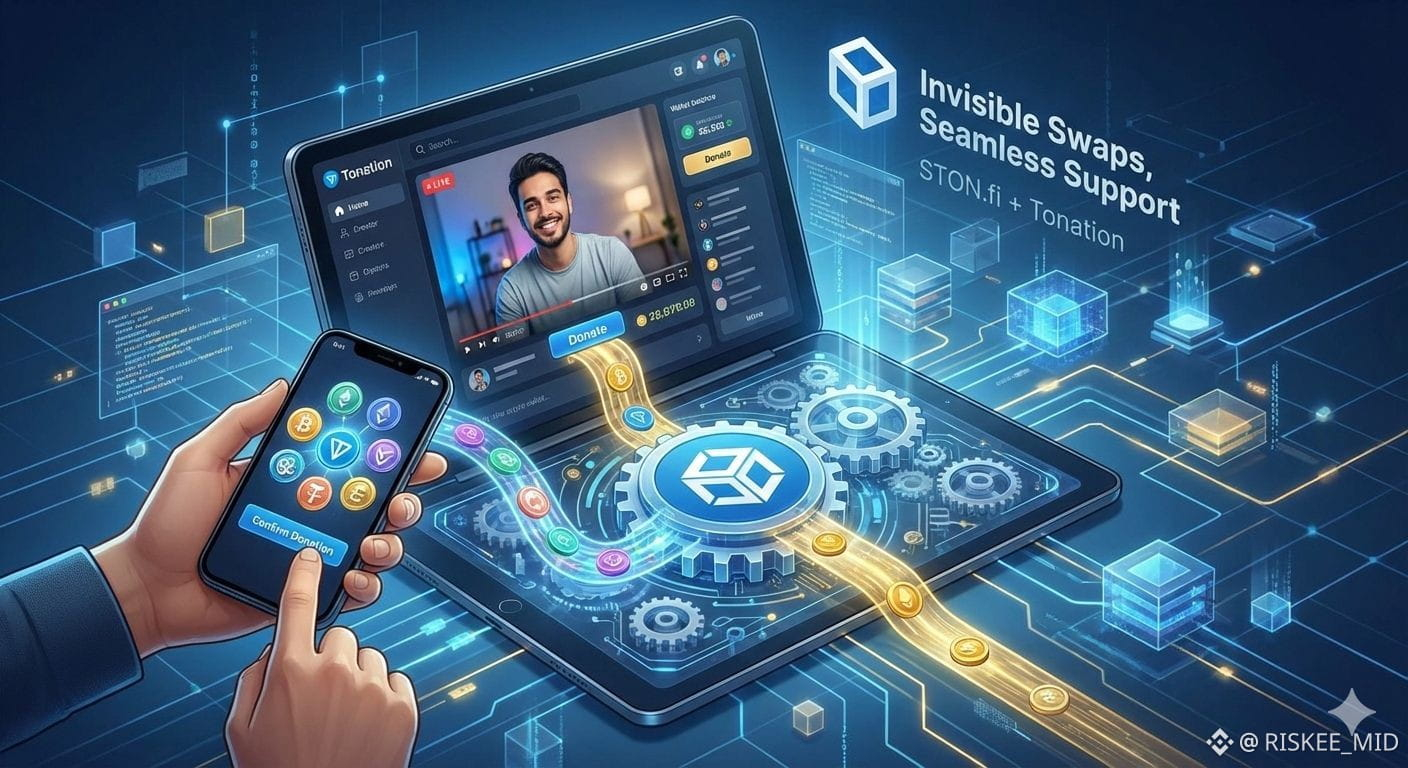
How STON.fi’s integration with Tonation makes swaps disappear
The recent integration between STON.fi and Tonation illustrates a pivotal shift in DeFi design: decentralized exchanges are no longer positioned as user destinations to be visited, but as invisible infrastructure embedded inside existing products. By turning token routing and execution into a background service, this integration removes a persistent friction point for stream viewers — and in doing so, demonstrates how on-chain activity can scale by becoming invisible.
From friction to flow: why donations fail (and how background swaps fix it)
One of the most common reasons crypto donations stall is conversion friction. Donors often hold a token the creator doesn’t want; the platform requires them to leave, find a DEX, perform a trade, and then return to donate. Each additional step introduces drop-off risk: lost attention, confusion, failed transactions, or simply a change of mind.
Embedding swap functionality directly into the donation flow changes the conversion funnel. Donors can give in whatever jetton they hold; the platform accepts it, and the recipient receives their preferred asset. For viewers this feels identical to a fiat donation flow — no mental context switch, no protocol hunting. The result is higher completion rates and more predictable revenue for creators.
The technical layer: routing as a utility
At the system level, STON.fi’s routing engine abstracts the hard parts of DeFi — price discovery, liquidity sourcing, slippage protection, and execution — away from users and application developers. Instead of surfacing order books, pools, or complex UX, the engine exposes a simple “accept this token, deliver that token” primitive to Tonation.
That architectural choice reframes DeFi components as rails rather than products. When routing and execution are reliable utilities, application teams can focus on user experience and content. Developers don’t need to become market-making experts; they embed a tested swap primitive and rely on it to handle liquidity fragmentation across on-chain venues. This is the same mental model that powered payment networks in Web2: developers expect a payment rail to just work, without showing the plumbing to end users.
Why this matters for TON adoption
For the TON ecosystem, the implications are strategic. Adoption is less about forcing users to learn new protocol names and more about integrating blockchain value into everyday activities. When creator platforms, games, and social apps include seamless token conversion, the blockchain becomes an incidental part of the experience — and that lowers the barrier for first-time users.
Seamless, embedded swaps drive organic on-chain growth: creators receive more consistent revenue, donors transact more often, and the network sees a higher volume of small, frequent interactions that compound into meaningful activity. That activity, importantly, occurs without asking users to prioritize the protocol over the content they came for.
Product and behavioral outcomes
When swapping is invisible, product metrics change in predictable ways:
Conversion improves: fewer abandoned donations because users no longer must leave the platform to swap.
Retention increases: creators who receive reliable payouts are likelier to keep using the platform.
Frequency rises: low-friction donations and micro-tips encourage repeated engagement.
Network effects strengthen: as more creators rely on the same rails, liquidity and utility consolidate, making the integrated swap experience even more robust.
These shifts all feed back into healthier platform dynamics: a better creator experience attracts higher-quality content, which attracts viewers who transact more often — a positive loop accelerated by invisible infrastructure.
Design considerations and risks
Making swaps invisible requires careful product and risk engineering. Important considerations include:
UX transparency: users should understand fees and expected delivery amounts without being exposed to raw market mechanics.
Slippage limits and protections: routing engines must enforce sensible bounds to avoid surprising creators or donors.
Settlement guarantees: creators need clarity about final settlement asset and timing.
Security and auditability: embedded swap providers must be reliable and auditable to preserve user trust.
When these elements are handled correctly, the benefits of an invisible swap layer outweigh the complexity it imposes on backend teams.
Conclusion
STON.fi’s work with Tonation is a concrete example of how DeFi can expand its reach not by asking for attention, but by integrating into existing experiences. By making swaps a utility — a behind-the-scenes rail that simply delivers value in the right token — developer teams can remove conversion friction, increase engagement, and help on-chain economies grow organically. For creators and platforms on TON, the lesson is clear: the most successful DeFi features will be the ones users never have to think about.