
Introduction
Since its inception in 2008, Bitcoin has evolved from a niche cryptographic experiment into a multi-trillion-dollar global asset. With a fixed maximum supply of 21 million coins and a programmed halving event every four years, Bitcoin operates under a monetary policy fundamentally different from fiat systems
As we look toward the next decade, a serious question emerges:
Is a $1,000,000 Bitcoin by 2037 realistic — or purely speculative?
To answer this, we must examine three structural pillars:
The halving cycle mechanism
Long-term technical growth models
Global macroeconomic dynamics
1. The Halving Cycle: Bitcoin’s Structural Engine
Bitcoin follows a consistent four-year cycle pattern:
2013 – First major cycle peak
2017 – Second cycle peak
2021 – Third cycle peak
2025/2026 – Expected fourth cycle peak
2029/2030 – Expected fifth cycle peak
2033/2034 – Expected sixth cycle peak
2037/2038 – Potential seventh cycle peak
Upcoming halving events:
2028
2032
2036
By 2036, block rewards will fall to approximately 0.39 BTC per block. By 2037, Bitcoin will enter what could be its most restrictive supply phase in history
Historically, 12–18 months after each halving, Bitcoin enters an expansionary bull phase driven by supply shock and renewed demand
2. Diminishing Returns & Logarithmic Growth Structure
Bitcoin has shown a clear pattern of diminishing returns:
2013 → 100x+
2017 → ~20x
2021 → ~6–7x
2025/2026 → Estimated 2–4x
2029–2030 → 1.5–3x
2033–2034 → 1.5–2x
If the 2033–2034 cycle peaks between $400,000 and $600,000, a conservative 1.5–2x expansion in the next cycle would mathematically place Bitcoin in the $800,000 to $1,000,000 range during the 2037–2038 peak
This aligns with Bitcoin’s long-term logarithmic growth curve and power-law modeling, suggesting structural continuation rather than speculative anomaly
3. Macro Economics: The Decade of Monetary Stress
A. Sovereign Debt & Monetary Expansion
Global sovereign debt continues to rise at historically unprecedented levels. The typical resolution mechanisms include:
Currency debasement
Inflationary policies
Quantitative easing
Liquidity injections
If the 2030s see renewed monetary expansion cycles, scarce digital assets like Bitcoin may appreciate significantly relative to fiat currencies
Importantly, Bitcoin does not need to become more valuable in absolute terms — fiat may simply become less valuable.
B. Gold Parity Comparison
The global gold market capitalization stands around $13–15 trillion
If $BTC reaches valuation parity with gold, its price per coin approaches $1 million
Given the growing narrative of Bitcoin as “digital gold,” partial or full parity by 2037 is within the realm of structural possibility.
C. Institutional and Sovereign Allocation
If sovereign wealth funds, pension funds, or central banks allocate even 1–3% of reserves into Bitcoin, demand could structurally push market capitalization toward $15–25 trillion.
At that scale, a $1 million Bitcoin becomes mathematically plausible.
4. Supply Structure in 2037
By 2037:
Over 95% of total supply will have been mined
Block issuance will be minimal
Miner sell pressure significantly reduced
A substantial portion of coins likely permanently lost
This shifts price discovery almost entirely to demand-side forces.
Bitcoin transitions from a growth asset driven by issuance to a scarcity-driven macro asset.
5. Scenario Modeling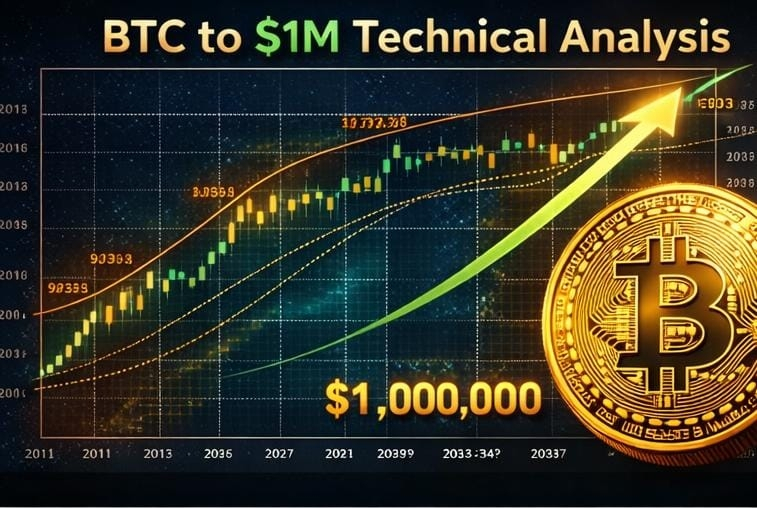
Bullish Scenario
Global liquidity expansion
Persistent fiat debasement
Institutional and sovereign adoption
Bitcoin solidifies status as digital reserve asset
Target Range: $800,000–$1.2 million during cycle peak
Moderate Scenario
Stable regulation
Gradual adoption
Neutral macro environment
Target Range: $400,000–$700,000
Bearish Scenario
Aggressive global regulation
Deflationary macro environment
Technological displacement
Target Range: Below $300,000
Conclusion
A $1,000,000 Bitcoin by 2037 is not guaranteed — but neither is it irrational.
If:
Halving cycles continue to function structurally
Global liquidity expands
Bitcoin retains dominance as the primary decentralized store of value
No systemic global prohibition occurs
Then $1 million may represent a cyclical peak valuation rather than a permanent equilibrium price
In long-term macro perspective, the question is less about whether Bitcoin can reach $1 million — and more about what the purchasing power of fiat currencies will represent by 2037