$FOGO: A Deep Dive Into Speed, Finality & Latency on the Fastest SVM Layer-1
FOGO isn’t just another blockchain token — it’s the native asset of a Layer-1 network engineered specifically for ultra-fast practical execution, especially in high-frequency finance. Its core selling point is blunt: real-time on-chain performance that rivals centralized systems — but on a decentralized ledger.
40 Milliseconds That Feel Immediate
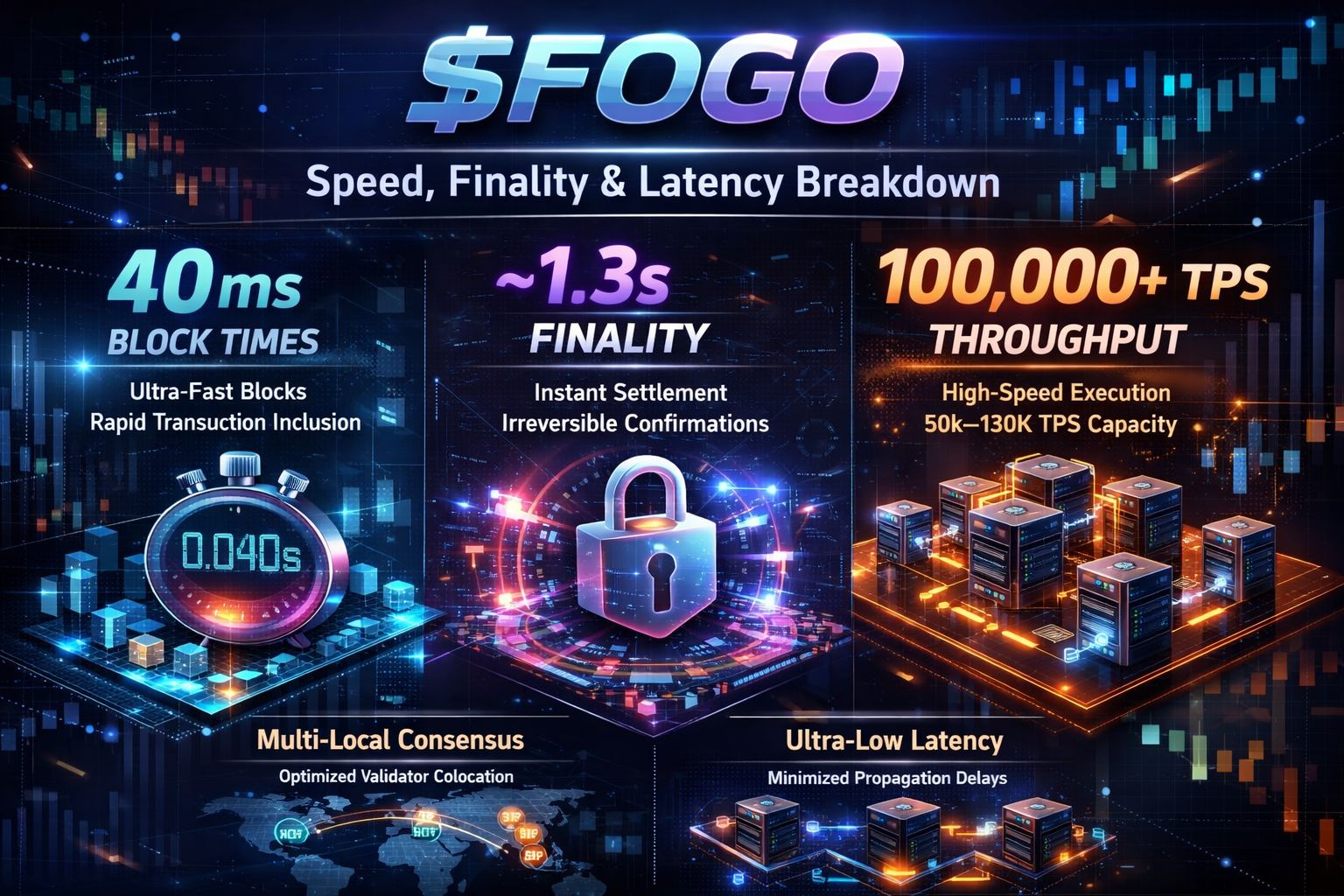
At the heart of FOGO’s performance claim is an aggressive block time target of around 40 milliseconds. That’s orders of magnitude faster than most Layer-1s today — for comparison, Ethereum often settles blocks every ~12 seconds, and even Solana is measured in hundreds of milliseconds.
In blockchain terms, block time is how long it takes for the network to produce and propagate a new block of transactions. Lower block time typically means:
Faster transaction inclusion
Lower median latency for confirmation
Greater responsiveness for applications that depend on state updates
FOGO hits this by standardizing on a single, highly optimized validator client and optimizing networking between validators — more on that next.
In practice, 40 ms block times feel “instant” — the time it takes for a trader to place an order and see it officially execute on chain — which is a major advantage for on-chain trading models, centralized limit order books (CLOBs), and arbitrage strategies.
Making It Count in ~1.3 Seconds
One thing developers and traders care a lot about is finality — not just that a transaction is included in a block, but that it’s irreversible and not subject to forks or rollbacks.
FOGO claims ~1.3 seconds to finality — meaning a transaction is considered fully settle and immutable very quickly.
By contrast:
Many Layer-1 networks have probabilistic finality (requiring more blocks before you can be confident), often measured in seconds or minutes.
Even Solana — despite fast block times — often has finality in the ~12 seconds range in real operating conditions.
FOGO’s faster finality stems from a consensus design that merges locally optimized voting with rapid block production. Treating finality as a design goal — and engineering the consensus to enable it — matters especially in finance where delays impact risk calculations, settlement guarantees, and automated risk management systems.
Throughput & Transactions Per Second (TPS)
Blockchains often talk about TPS as a headline number, but it has two different flavors:
Theoretical TPS — max measured in controlled tests.
Real-world TPS — measured on the live network during actual usage.
FOGO’s design — optimized transactions, rapid blocks, and parallel execution — pushes throughput into the tens of thousands of TPS realm, and in controlled testnets it even crossed 50 k–100 k TPS peaks.
Real-time performance dashboards and testnet data show ~100,000 TPS burst capacity, with sustained real-world TPS lower but still impressive given load variability.
A quick intuition: More TPS at lower latencies means the network isn’t just fast in theory — it can support many users and complex DeFi interactions without clogging. That’s foundational for building exchanges, lending markets, derivatives, and even gaming sessions where every millisecond counts.
Architectural Choices That Power the Numbers
The raw numbers are impressive, but getting there requires design choices that depart from typical decentralized approaches.
Firedancer First
FOGO runs on Firedancer — a high-performance validator client originally developed for Solana but optimized further here. Unlike ecosystems that support multiple implementations (which increases resilience but can slow synchronization), FOGO standardizes on this one ultra-optimized client.
Firedancer is implemented in lower-level system languages with performance in mind. This results in:
Lower networking and compute overhead
Faster transaction verification and block assembly
Better utilization of modern hardware
This is a big part of why FOGO sustains its claimed TPS and latency levels — the engine really matters.
Validator Colocation & Multi-Local Consensus
Instead of fully decentralized validator nodes scattered globally, FOGO initially runs its primary validating infrastructure in co-located data centers in strategic regions. This reduces signal travel time — literally shortening the physical distance that data must move.
They also use a multi-local consensus design:
Validators in geography-specific “zones” reach rapid local consensus.
Blocks and votes are then stitched into a global layer to finalize the chain.
This hybrid architecture strikes for ultra-fast local confirmation while still maintaining global security — at the cost of some early decentralization (as the validator set is curated and data centers are strategic).
It’s similar to how financial exchanges put trading engines and matching engines in colocated server racks to eliminate latency.
The Hidden King in On-Chain Performance
Latency — the delay between when a transaction is issued and when it’s confirmed — is often overlooked when chains boast TPS numbers. But for trading, arbitrage, and fast settlement, latency is everything.
Latency impacts:
Order execution timing
Arbitrage profitability
Front-running and MEV exposure
Liquidation accuracy
FOGO seeks low latency by:
Physical proximity of validators
Network optimizations minimizing propagation delays
Single validator client to reduce coordination overhead
Together these reduce the “latency tax” that slows transaction flows and often costs traders money in volatile markets.
How FOGO Compares with Other High-Performance Chains
FOGO’s goals place it in direct competition with other fast Layer-1s like Solana, but there are meaningful distinctions:
Solana: Fast but broader ecosystem; more distributed validators; typically slower blocks and finality.
FOGO: Focused on real-time execution first, with aggressive optimization choices tuned for finance-centric latency and finality.
Where chains like Solana optimize for general-purpose scalability with a large ecosystem, FOGO is engineered for predictable, ultra-low latency and execution fairness — making it a finance-first Layer-1 in practice, not just in intention.
Trade-offs & What It Means Practically
High performance doesn’t come for free:
Validator decentralization starts limited, which can raise questions about censorship resistance and resilience.
Mainnet and ecosystem maturity still early, meaning real-world stress tests at scale are yet to be fully proven.
Real throughput under economic load (when many DeFi projects are live) may differ from testnets or benchmarks.
Despite that, the architectural focus is clear: deliver real-time performance that feels as close as possible to centralized systems — but on decentralized rails.
Why FOGO’s Speed, Finality & Latency Matter
These aren’t just numbers. They enable capabilities that haven’t been feasible at scale on previous Layer-1s:
Order-book based DeFi that can handle milliseconds-level execution
Automated arbitrage strategies on chain
Liquidations with predictable timing
Institution-grade settlement guarantees
Where earlier blockchains were about high throughput without guaranteed finality speed, FOGO’s architecture flips that: fast, reliable, and predictable execution with meaningful finality guarantees. That’s a meaningful shift in how on-chain finance might operate.
Looking Forward
FOGO’s early performance metrics are impressive, but as with all cutting-edge systems, the long game depends on:
Ecosystem adoption
Resilience under stress
Real-world DeFi liquidity
Community trust and decentralization evolution
In the meantime, for traders and developers focused on execution-sensitive applications, FOGO represents a significant evolution in blockchain performance design.