
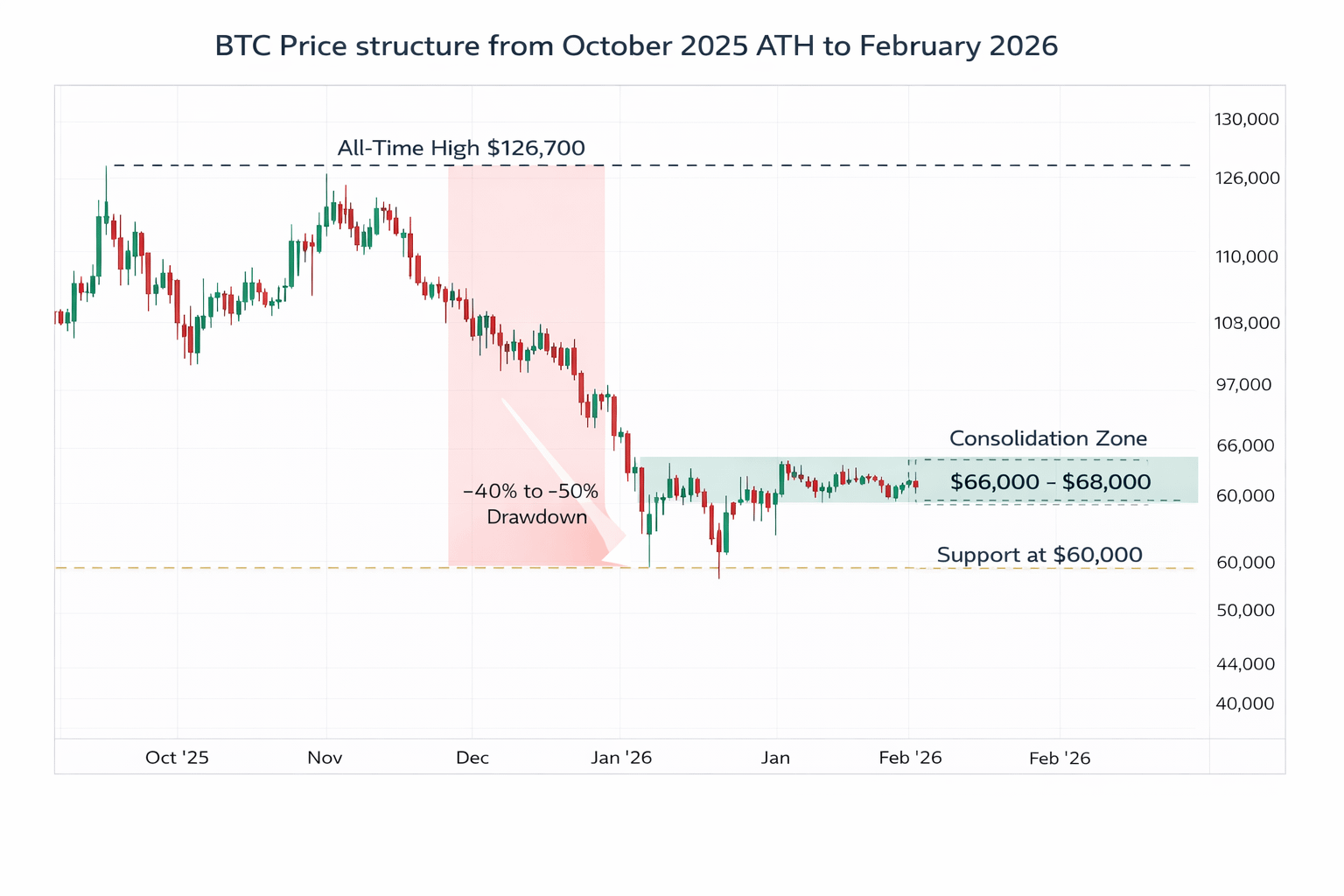
Bitcoin, the first and most established cryptocurrency, is once again experiencing significant price volatility in 2026. After reaching an all-time high above $126,000 in October 2025, the asset entered a sustained correction beginning in January 2026. By early February, prices had fallen to nearly $60,000, before stabilizing around $66,000–$68,000 in mid-February. This represents a decline of approximately 40–50% from the peak.
While such movements may appear dramatic, they are not unusual within Bitcoin’s historical behavior. Understanding the structural causes behind this correction is essential, particularly for individuals who rely on Bitcoin not only as an investment but also as a tool for remittances, savings, or cross-border transactions.
This article examines the key drivers of the 2026 decline, places it within historical context, and outlines practical considerations for navigating volatile markets.
1. Structural Drivers of the 2026 Decline
Bitcoin’s price is shaped by an interaction of macroeconomic conditions, investor behavior, and internal market mechanics. The correction that began in January 2026 reflects a combination of these forces rather than a single triggering event.
Post-Rally Profit Taking
Following the strong rally of 2025, many institutional and early investors began locking in gains at the start of 2026. After rapid appreciation, markets typically undergo periods of consolidation or retracement. The January decline can therefore be understood partly as a natural correction after an extended bull cycle.
Macroeconomic Uncertainty
Global financial markets in early 2026 faced renewed uncertainty. Shifts in expectations regarding U.S. monetary policy, concerns about economic growth, and volatility in equity markets contributed to broader risk aversion. Bitcoin, increasingly correlated with other risk assets, reacted accordingly.
When investors reduce exposure to risk, highly volatile assets such as Bitcoin often experience amplified downside pressure.
Leverage and Liquidations
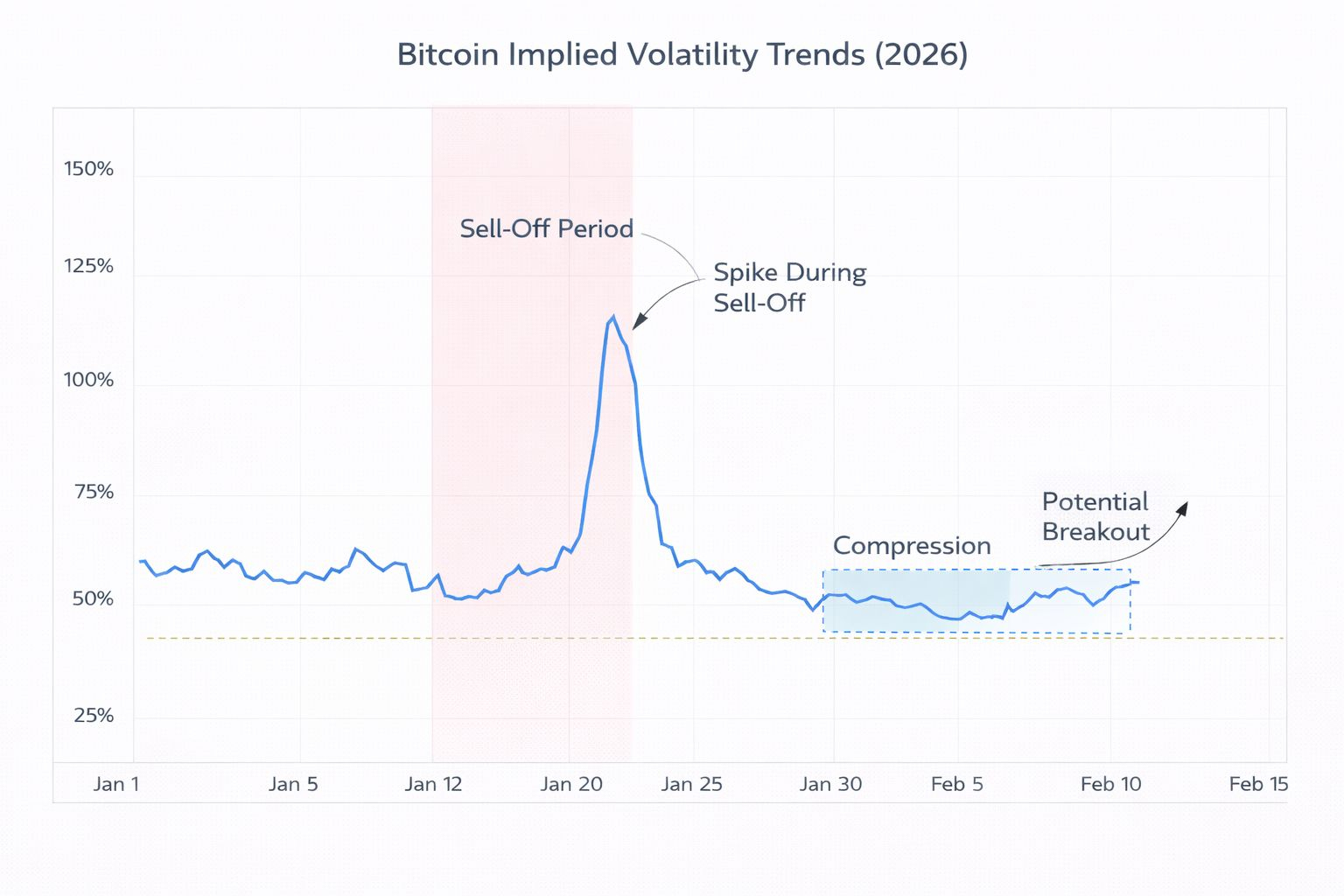
The expansion of derivatives markets has increased the role of leverage in crypto trading. As Bitcoin declined in January and early February, leveraged positions were liquidated, accelerating selling pressure. This mechanical unwinding contributed to the rapid move toward the $60,000 range.
Such episodes are characteristic of modern crypto markets, where leverage can intensify both upward and downward movements.
Reduced Market Liquidity
Compared with the peak of late 2025, market liquidity in early 2026 appears thinner. Lower liquidity means fewer buy orders at key price levels, allowing moderate sell-offs to generate disproportionately large price swings.
Together, these elements, profit taking, macro uncertainty, leverage unwinding, and reduced liquidity help explain the magnitude of the current correction.
2. Current Market Position: February 2026
As of mid-February 2026:
Bitcoin trades near $66,000–$68,000
Year-to-date performance remains negative
The asset is roughly 45–50% below its October 2025 peak
After touching nearly $60,000 in early February, Bitcoin rebounded toward $70,000 before consolidating in the mid-$60,000 range. This stabilization phase suggests the market is attempting to establish a new equilibrium following the initial wave of selling.
Support levels near $60,000 are being closely observed by market participants. A sustained break below that level could lead to further downside, while successful consolidation may strengthen the foundation for gradual recovery.
3. Historical Context: Volatility as a Recurring Pattern
Bitcoin’s history is marked by pronounced boom-and-bust cycles. Corrections of 40–70% have occurred multiple times over the past decade, often following periods of rapid expansion.
During the 2021–2022 bear market, Bitcoin declined by more than 70% before eventually recovering. Similarly, previous bull cycles have been followed by substantial retracements before new highs were achieved.
The current 2025–2026 correction aligns with this historical pattern. While each cycle differs in its catalysts, the magnitude of the drawdown is consistent with Bitcoin’s long-term volatility profile.
Importantly, over extended time horizons, Bitcoin’s overall trajectory has remained upward despite intermittent severe corrections.
4. Strategic Considerations in a Volatile Environment
Volatility can generate uncertainty, but structured approaches can reduce emotional decision-making.
Dollar-Cost Averaging (DCA)
Investing fixed amounts at regular intervals reduces exposure to short-term price fluctuations. This method emphasizes discipline over timing and has historically benefited long-term participants.
Risk Management and Diversification
Allocating capital across different asset types —including stable instruments can moderate overall portfolio volatility. Concentrated exposure increases sensitivity to large price swings.
Avoiding Emotional Reactions
Sharp declines often trigger fear-driven selling. However, history suggests that impulsive exits during corrections may crystallize losses that would otherwise recover over time.
Education and Long-Term Perspective
Understanding the structural drivers of volatility rather than reacting to headlines allows investors and users to make informed decisions aligned with their financial objectives.
5. Broader Implications for Global Users
In many emerging markets, Bitcoin serves practical purposes beyond speculation. It facilitates remittances, offers an alternative store of value, and provides access to global financial infrastructure.
For everyday users volatility does not eliminate utility. Instead, it underscores the importance of risk awareness and prudent financial planning.
As adoption increases and markets mature, volatility patterns may evolve. However, fluctuations remain intrinsic to Bitcoin’s decentralized and supply-constrained design.
6. Conclusion
The decline in Bitcoin’s price since January 2026 reflects a multifaceted adjustment following the strong rally of 2025. Profit taking, macroeconomic uncertainty, leverage dynamics, and liquidity conditions have collectively shaped the current market environment.
While a 40–50% correction appears severe, it is consistent with Bitcoin’s historical cycles. Volatility should therefore be viewed not as structural failure, but as a defining characteristic of a rapidly evolving financial asset.
Navigating such environments requires discipline, informed analysis, and a long-term perspective.