
Robotics is drowning in data these days. Autonomous vehicles, warehouse bots, drones all churning out endless streams: telemetry, sensor readings, environmental stats, performance logs. Yet most of these machines stash their records in tightly controlled, centralized silos. It’s a glaring problem. Robot-generated data holds huge value, but right now, it’s mostly inaccessible, hard to verify, and nearly impossible to trade between organizations. Fabric Protocol flips the script. Rather than treating this info as ordinary robot logs, it sees each dataset as a verifiable digital asset, ready to flow through decentralized networks.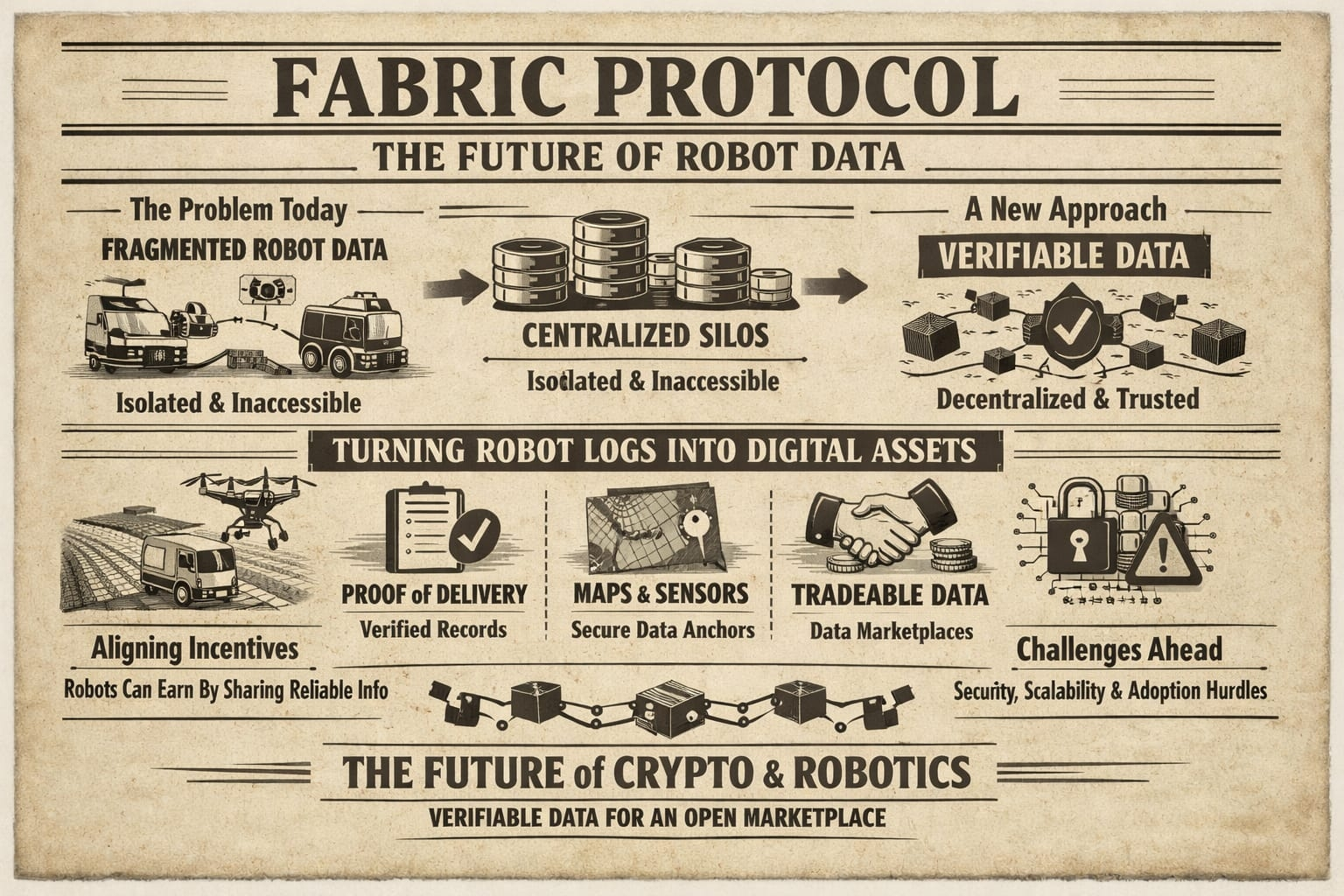
Fragmented Robot Data: The Structural Problem
Robots operate in the real world, but their data is a mess scattered and locked away. Picture a delivery robot logging thousands of routes, navigating obstacles, tracking weather. All these details get trapped inside corporate databases. Other networks, even those with a legitimate need for that info, have no way to check what really happened or detect tampering.
Economically, this just doesn’t make sense. Robot data drives logistics, supercharges machine learning, shapes forecasts. But there’s no neutral ground to value it, trade it, or verify it. If outsiders can’t trust the data, they simply don’t use it.
Fabric Protocol’s answer is to treat this as a missing infrastructure layer not just another robotics hurdle.
Verifiable Data: Turning Robot Logs into Economic Primitives
Here’s where Fabric comes in. It brings a decentralized platform for recording and confirming robot actions. Instead of keeping logs hidden, machines can publish cryptographic proofs digital receipts showing, “I made this delivery, mapped this environment,I scanned these assets.”
Crucially, the data doesn’t need to live entirely on chain to be trusted. Fabric anchors cryptographic commitments to off chain datasets. That keeps blockchains fast and uncluttered, but preserves the data’s verifiability.
Suddenly, robot operations become something you can reference, audit, and trade. Logistics firms, insurers, data marketplaces they can check the authenticity of a dataset before plugging it into their systems.
Aligning Incentives for Autonomous Machines
Now that data is verifiable, robot operators have fresh motivations. Traditionally, robots gather info for their own companies. Fabric opens the door to data marketplaces, where proven datasets have real, tradable value.
Think warehouse maps, used to train navigation software for multiple players. Or agricultural drones feeding verified environmental readings to predictive crop models. If data is proven genuine, it becomes a digital commodity that anyone can buy or sell.
This trend fits right into the broader shift in crypto, where data and computation are moving towards open markets. Shared GPU power, distributed storage, and now robot generated data Fabric is expanding Web3’s economy.
Risks and Technical Limits
Of course, the road isn’t smooth. Accuracy relies on the robot’s hardware. If someone tampers with sensors, cryptographic proofs can’t rescue the data. So, hardware attestation and secure modules are essential.
And scalability is no joke. Large fleets crank out staggering amounts of data indexing, compressing, and storing it off chain takes serious engineering. If verification costs too much, people just won’t bother.
Adoption is another obstacle. Robot manufacturers and operators need convincing reasons to switch to decentralized identity and verification. That’s a tough sell.
Implications for Crypto Infrastructure
Fabric Protocol represents a bigger shift in blockchain, moving beyond finance to solve real world data coordination. As robotics extends into logistics, manufacturing, and monitoring, the need for reliable, machine produced data keeps growing.
What’s the bottom line? Blockchains don’t have to store everything. Their real power lies in verifying where data came from and whether it’s authentic. For anyone watching the convergence of AI, robotics, and crypto, verifiable machine data marks a new frontier. That’s Fabric’s target.