
One night, I sat watching a cluster of agents lining up to sign transactions, and I understood why Fabric Protocol touches the very core of this story. When robots begin to read data on their own, choose actions on their own, and directly interact with assets, what is missing most is no longer speed, but an onchain identity clear enough, and a wallet private enough, for the network to know who is doing what.
I have lived through 3 market cycles long enough to understand that the market always prefers the performance over the foundation. But with Fabric Protocol, it would be a mistake to see it merely as a utility layer for robots. The problem this project pushes forward is not about making machines look smarter, but about forcing the system to answer an uncomfortable question. When a robot signs a transaction, pays fees, holds assets, or interacts with another protocol, is it simply an extension of a human hand, or is it an actor with its own boundary of responsibility.
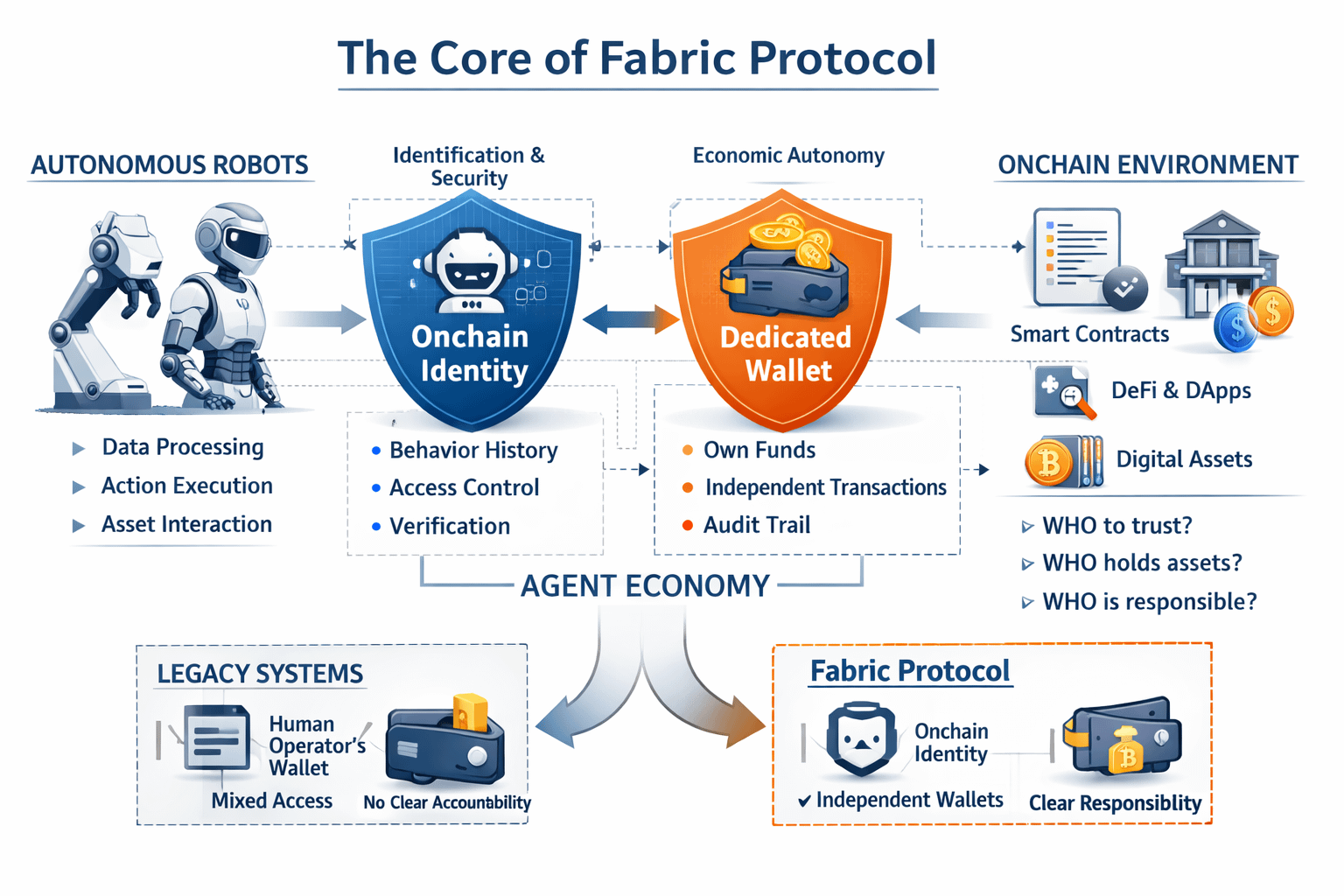
What made me pause the longest with Fabric Protocol is the way the project places onchain identity at the center. Identity here is not a label stuck onto an automation product. It is the place where behavioral history, access rights, trust level, and traceability come together when something goes wrong. Out of 10 automated systems I have examined very closely, 9 were only operational layers temporarily attached to the wallet of the human operator. They could run very fast, but when an error happened, almost no one could clearly separate whether the fault came from the person issuing the command, the code, or the machine agent itself.
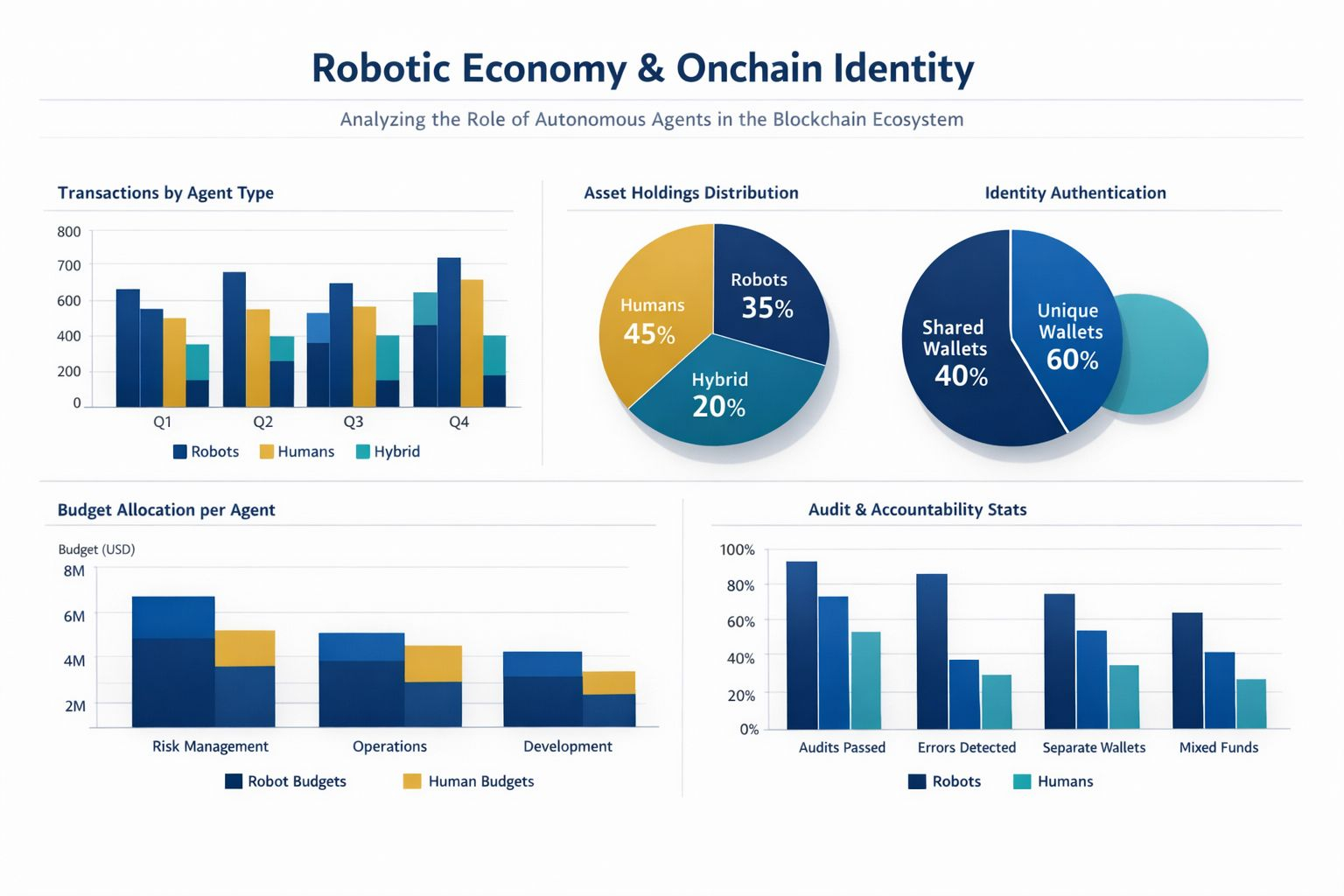
That is why the wallet layer is the slice I value most in Fabric Protocol. A robot without its own wallet does not yet have its own economic agency. It is only spending on behalf of someone else. It sounds like a small difference, but onchain that is the line between a demo model and one that can actually live in the real world. Only when a robot has its own wallet can we really talk about budgets assigned per agent, risk limits defined per task, transaction history that is not mixed together, and auditability clean enough to scale into machine to machine relationships.
Identity is not decoration for machines, it is where responsibility begins.
That is the anchor that made me read Fabric Protocol in a completely different way. This project is not promising a glossy future where robots are free to do everything, but instead brings back an old question: if a robot appears onchain as an actor, how should it be seen, constrained, and held accountable. Ironically, the ecosystem talks a lot about the agent economy, yet far too little about the identity and wallet of the agent. Everyone wants to tell the story of productivity, while the foundation of authority and responsibility is usually left aside until a real incident happens.
I am not romanticizing this project either. Projects that work at the core are often right too early, right in ways that are hard to explain, and because of that, they are usually treated rather coldly by the market. They do not create the kind of excitement that makes the crowd cheer immediately. Builders have to be patient with infrastructure that few people want to study carefully. Investors have to tolerate the feeling of holding a thesis that may be right, but is not yet priced in by the majority. Perhaps the biggest challenge for Fabric Protocol lies exactly there. If it cannot build language clear enough for people to understand why robots need onchain identity and their own wallets, it can very easily be glanced over as just another secondary piece.
But going straight to the topic you gave, I think Fabric Protocol truly steps into the deepest core at the exact moment robots begin to be seen as economic actors rather than mere tools. Without onchain identity, the network does not know who it is trusting. Without a private wallet, the network does not know who it is assigning responsibility to. Only when those two layers align does the robot stop being a technical shadow standing behind a human wallet. And if Fabric Protocol follows that argument all the way through, can we really keep seeing robots as mere tools anymore.