
Fabric Protocol: Blueprint for the Machine Econom
As we navigate the complexities of 2026, the global economy is undergoing its most significant transformation since the Industrial Revolution. We have moved beyond humans simply using AI; we are now witnessing the birth of a "Robot Economy" where autonomous agents act as independent economic actors. At the heart of this shift lies the Fabric Protocol, a decentralized open network backed by the non-profit Fabric Foundation. It serves as the essential connective tissue—the economic layer—that allows machines to interact, trade, and verify their existence without a human intermediary
The Foundation of Autonomy: Breaking the Silos
For years, the robotics and AI industries were trapped within "walled gardens." A robot built by one corporation couldn't easily communicate or transact with hardware from another because they were locked in proprietary, private APIs. The Fabric Protocol shatters these silos by providing a standardized, open-source framework.
1. On-Chain Identity (Self-Sovereign Machines)
In the Fabric ecosystem, every robot and AI agent is granted a Unique Digital Identity (UDI). This isn't just a serial number; it is a self-sovereign on-chain identity linked to a crypto wallet. This allows a machine to "own" its reputation, its data, and its earnings. For the first time, a delivery drone or a smart grid sensor can act as a legal and economic entity in the digital realm.
2. Machine-to-Machine (M2M) Payments
The true power of the protocol is realized through the native $ROBO token. In a world of micro-services, the Fabric Protocol enables instant, frictionless M2M payments. Imagine an autonomous delivery drone that realizes its battery is low. It can autonomously negotiate a price and pay an independent charging station to refuel. No human intervention, no credit card processing fees—just pure, programmatic value exchange.
3. Proof of Robotic Work (PoRW)
Trust is the biggest hurdle in automation. Fabric introduces Proof of Robotic Work, a specialized consensus mechanism. It ensures that funds are only released from a smart contract once the network verifies that a physical or digital task—such as a delivered package or a completed data analysis—has actually been performed.
The ROBO Reward System: Incentivizing Value
To ensure the network grows healthily, the Fabric Foundation has moved away from the "participation trophies" of early crypto projects. Instead, they use Hybrid Graph Value (HGV) to anchor their meritocratic reward system.
Merit-Based Emissions
Under the HGV model, rewards are not distributed based on how long a machine has been "online," but rather on the verified economic value it contributes to the network. If a robot performs a high-utility task that a user or another machine pays for, its HGV score rises. This high score triggers higher $ROBO emissions.
"By tying rewards to real-world utility, we ensure the 10-billion token supply isn't wasted on 'bot-farming,' but is used to fuel a legitimate marketplace of autonomous labor." — Fabric Foundation Principle
The Path to 2027: Migration to Layer 1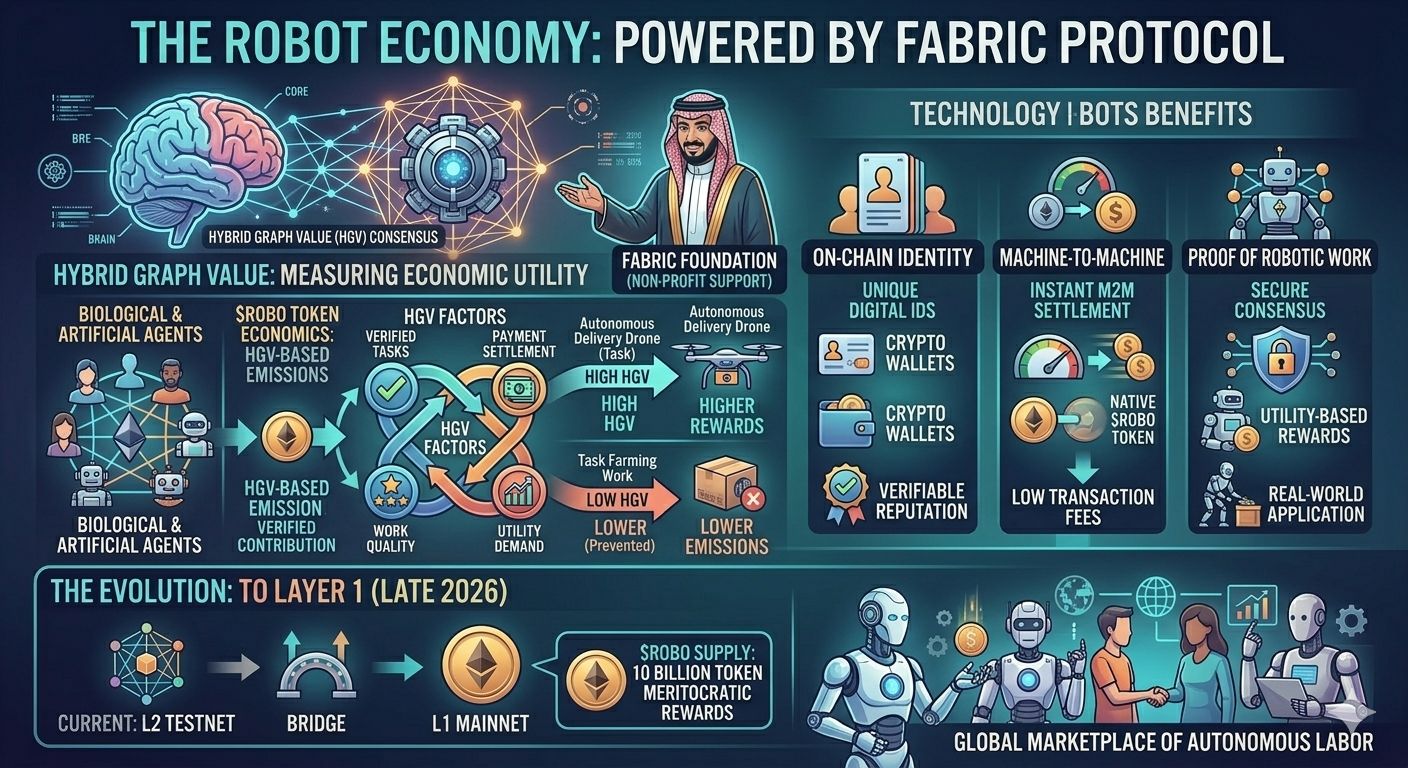
As the protocol prepares to migrate to its own dedicated Layer 1 blockchain in late 2026, the vision is clear: to create a self-sustaining, global marketplace where autonomous labor is accessible to everyone. By providing the tools for identity, payment, and verification, Fabric isn't just building a network; it is building the infrastructure for the next century of commerce.