I will admit something honestly. When I first came across Fabric Protocol my immediate reaction was skeptical. In the crypto and emerging technology space new projects appear constantly and each claims to reshape the future in some way. At first glance Fabric looked like it might be just another protocol trying to attach itself to big ideas like robotics and AI.
But after spending more time reading about it and trying to understand the reasoning behind it my perspective slowly changed. The deeper story here is not really about hype or trends. It is about a quiet but serious thought that does not get discussed enough. What kind of infrastructure will exist when machines start acting independently in the real world.
Machines are already entering our daily environment. Robots move products through warehouses. Automated systems manage parts of manufacturing. Delivery robots are slowly appearing in cities. Artificial intelligence systems assist in decision making across industries.
But here is the strange part.
While the machines themselves are improving rapidly the systems around them are still incomplete.
We have built the tools.
What we have not fully built yet is the structure that governs how those tools interact with each other and with society.
And this is where Fabric Protocol becomes interesting.
The idea behind Fabric begins with a simple observation. Most robots today operate inside closed environments. A company builds a robot installs its own software and keeps everything under its control. That works well inside a factory or a private warehouse.
But imagine robots from different companies operating in the same environment. Imagine machines interacting with public infrastructure shared spaces or services provided by other organizations.
Things become messy very quickly.
Think about a simple scenario. A delivery robot is navigating a busy street. It avoids pedestrians follows navigation instructions and transports a package. Now imagine something unexpected happens. Maybe the robot malfunctions or causes an accident.
Then a practical issue appears.
Responsibility becomes unclear.
Is the developer responsible.
Is the company responsible.
Is the hardware manufacturer responsible.
These are real questions that society will need to deal with as automation expands.
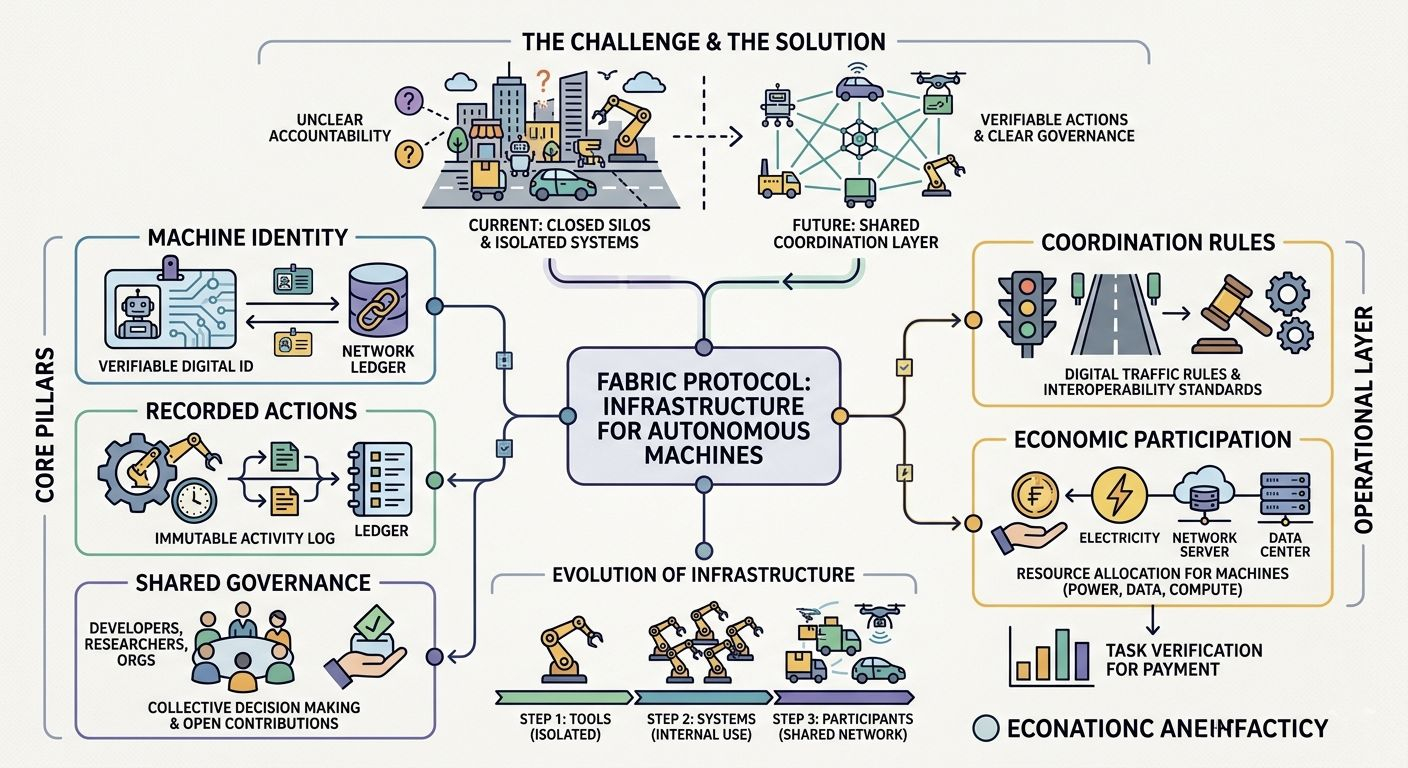
Fabric Protocol tries to address this gap by focusing not on the robots themselves but on the systems that surround them. The project proposes a shared coordination layer where machines can have verifiable digital identities and where their actions can be recorded in a transparent way.
In simpler terms robots would not operate in isolated systems controlled by individual companies. Their activities could exist within a network where actions are recorded and verifiable.
When I first encountered this idea it reminded me of something from everyday life.
Think about traffic rules.
Cities have thousands of vehicles from different manufacturers and owned by different people. Yet they move through the same roads without constant chaos. The reason is simple. Shared rules exist. Traffic lights lanes signals and legal frameworks create a system that allows everyone to operate safely within the same environment.
Fabric Protocol is trying to create something similar for machines.
Not traffic lights and road signs but digital rules and coordination systems that allow different machines to operate within the same ecosystem without confusion or conflict.
This analogy helped me understand the project much better.
Without traffic rules roads would be dangerous.
Without coordination rules for machines future automated systems could become equally chaotic.
One of the key ideas in Fabric design is machine identity. Each robot or autonomous system connected to the network can have a digital identity that allows its actions to be authenticated. If a machine performs a task such as moving goods processing data or completing a delivery that action can be logged and verified within the network.
This may sound technical but the reasoning behind it is practical. Trust becomes difficult when autonomous systems are involved. Humans trust institutions partly because responsibilities can be traced. Machines complicate that structure because they simply execute decisions without explanation.
The real challenge therefore becomes clear.
How do we verify what a machine actually did.
Fabric approach is to build systems where machine actions are recorded in ways that are transparent and difficult to manipulate. The goal is not surveillance or control. The goal is accountability.
Another aspect of the project that stands out is its emphasis on coordination rather than ownership. Many technology platforms today revolve around a single company controlling the ecosystem. Fabric attempts something different by creating shared infrastructure where multiple participants can contribute.
Developers researchers and organizations can build systems that connect to the network. Governance decisions are designed to happen through collective participation rather than a single authority deciding everything.
At first this may sound idealistic. But when you think about it carefully it makes sense. Robotics is becoming too complex and too widespread for any single organization to manage globally. Machines will operate in cities factories hospitals farms and logistics networks. A shared framework could make cooperation between different systems easier.
Another issue Fabric explores is the economic participation of machines.
That idea can sound unusual at first. Machines do not need salaries or bank accounts. But they do require resources. Robots may need computational power data access electricity maintenance or software updates. When machines perform useful work within networks systems are needed to coordinate how those resources are allocated.
Traditional financial infrastructure was designed for humans and companies not autonomous systems. Fabric is exploring ways to structure these interactions so that tasks services and verification processes can be coordinated in a shared environment.
One thing I personally appreciate about the project is that it does not pretend the future has already arrived. Much of the work around Fabric focuses on foundational infrastructure rather than flashy applications. Identity systems verification mechanisms and governance structures may not generate headlines but they are the components that determine whether networks function reliably over long periods of time.
Recent developments around the Fabric ecosystem reflect this focus. The Fabric Foundation which stewards the project has been concentrating on governance frameworks and contribution systems that recognize technical participation within the network. Engineers researchers and developers can contribute to the ecosystem and have their work recorded as part of the network development process.
Early testing environments have also been used to experiment with how machines interact with this coordination layer. These tests observe how task verification identity tracking and data exchange behave in real scenarios.
The experiments are still early. That is normal for infrastructure projects.
Infrastructure rarely appears overnight. It evolves slowly through testing adjustments and gradual adoption.
While researching Fabric Protocol I kept returning to one thought.
What happens when machines stop being simple tools and start becoming participants in complex systems.
Not just assistants. Participants.
That shift would require entirely new layers of infrastructure. Machines would need identities. Their actions would need verification. Governance systems would need to determine how they interact with human institutions. Coordination frameworks would need to exist so different technologies can work together instead of remaining isolated.
Fabric Protocol appears to be thinking about these challenges earlier than most projects.
Of course it is still an experiment. No one knows exactly how robotics artificial intelligence and decentralized infrastructure will evolve over the next decade. But projects like Fabric are valuable because they explore problems that may not seem urgent today yet could become critical tomorrow.
What systems will manage networks of autonomous machines
Who verifies the actions those machines take
Who decides the rules they follow
Fabric Protocol does not claim to have final answers. But it offers a thoughtful framework for exploring these ideas.
Sometimes in technology asking the right questions early matters just as much as building the solutions.