

I used to think privacy on a blockchain was almost a contradiction because my assumption was simple: if a network is public enough for strangers to verify then it must also be public enough to expose more than most people really want exposed. What draws me to Midnight Network is that it treats that tension as the main design problem instead of treating it like a side issue that can be patched over later.
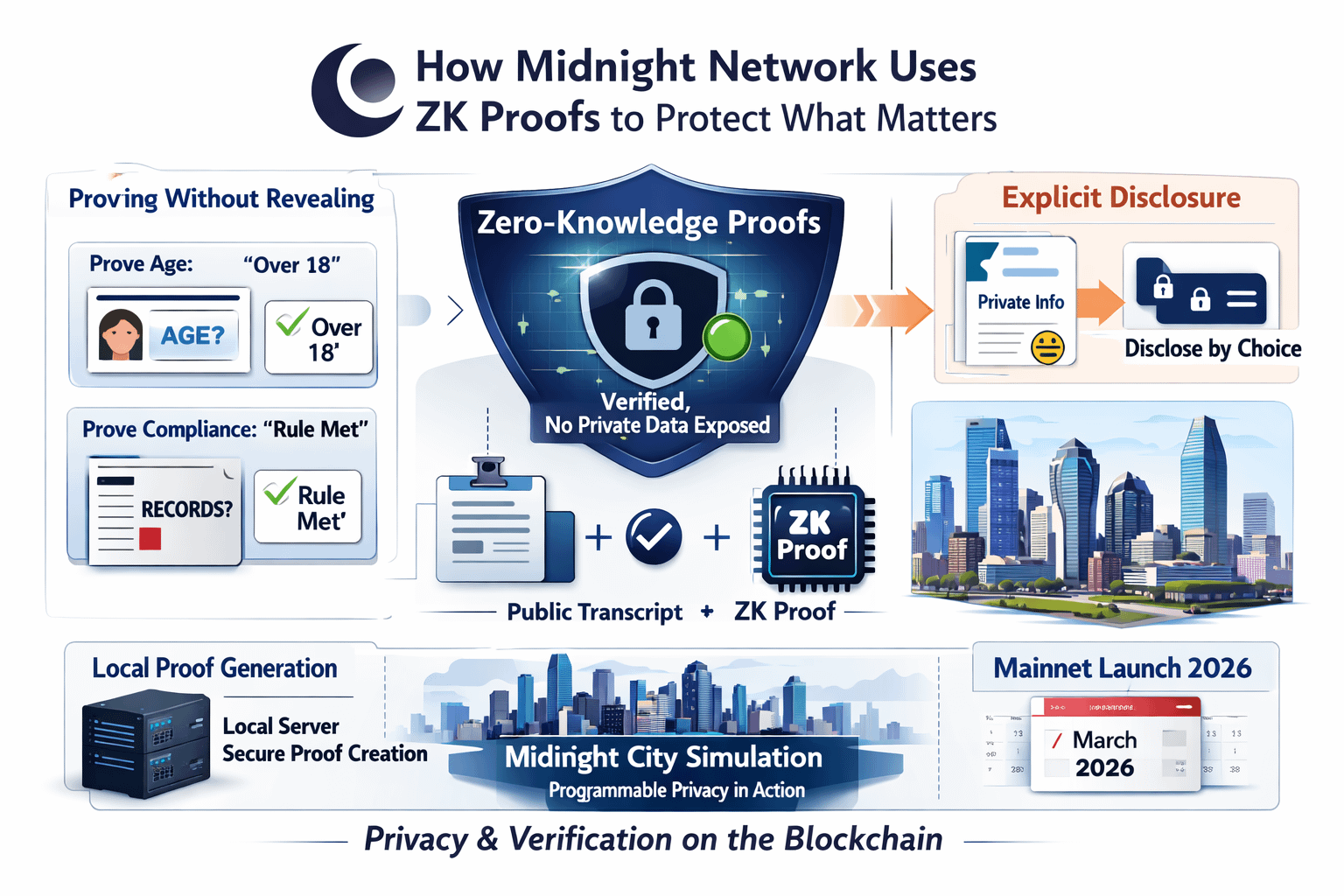
At its core Midnight says a person or an application should be able to prove something important without laying all of its underlying data on the table and that is where zero-knowledge proofs come in. In Midnight’s own documentation the idea is pretty direct since the network is built to keep sensitive data private while still letting others verify correctness and share only what a user chooses to disclose while also proving compliance without revealing confidential records. I find it helpful to strip the jargon away and look at the human version of that promise because instead of showing your full ID you might prove you are old enough and instead of exposing a company’s internal records it might prove it meets a rule. The interesting part is not secrecy for its own sake but the ability to show enough truth for a real-world interaction while keeping the rest of your life or business or identity out of the blast radius.
What surprised me once I dug a little deeper is that Midnight is not just hiding transactions in a vague way because it is trying to separate what must be public from what can remain private. Its smart contract model describes transactions as a public transcript plus a zero-knowledge proof that the transcript is correct which means the network can see the shape of what happened and verify that the rules were followed without needing every private input that led there. That matters because a lot of privacy talk in crypto gets fuzzy fast while this is more concrete. Midnight also pushes something called explicit disclosure and I think that phrase gets to the heart of its approach because private data is supposed to stay private by default and if a contract is going to reveal something that reveal has to be declared on purpose. I like that because accidental exposure is usually the real danger in digital systems since most people are not trying to publish their private details and are instead tripped into doing it by systems that collect too much and store too much and make exposure the default. Midnight is trying to reverse that posture so disclosure becomes the exception rather than the habit.
Another piece I did not expect to matter so much is where the proof itself gets made because Midnight’s current design includes a local proof server and the docs are unusually plain about why. The data sent to generate a proof can include private details so users are told to run that proof generation locally or only on infrastructure they control over an encrypted channel. That is a small but telling choice because it suggests Midnight is not saying that privacy happens somewhere in the cloud and asking people to trust the system blindly. It is saying the proof machinery should sit as close to the user as possible because that is part of protecting the user in the first place.
Under the hood the project has also kept refining its proving system and in 2025 it completed a move to a BLS12-381-based proving system while its docs describe the broader architecture as one that splits contract state between public on-chain components and private off-chain components. I would not pretend that makes the whole problem easy because ZK systems are still hard to build and hard to audit and often hard for ordinary developers to reason about. Still this is where Midnight feels more serious than a lot of vague privacy branding I have seen because it treats privacy as something engineered through transaction design and contract rules and proof generation rather than something advertised on a homepage.
The reason this is getting more attention now I think is that the market has finally run into the limits of radical transparency. Recent Midnight material points to a privacy paradox in which huge volumes of blockchain activity still move on transparent rails while users say they want much better data protection and would switch to products that offer zero-knowledge tools. At the same time Midnight itself is moving from concept toward live production and its official updates say mainnet is planned for late March 2026 while the team has been showcasing Midnight City which is a simulation meant to show how selective disclosure and programmable privacy behave under more realistic activity.
I do not read that as proof that every hard question is solved although it does tell me the conversation has shifted. Five years ago privacy on-chain often sounded like a niche argument or a compliance headache whereas now the discussion feels more adult because the real question is how to protect financial data and identity and business logic without breaking verifiability or coordination or legal obligations. Midnight’s answer is that ZK proofs let you verify what matters while revealing less by default and I think that is why it is resonating. It is not because privacy suddenly became fashionable but because too many people now understand what it costs when every meaningful action is exposed forever.
@MidnightNetwork #Night #night $NIGHT
