
As we move through 2026, the boundary between the digital and physical worlds is dissolving. We are no longer just talking about AI chatbots; we are witnessing the rise of the Robot Economy, where humanoid and industrial machines are becoming autonomous economic actors. At the center of this revolution is the @Fabric Foundation Fabric Foundation, providing the decentralized "nervous system" that allows these machines to function, trade, and scale without centralized gatekeepers.
Breaking the "Siloed Robot" Model
Historically, robotics has been a world of closed ecosystems. A robot from one manufacturer couldn't easily collaborate with a robot from another, and they certainly couldn't hold their own money. The @Fabric Foundation changes this by introducing:
* Sovereign Identities (DIDs): Every robot on the network receives a unique on-chain identity.
* Programmable Wallets: Robots can now hold $ROBO, allowing them to pay for their own electricity, maintenance, and compute.
* OM1 Operating System: Often described as the "Android of Robotics," this hardware-agnostic OS allows developers to build "Skill Apps" that run seamlessly across different robotic forms.
The Power of Robo and Proof of Robotic Work (PoRW)
The ROBO token is the lifeblood of this new economy. Unlike speculative assets, its value is tied to actual utility. One of the most significant innovations is the Proof of Robotic Work (PoRW) mechanism.
Through PoRW, the network verifies that a robot has successfully completed a physical task—whether it’s moving a pallet in a warehouse or assisting in a healthcare facility. This verified work is then settled instantly using $ROBO. This creates a meritocratic system where the most efficient and reliable machines earn the most, incentivizing a global upgrade in robotic labor quality.
Ecosystem Synergy: Intelligence Meets Execution
A major catalyst for the current momentum is the strategic partnership between @Fabric Foundation and Virtuals Protocol. By launching as the first "Titan" project, $ROBO bridges the gap between digital AI Agents (intelligence) and physical robots (execution).
This synergy allows for Agentic GDP (aGDP)—a future where an AI agent can hire a physical robot to perform a task in the real world, with the entire transaction settled on-chain.
Tokenomics & Market Outlook
With a fixed supply of 10 billion tokens and no inflation, the ROBO 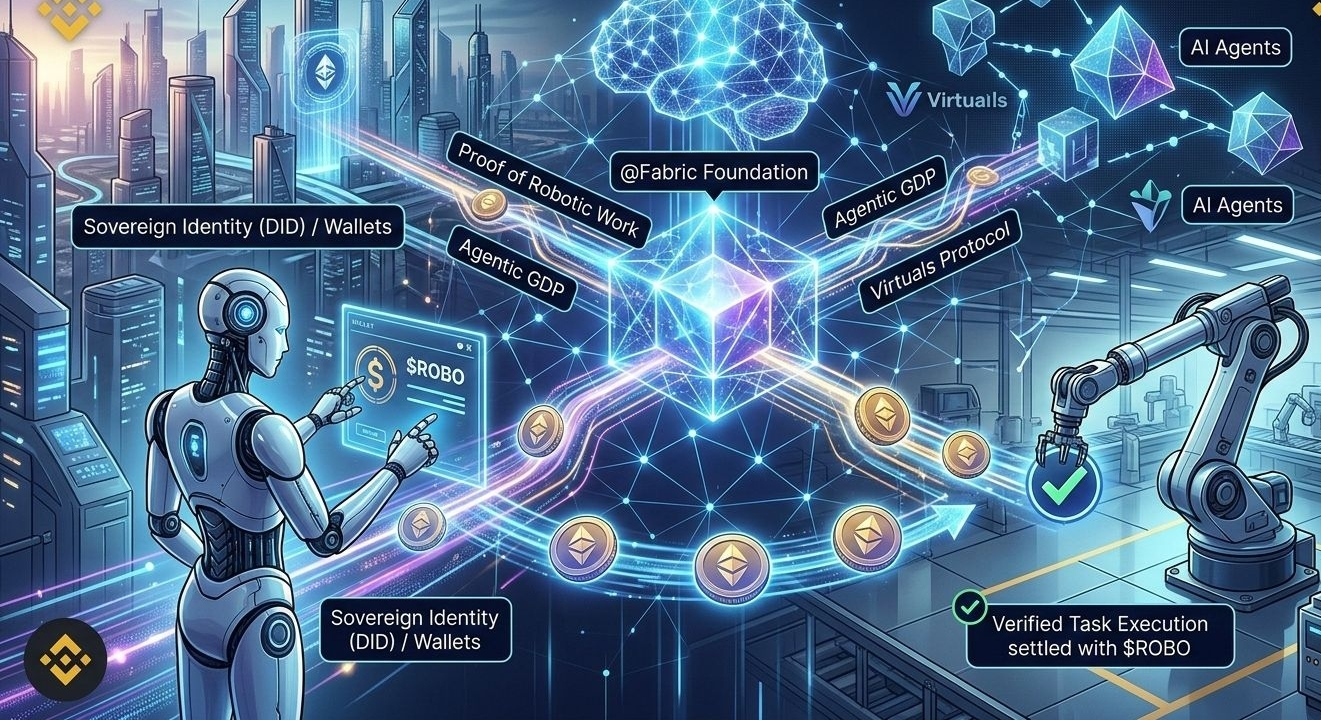 economy is built for long-term sustainability. The recent listing on Binance (Seed Tag) has provided the necessary liquidity to support the massive influx of industrial partners, including manufacturers like UBTech and Fourier.
As we look toward the rest of 2026, the question isn't whether robots will run our world, but which infrastructure they will use to do it. With its robust identity layer and the utility of @ROBO, the Fabric Foundation is clearly leading the charge.