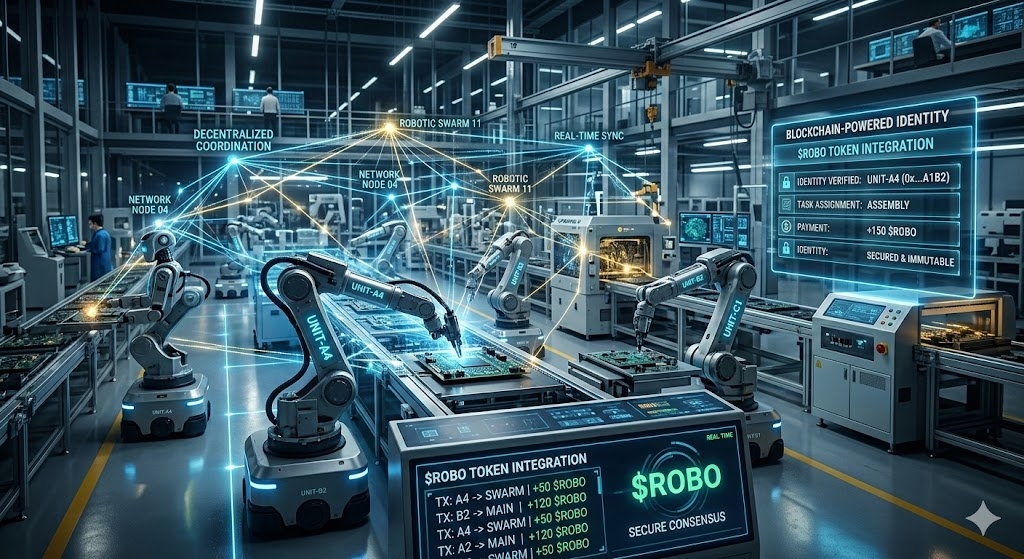
As autonomous systems and artificial intelligence transition from the digital realm into the physical world, the barriers separating robots from participating in the global economy are rapidly dissolving. At the heart of this transformation is the Fabric Foundation — a mission‑driven organization building the technical and economic infrastructure that will allow intelligent machines to operate as accountable, aligned, and value‑producing participants in global markets. Central to this vision is the ROBO token, the native utility and governance asset engineered to fuel decentralized robotic coordination, identity, and on‑chain settlement.
The Need for On‑Chain Robot Infrastructure
Current robotics deployments, whether in manufacturing, logistics, healthcare, or service industries, are often siloed under proprietary control. Robots lack independent economic agency: no global identity registry, no autonomous wallets, and no standardized mechanism for coordination or settlement. Fabric addresses these foundational challenges by leveraging decentralized ledger technology to create a neutral, transparent, and programmable coordination layer. This platform enables robots and autonomous agents to function across trust boundaries with auditable identity, verifiable contribution tracking, and permissionless access — unlocking real‑world scale.
In traditional settings, robotic fleets are tightly controlled by single operators, with limited interoperability and fragmented data silos. Fabric’s architecture dismantles these constraints by making robots programmable economic entities. Onchain identity registries ensure provenance, control rights, historical performance, and governance attributes are publicly verifiable. Similarly, autonomous wallets anchored in ROBO enable machines to pay for services — from compute and cloud resources to charging infrastructure — without human mediation.
$ROBO: Engine of the Robot Economy
At its core, $ROBO is designed as the settlement, coordination, and governance token of the Fabric ecosystem. Every meaningful interaction within Fabric — whether it’s network fees, task settlement, identity verification, staking for participation, or governance voting — flows through the $ROBO token. Initially deployed on Base (an Ethereum Layer‑2 network), Fabric is architected to evolve into its own Layer‑1 optimized for high‑frequency machine‑to‑machine coordination.
The tokenomics of ROBO reflect deliberate economic engineering for long‑term stability and ecosystem alignment. Out of a fixed supply of 10 billion tokens, allocations balance growth incentives, community participation, and responsible stewardship. A significant portion is designated for ecosystem and community initiatives, designed to reward contributions such as Proof of Robotic Work, data provisioning, and task completion. Structured vesting schedules for team members and investors temper supply shocks while aligning long‑term interest with network success.
Technical Innovation Meets Practical Application
From a technical viewpoint, $ROBO integrates with decentralized identity systems and wallet primitives to enable autonomous agents to participate in programmable labor markets. Robots can receive tasks, accept payment, fulfill compute and compliance obligations, and settle transactions — all in a way that’s verifiable, auditable, and resistant to manipulation. This level of coordination is unprecedented in robotics and represents a foundation for future industrial workflows, where machines operate subject to transparent incentive structures rather than proprietary contracts.
The Fabric protocol also enables stake‑based coordination for robot genesis, meaning participants can stake ROBO to contribute to the deployment and activation of hardware networks. This decentralizes the capital and operational requirements inherent to large‑scale robot fleets and opens the door for broader participation by developers, enterprises, and enthusiasts.
Ecosystem Momentum and Market Adoption
The ROBO token has already made notable strides in market accessibility. In late February 2026, Fabric’s ROBO began trading on major centralized exchanges including Binance Alpha, Coinbase, and other top-tier venues — a key milestone in its liquidity and discovery phase. These listings broaden access for both institutional and retail participants who wish to engage with the fabric of an emerging robot economy.
Moreover, community events such as token claim portals and promotional campaigns on various exchanges are driving engagement and participation. As the ecosystem matures, these early milestones are catalyzing deeper liquidity and user interest, reflecting the technical credibility and real‑world applicability of Fabric’s vision.
Conclusion: Catalyzing a New Frontier
ROBO isn’t just another utility token — it’s the backbone of an ambitious decentralized infrastructure designed to enable autonomous machines to operate harmoniously alongside humans. By integrating blockchain principles with robotic autonomy, Fabric is positioning itself as a pivotal player in the unfolding robot economy. As smart machines proliferate across industries, the $ROBO token stands as both a technological utility and an economic catalyst — empowering participants to build, govern, and scale the next era of programmable labor markets.