
The first time I started depending on AI for real work, I was honestly impressed. The responses were smooth. The structure felt professional. The tone sounded certain. It almost felt like having an expert on demand.
But the longer I used it, the more I noticed something subtle and uncomfortable. The problem was not that AI makes mistakes. Humans do that too. The problem was how confidently it delivers those mistakes. When something is wrong but sounds right, that is where risk quietly enters the system.
That is when Mira Network began to make sense to me. Instead of competing to build a smarter single model, it focuses on something different. It focuses on verification.
Today, most AI systems operate in a linear way. You ask a question. A model generates an answer. You either accept it or take on the responsibility of checking it yourself. The accountability sits with the user. That may work for casual prompts, but it becomes fragile when AI starts handling money, research, automation, or strategic decisions.
Mira shifts that responsibility into a structured network. It breaks AI generated outputs into smaller claims. Those claims are then evaluated independently by distributed validators. These validators can include separate AI systems that assess accuracy claim by claim. Through blockchain coordination and economic incentives, consensus determines which statements are reliable.
The difference here is subtle but important. You are no longer trusting a single model’s internal reasoning process. You are trusting a verification market where participants have something at stake. Incorrect validation carries consequences. Correct validation earns rewards. That dynamic introduces accountability directly into the evaluation layer.
The more I think about autonomous agents executing trades, managing workflows, or generating information that influences real world decisions, the more I realize that “mostly accurate” is not enough. Systems operating in high stakes environments need outputs that can be audited and traced. Reliability must be measurable, not assumed.
What I find practical about Mira’s approach is that it does not pretend hallucinations will disappear as models grow larger. It assumes errors will continue to exist and builds an external mechanism to manage that reality. Instead of chasing perfect intelligence, it builds structured oversight around imperfect intelligence.
There are still open challenges. Distributed validation must scale efficiently. Latency cannot slow down critical applications. Validator diversity must be genuine to avoid shared blind spots. But directionally, the framework addresses a gap that is becoming harder to ignore.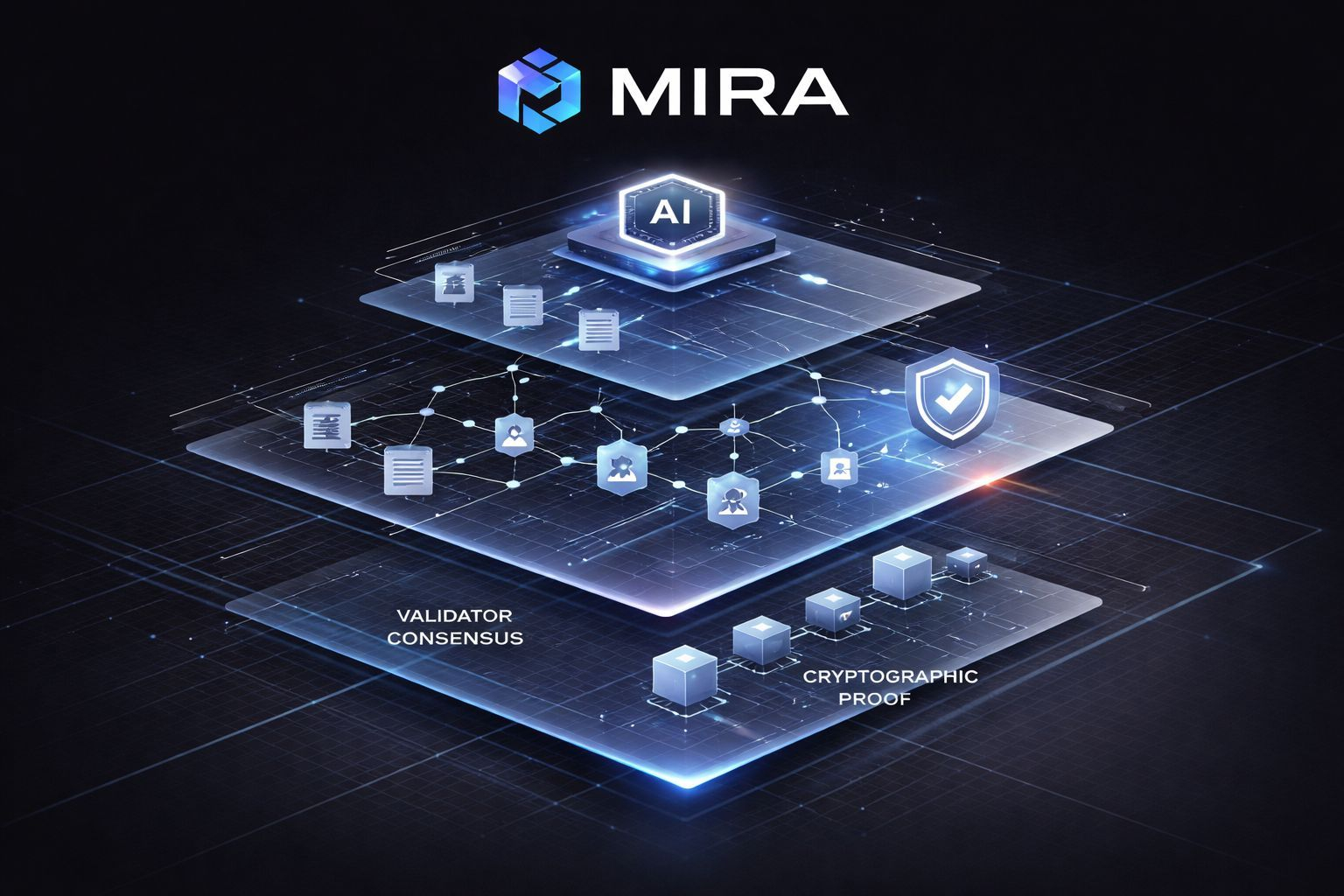
For me, Mira represents a shift in focus. It is less about making AI sound smarter and more about making AI accountable. As autonomy increases and AI systems take on more responsibility, verification may become just as important as intelligence itself.
#mira $MIRA @Mira - Trust Layer of AI
