I have seen a lot of people treat account locking like a small technical footnote, but in Fogo it is closer to a market structure rule than a coding detail.
That matters for traders and investors because Fogo is not only selling speed. It is selling a specific kind of execution experience on top of the Solana Virtual Machine. Fogo’s own architecture docs and litepaper are clear that it keeps SVM compatibility and builds around performance improvements in client implementation and network design, rather than replacing the execution model entirely. If you care about whether liquidity can actually stay on a chain after the first wave of excitement, that distinction is important.
The easiest way to understand the issue is this. Parallel execution sounds great until two transactions want to touch the same state at the same time. Then the chain needs rules. Without rules, you do not get speed, you get chaos. Account locking is part of the rule set that keeps parallel execution safe and predictable.
In the Solana style model that Fogo inherits at the execution layer, transactions declare the accounts they need, including which ones are read only and which ones are writable. Solana’s documentation explains the transaction message structure and how account permissions are encoded through the header and ordered account keys, and Solana’s Sealevel writeup explains why declaring read and write access in advance is what allows non overlapping work to be scheduled in parallel. That is the core mechanic behind parallelism. It is not magic. It is a scheduling system built on declared access.
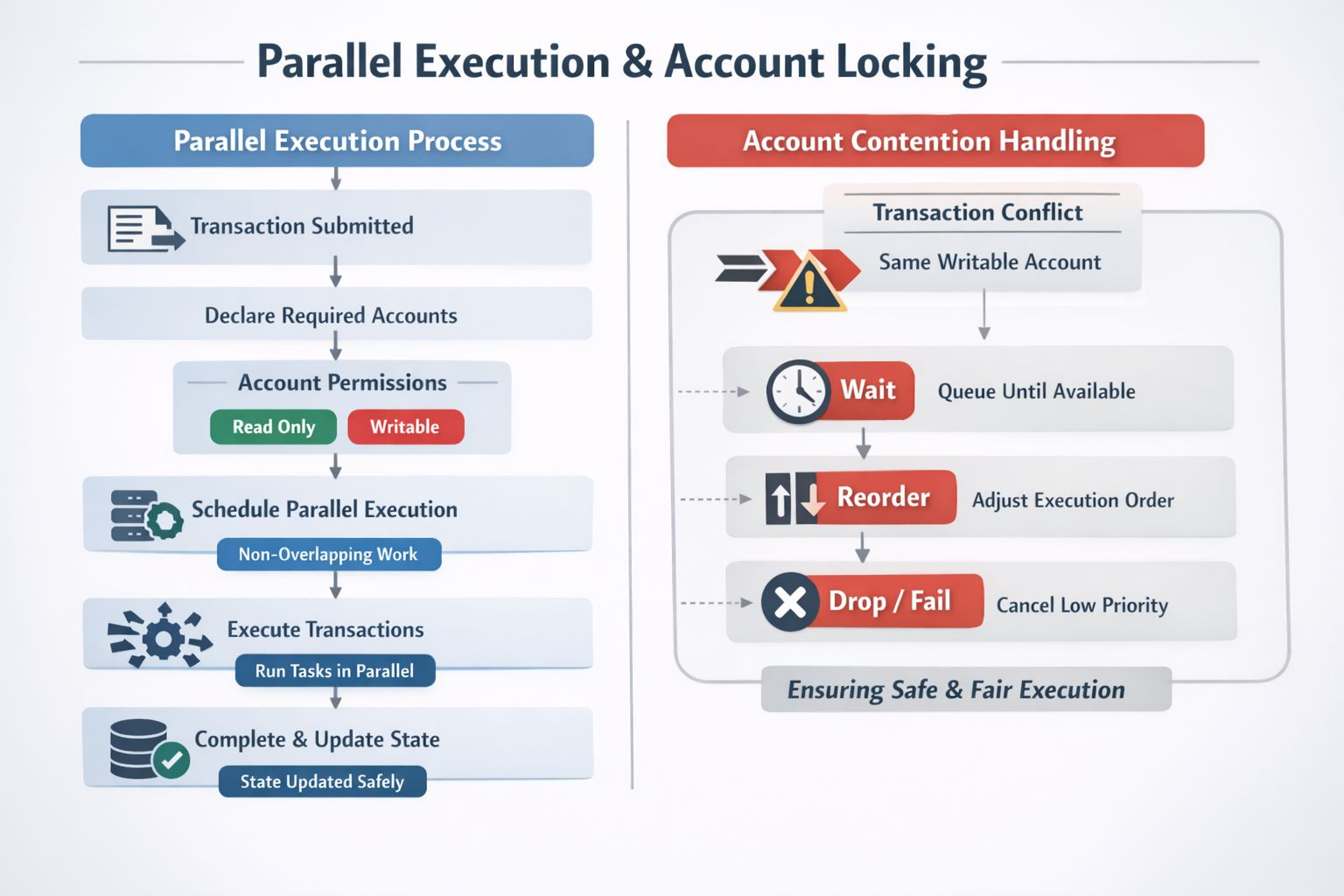
For a trader, the practical takeaway is simple. The chain can process many things at once, but not everything at once. If multiple transactions collide on the same writable accounts, they become a contention problem. They may need to wait, be reordered, or lose priority depending on how the execution pipeline handles the conflict. That is not a flaw. That is the cost of preserving correctness while chasing low latency.
This is exactly why rules matter more on a fast chain than on a slow one. When a network is optimized for lower latency and better throughput, as Fogo positions itself to be with a Firedancer based canonical client path and localized consensus design choices, execution quality becomes more visible to users. On a slower system, users already expect delay. On a faster system, they notice inconsistency immediately. If one trade lands instantly and another fails or stalls because of account contention, users will not blame abstract concurrency theory. They will blame the app, the chain, or both.
That is where the investor angle gets interesting. Account locking is not only a developer concern. It affects which apps work well on Fogo and which apps struggle. Applications that design around conflict reduction can benefit more from parallel execution. Applications that funnel too much activity through the same hot accounts may create bottlenecks even if the chain itself is technically strong. In other words, part of Fogo’s real performance story will be decided by application architecture, not only protocol architecture.
I think this is one of the easiest mistakes to make when evaluating emerging high performance chains. People hear throughput claims and assume every use case scales equally. In practice, the shape of state access matters. A market with many independent actions can parallelize well. A market where everyone is racing to hit the same state at the same instant creates contention. The chain can still be fast, but the experience becomes path dependent. That is why understanding the rules behind parallel execution gives investors a more realistic lens than looking at headline speed claims alone.
A real world analogy helps here. Think about a modern warehouse with many workers and many lanes. If every worker is picking items from different shelves, the system feels incredibly efficient. If everyone rushes the same shelf at once, the warehouse still has great infrastructure, but the line forms anyway. The problem is not that the warehouse is fake. The problem is that access to one resource needs coordination. Account locking is that coordination layer for onchain state.
There is also a retention problem here, and I would argue it is one of the most important long term issues for Fogo. Early users can be attracted by narrative and speed demos. They stay only if the execution experience feels consistent under real load. If traders repeatedly run into confusing failures, retries, or uneven outcomes caused by state contention that apps did not design for, they may not care that the chain is technically advanced. They will move to wherever execution feels more reliable. Retention is not won by peak performance. It is won by predictable performance.
That is why Fogo’s account locking conversation should be framed as a rules conversation, not just a throughput conversation. Rules determine who can safely run in parallel, who must wait, and how conflict is contained. For builders, that means designing with account access patterns in mind. For investors, that means evaluating whether the ecosystem is learning how to use the execution model well. For traders, that means understanding why some markets will feel smoother than others even on the same chain.
If you are studying Fogo seriously, do not stop at the words parallel execution. Ask the harder question that actually predicts durability: which apps can avoid hot account contention, preserve fairness, and keep execution quality high when attention arrives. That is where the long term winners will emerge, and that is where Fogo’s real edge will either prove itself or fade.