
When I step back and evaluate VANRY from a macro perspective, I don’t see it as just another altcoin competing for attention in an already saturated market. I see it as something more deliberate, a directional hedge. Not a hedge in the traditional financial sense of offsetting short-term volatility but a hedge against being positioned on the wrong side of a major technological shift.
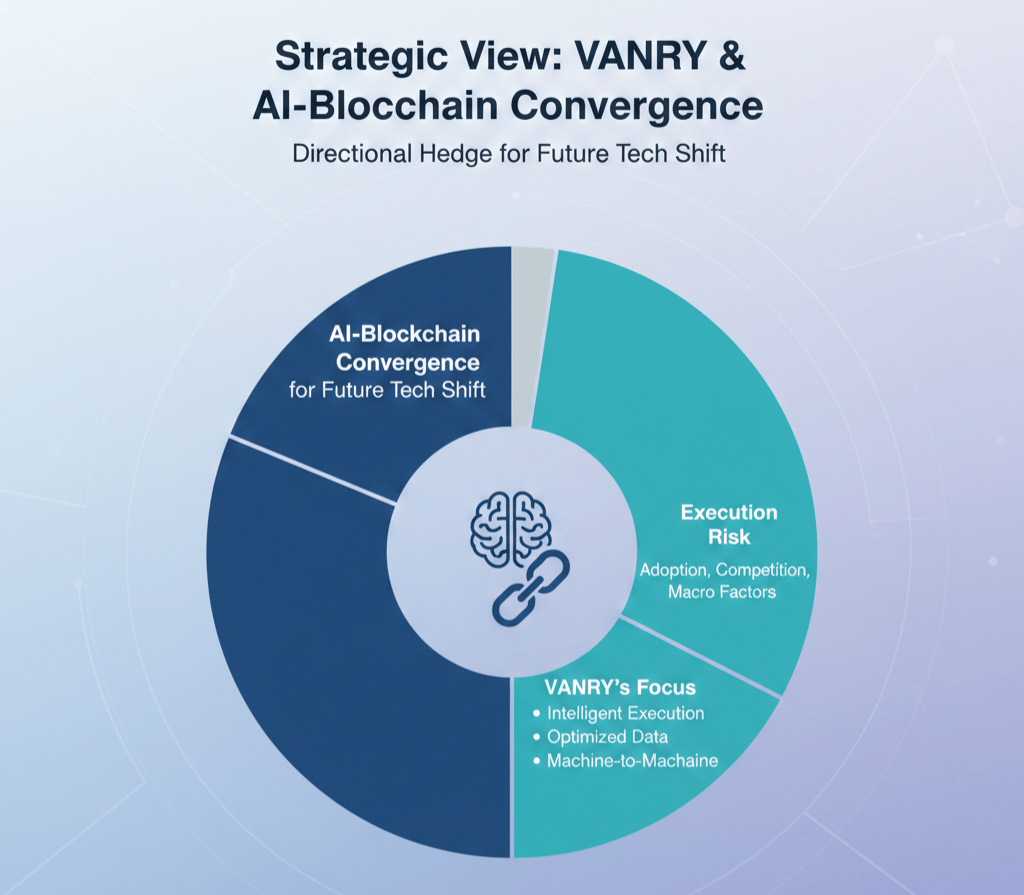
A hedge on what exactly? On the convergence of artificial intelligence and decentralized infrastructure.
We are entering a period where AI is no longer experimental. It is becoming embedded into automation, decision-making, logistics, content generation, financial modeling and digital coordination at scale. At the same time, blockchain continues to mature as a settlement layer for trust, ownership, identity and value transfer. These two systems solve different problems, but they are increasingly complementary.
AI optimizes decisions. Blockchain verifies outcomes.
AI generates actions. Blockchain anchors accountability.
AI scales coordination. Blockchain secures coordination.
The intersection of those forces doesn’t feel speculative to me. It feels inevitable.
That’s where Vanar positions itself, not as a general-purpose chain trying to replicate everything that already exists but as infrastructure attempting to integrate intelligence at the architectural level. Instead of retrofitting AI tools onto legacy systems, the thesis appears to revolve around designing a network where intelligent execution and optimized data handling are core considerations from the beginning.
This distinction matters.
Most blockchains were built in an era focused on decentralization and financial programmability. That was phase one. But intelligent agents introduce a different set of demands: dynamic data processing, low-latency execution, predictable performance under algorithmic load and structured interaction between automated systems.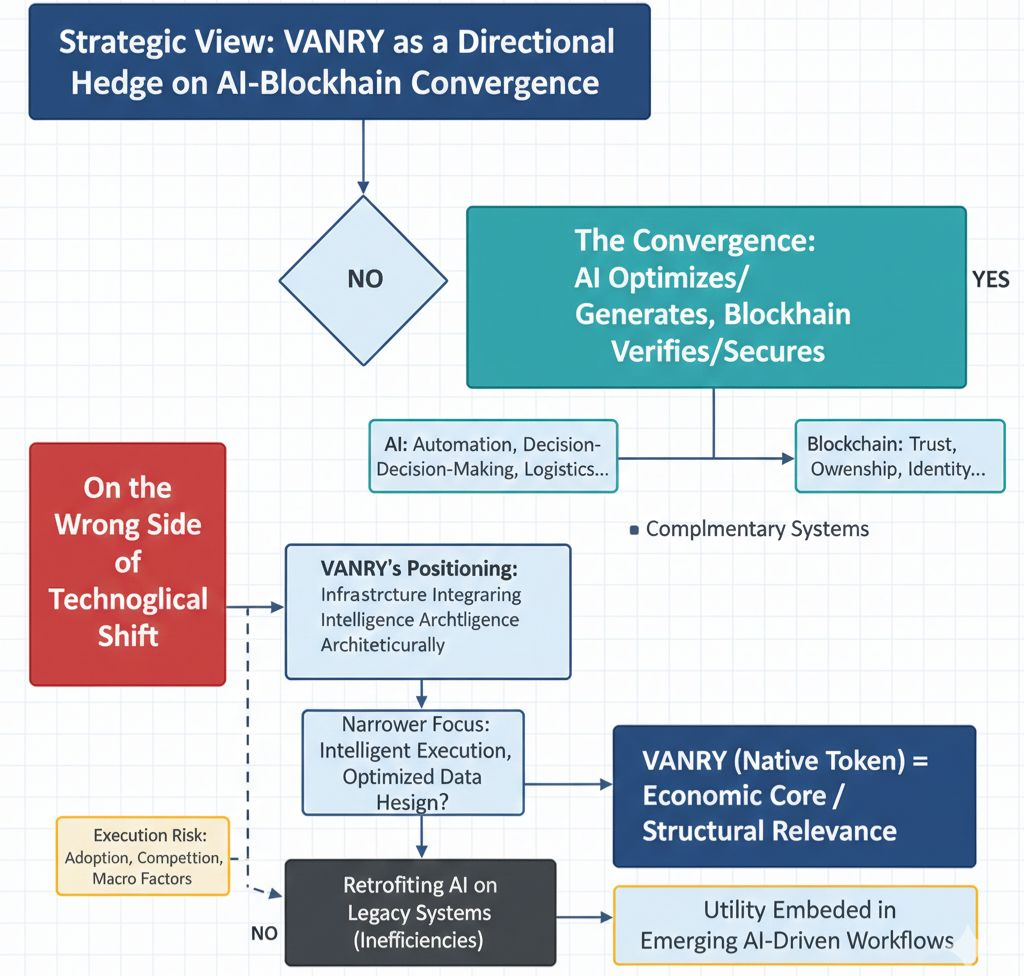
If decentralized networks are going to serve AI-driven applications in the future, they must handle machine-to-machine coordination efficiently. They must support execution environments where smart contracts are not just passive scripts but components within larger intelligent workflows.
Vanar’s narrower focus, in my view, reduces dilution of purpose. It doesn’t attempt to dominate every vertical. It concentrates on intelligent execution and optimized infrastructure design. That kind of specialization can be a strength in a competitive environment where many chains are still fighting for identity.
VANRY, as the native token, functions as the economic core of that design. If AI-driven systems increasingly require decentralized settlement layers for verification, payments or ownership logic, tokens embedded within AI-aligned networks could gain structural relevance. Not because of speculation alone, but because of utility embedded in emerging workflows.
This is why I frame it as a directional hedge.
I’m not analyzing it purely through price cycles or short-term volatility. I’m looking at the broader architectural thesis: that the next generation of decentralized networks must be intelligent by design, not upgraded later as an afterthought. Retrofitting intelligence onto systems not built for it can introduce inefficiencies and bottlenecks. Designing with intelligence in mind from the outset changes how infrastructure scales.
Of course, none of this removes execution risk.
Adoption is never automatic. Competition across AI-integrated chains is intensifying. Established ecosystems may pivot aggressively. Capital flows are unpredictable. And macro conditions always influence market cycles in ways that pure technology analysis cannot fully anticipate.
But direction still matters.
In long-term technological shifts, being aligned with structural momentum can be more important than perfectly timing entry points. The AI–blockchain convergence is not a single event; it’s a gradual layering of capabilities across industries. The networks that anticipate that layering rather than reacting to it may hold strategic advantages.
From my perspective, allocating attention to Vanar isn’t about chasing hype or reacting to narrative spikes. It’s about evaluating positioning within a broader transformation of digital infrastructure. If decentralized systems evolve toward becoming intelligent coordination layers rather than static transaction rails, then projects architected around that assumption deserve scrutiny.
That doesn’t guarantee success. It simply clarifies the bet.
To me, VANRY represents exposure to a thesis: that intelligence and decentralization will not remain separate domains. They will merge into hybrid systems where automated agents interact with verifiable networks seamlessly. If that thesis proves correct, tokens aligned with that convergence may become foundational components rather than peripheral assets.
That is why I continue analyzing it, not because of short-term excitement but because of structural positioning. In markets crowded with noise, clarity of direction can be more valuable than volume of attention.
