 I’ve read enough “fast L1” threads to know the routine. Someone posts a TPS number. Someone else replies “bullish.” Then the first real market spike hits and everything turns into a slow-motion traffic jam because the chain was never designed for the one enemy that doesn’t care about your code: distance.
So when I looked at Fogo, I didn’t care that it uses the Solana Virtual Machine. SVM compatibility is nice, sure, but it’s not a personality. What grabbed me was this: Fogo treats geography like a design constraint, not an inconvenience it can benchmark away. It builds consensus around the fact that the planet is large and your packets don’t teleport.
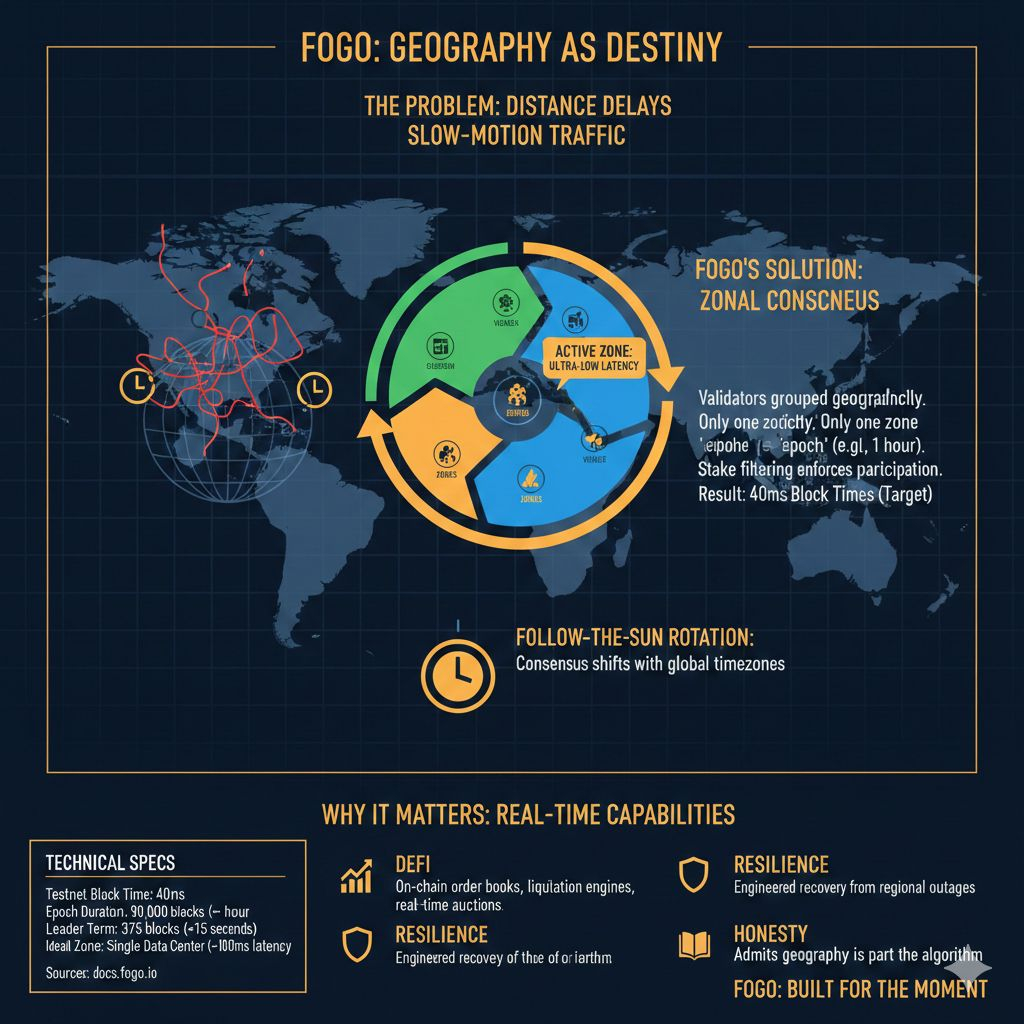
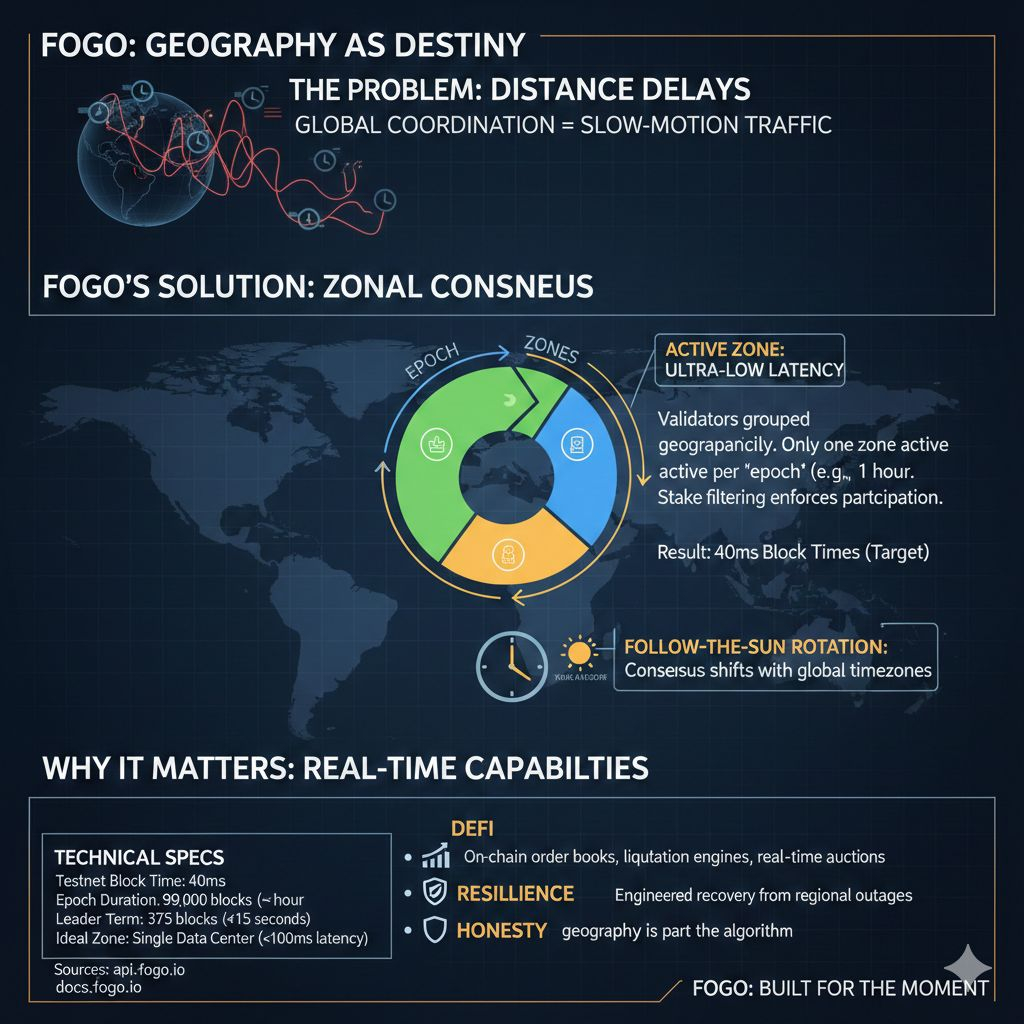
The core idea is simple enough to explain to a trader who’s half-asleep at 3 a.m. Fogo groups validators into geographic “zones,” and instead of making every validator everywhere participate in consensus every moment, it activates just one zone as the consensus set for an epoch. The enforcement isn’t hand-wavy. At the epoch boundary, the protocol applies stake filtering so validators in the active zone are the ones eligible for that epoch’s leader schedule and consensus participation. (api.fogo.io)
That’s not a cosmetic tweak. It’s the difference between a chain that’s “fast in the lab” and a chain that can stay fast when the network is under stress. Because most chains don’t actually run at the speed of their best validators. They run at the speed of their worst coordination path, the one that crosses oceans, hits congested routes, and turns “average latency” into a lie the moment volatility shows up.
I learned this the hard way watching execution systems. Average latency is a marketing number. Tail latency is what steals money. You click buy, price moves, your transaction lands late, and suddenly you’re the liquidity. The chain didn’t “fail.” It did exactly what it was built to do. It just wasn’t built for the moment you were actually in.
Fogo is trying to build for that moment.
On testnet, they’re targeting 40 millisecond blocks. Not “sub-second.” Not “fast-ish.” Forty milliseconds. That’s the cadence where the chain stops feeling like a slow settlement layer and starts behaving like infrastructure you can build real-time market logic on. (docs.fogo.io) And they tie that cadence to the zone model with details that feel like an engineer wrote them, not a marketer. Testnet epochs are set to 90,000 blocks, roughly an hour at that block time, and after each epoch consensus moves to a different zone. (docs.fogo.io) They even specify the leader term: 375 blocks per leader, about 15 seconds of continuous production before leadership passes. (docs.fogo.io)
Now, an obvious question: what are the other zones doing while one zone is active? The practical answer is that they’re not the ones producing and voting that epoch. The system is intentionally localizing the active quorum for speed, then rotating that responsibility over time to avoid one region becoming the permanent “center.” That’s the whole bet.
And here’s where Fogo gets genuinely interesting: zone activation doesn’t have to be simple round-robin. The litepaper describes multiple zone selection strategies, including classic epoch rotation and a “follow-the-sun” rotation driven by UTC time. In that model, zones can activate based on time windows across a 24-hour cycle, with durations configured in milliseconds and a defined daily start point, basically shifting consensus activity across regions throughout the day. (api.fogo.io)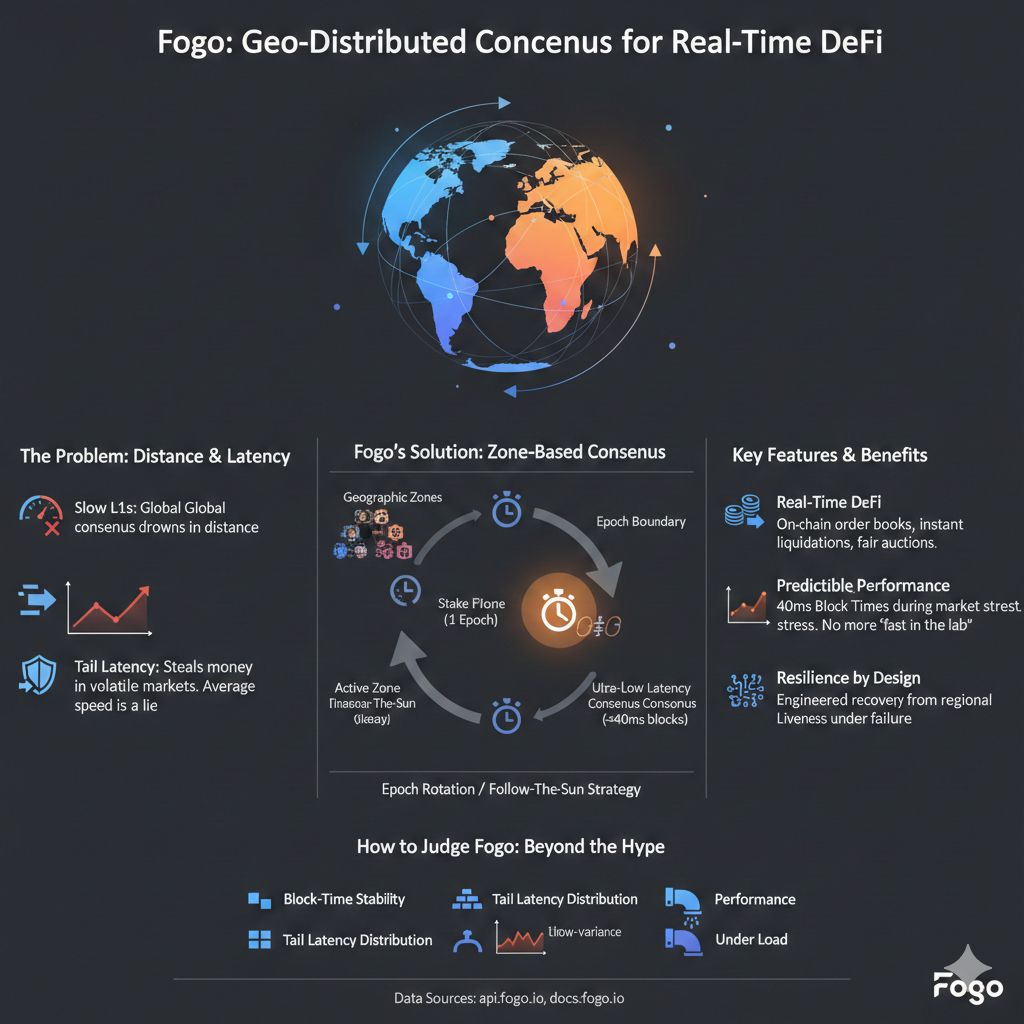
That’s the angle I’d campaign on, because it’s not generic “we’re fast.” It’s “we move consensus to where the users are.”
Picture crypto the way it actually behaves. Asia wakes up and flows start moving. Europe logs in and volatility shifts. New York opens and everything gets louder. Traditional systems already build around this rhythm. Support teams rotate. Market desks hand off. Cloud infra thinks about locality like religion. Blockchains mostly don’t. They insist on global coordination every block like it’s a moral requirement, then act shocked when latency and MEV extraction become permanent background radiation.
Fogo is essentially saying: we can preserve decentralization over time by rotating who is “in the room,” while keeping the room physically tight enough that consensus doesn’t drown in long-distance coordination. The architecture docs are blunt about what zones should be for maximum effect: ideally a single data center where latency approaches hardware limits, enabling ultra-low latency consensus with block times under 100ms. (docs.fogo.io) That’s not a cute line. That’s a design direction.
And yes, this opens the door to applications that stop feeling like cosplay. On-chain order books that aren’t fighting seconds of coordination delay. Liquidation engines that don’t need to pad risk margins because timing is unpredictable. Real-time auctions that can actually run on-chain without turning into a “who got lucky” contest by default. Fogo’s own docs call out DeFi apps where low latency is essential. (docs.fogo.io)
But let’s not pretend there’s no knife hidden in the handle. The moment you localize consensus, the sharp edges move from “can we coordinate globally?” to “how do we choose zones, enforce standards, and keep rotation legitimate?” The litepaper makes it clear the enforcement lever is stake filtering at epoch boundaries, and that zone selection is controlled by a protocol strategy, including follow-the-sun. (api.fogo.io) That means governance and operational policy aren’t side quests. They are the chain.
And the real pressure test is ugly and specific: what happens if the active zone gets hit mid-epoch? A regional outage. A connectivity collapse. A targeted attack on a concentrated cluster. If the chain is localizing the active quorum for speed, then resilience has to be engineered just as aggressively, or you end up with a network that’s insanely fast right up until the moment everyone actually needs it. This is where I want to see hard answers in practice: recovery behavior, liveness under failure, and how cleanly the system can continue when conditions aren’t perfect.
So here’s how I’d judge Fogo, in a way that cuts through the hype.
Don’t show me a peak TPS screenshot. Show me block-time stability during chaos. Show me tail latency distributions, not averages. Show me what happens when the market is on fire and memecoin mania is flooding the pipeline. If Fogo can keep 40ms blocks and predictable behavior under real load, then this stops being “another L1” and becomes something rarer: a chain that admitted the truth out loud. The ocean is part of your consensus algorithm, whether you like it or not. (docs.fogo.io)