
Vanar begins in the place most crypto stories avoid, not in performance bragging, not in flashy demos, not in the loud race for speed. It begins in the human moment right before a transfer, when your stomach tightens just a little because you know the truth. One wrong character and your money can disappear. No undo. No customer support that can reverse finality. Just silence. We are living with an interface that asks ordinary people to route value through unforgiving hex strings and then blames them when they slip. I’m not calling this innovation. I’m calling it a human bug that has been tolerated because early adopters learned to accept pain as the price of being first. But if It becomes the foundation for AI agents that move payments at machine speed and at machine scale, the damage multiplies. We are not talking about one mistake anymore. We’re talking about an economy where errors are permanent, automatic, repeated, and invisible until it is too late. That is the real fear behind the agent narrative, and it is why Vanar’s direction matters more than it looks on the surface. Vanar is paying attention to safety, identity, uniqueness, and safer routing, the things that are not glitzy but decide whether normal people and real companies will ever trust automated money.
At its core, Vanar positions itself as a Layer 1 blockchain built for the next era where applications are not only interactive software but intelligent systems that reason, learn, and act. Many chains talk about being fast. Vanar talks about being usable for an AI native future, where the chain is not just a settlement layer, but the foundation of a broader stack that supports data, memory, and decision automation. They’re building a base chain that is compatible with the EVM world so developers can use familiar tools and patterns instead of starting from scratch. That choice is not only about convenience. It is about safety. EVM systems have years of battle scars, years of audits, years of shared knowledge about what breaks and what survives. Compatibility reduces the number of unknown unknowns, and when money is involved, fewer unknowns is a form of protection.
But Vanar’s story becomes clearer when you stop asking only what it is and start asking why it is shaped this way. The answer is that Vanar seems to believe the next adoption wave will not be won by the fastest chain on a quiet day. It will be won by the chain that makes automation safe enough for real life. If It becomes normal for agents to handle payroll, subscriptions, supplier payments, treasury movements, and micro transactions across networks, then the chain must support a world where mistakes are caught early, identity is legible, costs are predictable, and routing does not feel like a trap. We’re seeing Vanar lean into that logic through a set of design choices that aim to reduce the two biggest sources of automated disaster, unpredictable cost and ambiguous destination.
One of the clearest signals is Vanar’s emphasis on predictable fees. In crypto, fees often behave like weather, calm one hour and violent the next, especially when token prices move or network demand spikes. That unpredictability is not just annoying. It is dangerous for automation. Humans can pause and rethink when fees surge. Agents will keep going unless you explicitly stop them. If you do not have guardrails, you wake up to a bill you never expected, or you watch an automated strategy collapse because the cost assumptions were wrong. Vanar communicates a fixed fee style approach that aims to express transaction costs in a more stable manner and discourage spam. The emotional promise is simple. You should be able to plan. A builder should be able to price a product. A business should be able to forecast expenses. And an agent should be able to operate within strict limits without being surprised by chaos. This is the kind of boring engineering that makes a future economy possible.
Yet the deeper truth is that predictable fees are not merely a convenience. They are a safety rail. If fees stay within expected ranges, you can write policies that actually mean something. You can cap daily spend. You can define safe retry behavior. You can set thresholds where a transaction must request human approval. You can design automation that behaves like a responsible assistant rather than a reckless machine. If It becomes easy to predict the cost of actions, then risk becomes measurable. When risk is measurable, it becomes manageable. When it becomes manageable, people begin to trust.
But every strong design also brings its own pressures. A fixed fee model has to be maintained. Someone has to set parameters and update them as markets move. If they’re updated too slowly, the system drifts. If they’re updated without transparency, users lose confidence. If pricing inputs can be manipulated, the model can be attacked. That is why the real question is not whether fixed fees sound good, but whether the mechanism is resilient, observable, and governed in a way that earns trust. We’re seeing the industry learn again and again that the best economics fail when governance is unclear. A safety focused chain must treat governance and transparency as part of the security perimeter.
Another pillar of Vanar’s direction is the way it frames validator credibility and trust. The project describes a path that begins with more controlled validation and moves toward models that incorporate reputation and community participation. That approach can be understood as an attempt to balance early reliability with a long term goal of broader network trust. Early stage networks often face a hard trade. Total openness can invite instability when incentives are young and tooling is new. Total control can bring reliability but raises questions about censorship and concentration. Vanar’s messaging implies an intention to evolve over time, using reputation and governance to decide who secures the network. In a world where agents move value, this matters more than many people admit. The safety of automated money is not only about wallet UX. It is also about whether the network behaves predictably under pressure, whether transaction ordering can be manipulated, whether outages happen, and whether there is accountability for the entities that run the infrastructure. They’re trying to create a culture where trust is not accidental.
Still, reputation systems are not magic. If reputation can be faked cheaply, it becomes meaningless. If it becomes political, it becomes fragile. If it becomes exclusive, it can reduce decentralization. The real test is not the word reputation. The test is how reputation is measured, how it can be challenged, and how it can be prevented from turning into a closed club. In the agent era, Sybil attacks do not only target governance. They target identity itself. They target the meaning of trust.
This brings us to the most important part of your observation, identity, uniqueness, and safer routing. Crypto has spent years teaching people to accept the absurd. That a wallet is a long string. That you must trust a clipboard. That you must compare the first and last characters and hope the middle is correct. That a typo is a life lesson. That sending to the wrong network is your fault. This is not a mature financial interface. It is a trial by fire that filters out ordinary people. And when agents arrive, that interface becomes catastrophic because automation amplifies the consequences of small errors.
Vanar’s direction suggests it is taking that problem seriously by leaning into the idea that identity must be more legible than a raw address. Identity does not have to mean exposing private life. Identity can mean a verified destination concept, a trusted recipient concept, a safe route concept. It can mean that when you send money, you are sending to a human readable entity that has been authenticated, not to a random string that looks the same as every other string. Uniqueness matters because without uniqueness, identity is just costume. If It becomes easy to create thousands of fake entities, then automation becomes a weapon. The safety of an agent economy depends on preventing cheap deception. That is why uniqueness is not a luxury. It is the foundation of reputation, and reputation is the foundation of safe automated routing.
In practical systems, safer routing is achieved through a few families of technology and design. One is account abstraction, where wallets become smart contract accounts with policy controls rather than raw key pairs. This allows modern authentication flows and recovery patterns, and it allows the wallet itself to enforce rules. Another is recipient verification and naming, where you can map identity to addresses in a way that is resistant to impersonation. Another is transaction simulation and intent confirmation, where the system shows what will happen before it happens, and blocks obviously dangerous actions. Another is permissioned automation, where an agent can only operate within strict constraints, and any action outside that boundary requires explicit human approval. These are not glamorous ideas, but they are exactly how you prevent an agent from turning a single human mistake into a thousand irreversible transfers.
Vanar’s materials mention account abstraction patterns, and that alone is a meaningful signal because it suggests they’re not only building for developers but also for onboarding and safer UX. The best case future is not that people become more careful. The best case future is that the system becomes more forgiving. A wallet that can enforce spend limits, whitelist recipients, require time delays for large transfers, or ask for additional confirmation when risk is high, is not only a wallet. It is a safety device. If It becomes standard, the fear in people’s chest when they press send begins to fade.
Vanar also describes a broader AI native stack above the chain, with components designed around data and reasoning. The reason this matters for safety is not only because it sounds advanced. It matters because agents need memory and context, and in finance, context is what prevents reckless action. If an agent does not know who the counterparty is, what the usual payment amount is, what the allowed range is, what the expected schedule is, what the user’s policies are, it will make mistakes that look logical to a machine and devastating to a human. A system that can store and reference structured data in a verifiable way creates the possibility of policies that are enforceable. It creates the possibility of decisions that can be audited. It creates the possibility of automation that can explain itself.
Vanar’s described data compression direction, often framed as creating compact onchain data objects, aims to make more information live inside the trust boundary of the chain rather than floating offchain in a way that is hard to verify. If It becomes practical, it supports a world where an agent’s actions can reference onchain context and where humans can later inspect not only what happened, but why it happened according to recorded rules and recorded state. Then the conversation shifts from blame to diagnosis. And diagnosis is the first step toward real safety.
But ambition also carries risk. AI native claims can drift into marketing if they’re not backed by developer adoption and measurable performance. The only way to know is to watch what builders do, not only what websites say. Real usage reveals the truth. If developers build products that rely on these layers, if they stay after the excitement fades, if they ship upgrades, if they handle incidents transparently, then the architecture is real. If not, then the chain must still win on fundamentals, reliability, tooling, documentation quality, and user safety patterns.
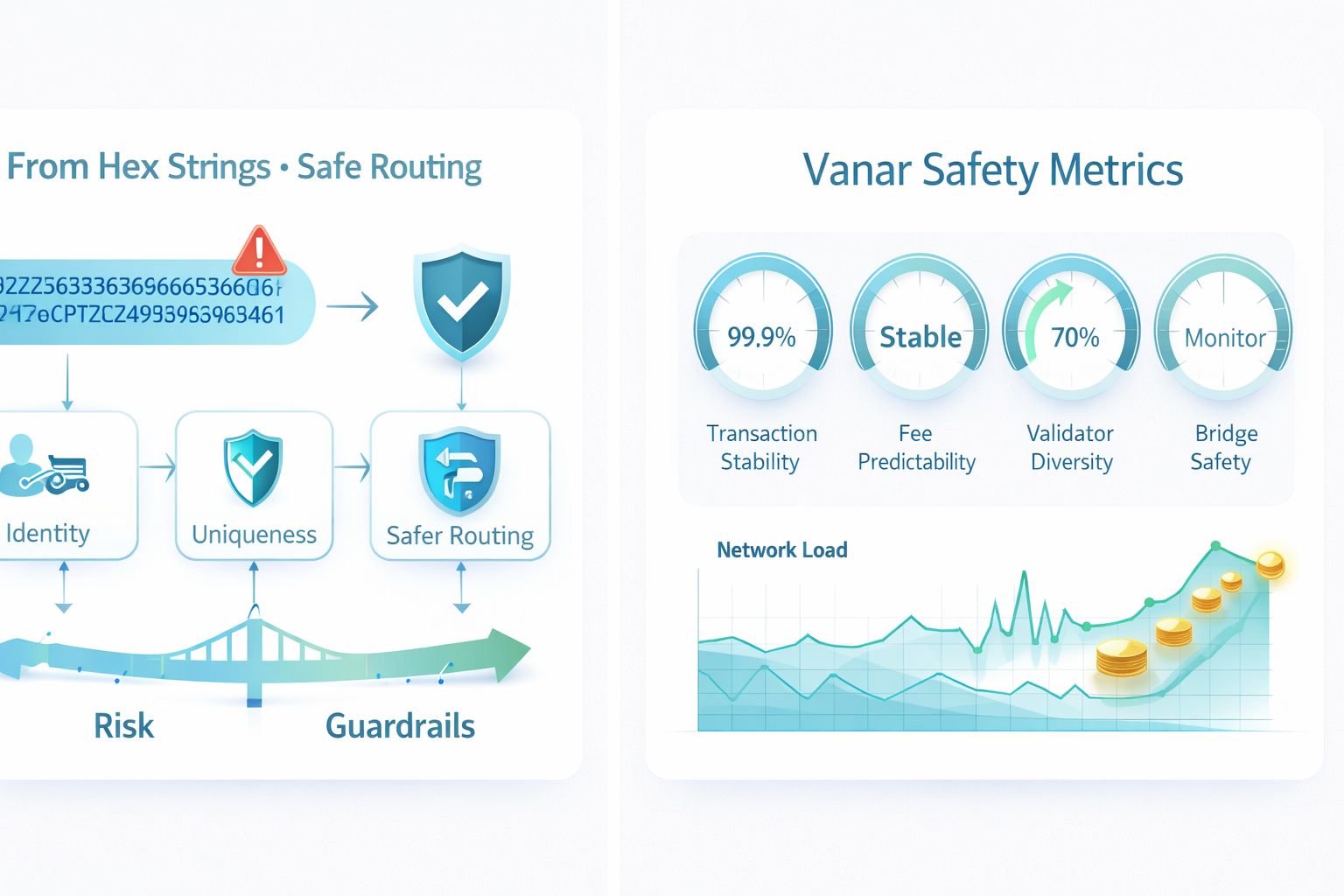
So how do we evaluate Vanar in a way that cuts through noise. We focus on the metrics that actually reflect safety and trust. We look at confirmation stability during busy periods. We look at whether transactions remain smooth under load or whether the network stutters. We look at fee behavior during volatility and whether the cost surface stays predictable. We look at decentralization progress and whether governance becomes more open over time. We look at wallet and onboarding patterns and whether they reduce user mistakes. We look at incident response speed and transparency when something breaks. We look at bridge exposure if cross chain movement is important, because bridges remain one of the highest risk zones in the industry. We look at whether the project treats user loss as a system failure to be reduced, rather than a moral lesson.
And we do not ignore the failure stories that could appear, because a safe future is built by facing the darkness honestly. A fixed fee model can fail if its update mechanism is manipulated or unclear. A reputation based validator approach can fail if reputation is gamed. Account abstraction can fail if recovery is poorly designed. AI oriented layers can fail if they introduce complexity without reliable value. Bridges can fail because they are bridges. Every one of these is real. A serious chain does not pretend otherwise. It builds pressure valves. It builds conservative defaults. It builds monitoring. It builds audits. It builds governance that is visible. It builds a culture where safety is the first product.
Now bring all of this back to your core statement. Transferring money to hex strings is a human bug just waiting to be an agent disaster. Vanar’s direction reads like a refusal to accept that bug as normal. The project is trying to shape a world where identity is clearer, uniqueness makes trust real, routing is safer, fees are predictable, and automation can be constrained by policy rather than unleashed into chaos.
If Vanar succeeds, the far future looks like relief. It looks like a world where you do not paste addresses. You select verified identities. Your wallet knows your habits and your rules. Your agent has hard limits. Your payments have safe routes. Your mistakes are caught early. Your biggest fear is not that you will lose everything because you were distracted for one second. Money automation stops feeling like a cliff edge and starts feeling like a quiet helper. We’re seeing the early outlines of this future across the industry, but only a small number of projects are taking the unglamorous path of guardrails and identity and safer routing as their headline.
In the end, the chains that win will not be the ones that shout the loudest about speed. They will be the ones that make people feel safe enough to stop checking an address ten times with trembling hands. They’re building for a world where trust is not a performance, it is a default. And if It becomes real, Vanar will not just be another network. It will be part of the moment crypto finally grows up, not by moving faster, but by finally refusing to let money feel like a permanent mistake waiting to happen.
