
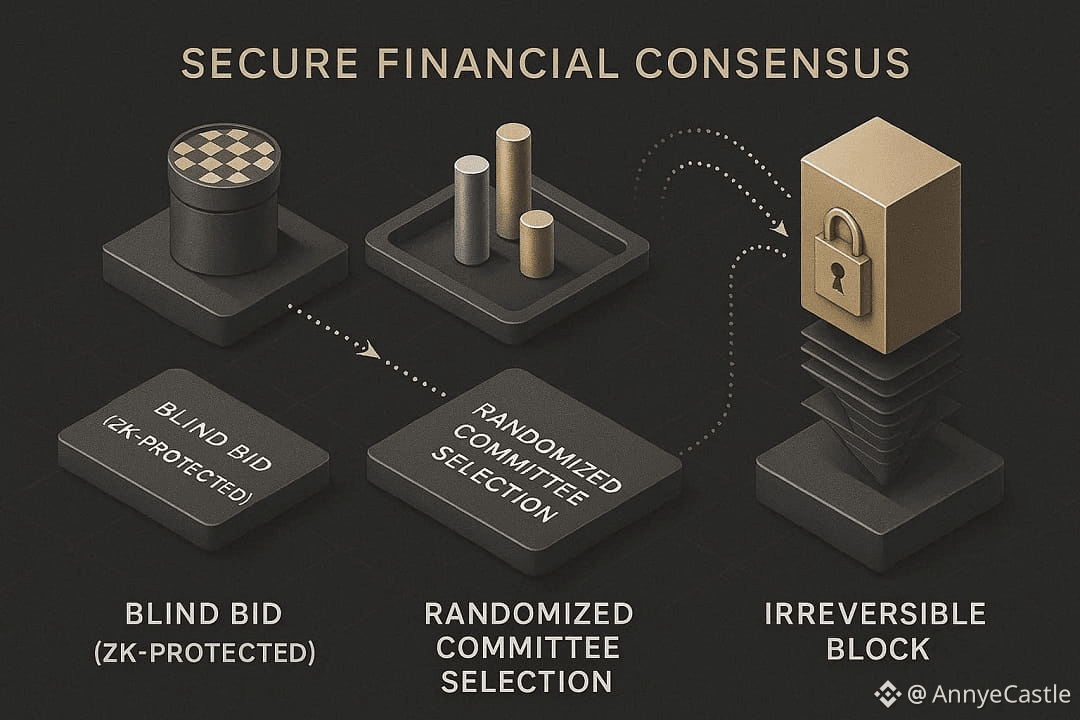
As we move deeper into 2026, the discussion around blockchain scalability has shifted. It is no longer enough for a network to be fast; it must be resilient against systemic risks that public, transparent ledgers cannot mitigate. The @Dusk has addressed this challenge by pioneering a consensus mechanism that mirrors the operational requirements of traditional financial "dark pools": the Segregated Byzantine Agreement (SBA). This report analyzes how the SBA consensus, powered by the $DUSK token, provides a unique competitive advantage for institutional liquidity providers and market makers.
The core of the SBA's superiority lies in its innovative Blind Bid mechanism. In a standard Proof of Stake (PoS) system, the identities and stake sizes of all validators are public information. This transparency, while democratic, creates a significant attack vector known as "Targeted Censorship." If a powerful entity knows which node is likely to produce the next block, they can initiate a DDoS attack or apply legal pressure to prevent specific transactions from being included. #Dusk eliminates this risk by utilizing Zero-Knowledge Proofs to keep the bidding process entirely anonymous.
In the SBA consensus, the selection of block proposers and the committee of validators is a randomized, private lottery. No one—not even the validators themselves—knows who will be selected until the moment of block production. This "Stealth Security" ensures that the network remains resistant to both external attacks and internal collusion. For a global bank managing the settlement of Real-World Assets (RWA), this level of censorship resistance is not a luxury; it is a mandatory requirement for moving billions of euros in private debt or equity onto the blockchain.
Furthermore, the SBA consensus is the engine behind Dusk’s Instant Finality. One of the greatest friction points for institutional liquidity is the uncertainty of "probabilistic settlement" found in legacy chains. On Dusk, once a committee reaches an agreement on a block, the transaction is considered final and irreversible. There are no forks, no "wait times" for multiple confirmations, and no risk of reorganization. This "Atomic Settlement" allows market makers to recycle their capital instantly, providing the deep liquidity necessary for a functioning 24/7 digital securities market.
From a liquidity standpoint, the SBA consensus also solves the problem of "Front-Running" and "Maximal Extractable Value" (MEV). In transparent networks, bots can see a large institutional buy order in the mempool and trade ahead of it, causing massive slippage and costs for the firm. Because Dusk is a privacy-first network, the contents of the transaction pool are shielded. Market makers can execute large block trades without tipping their hand to the rest of the market, preserving their alpha and reducing the overall cost of trading. This creates a "Protected Liquidity Environment" that is far more attractive to institutional capital than the "predatory" nature of public mempools.
The $DUSK token plays a pivotal role in this ecosystem, serving as the collateral for the Blind Bid. However, unlike other staking models that centralize power among the wealthiest participants, Dusk’s randomized selection ensures that even smaller nodes have a fair chance of contributing to the network's security. This maintains a high Nakamoto Coefficient (a measure of decentralization) while providing the high throughput and low latency required by modern high-frequency trading firms.
Moreover, the SBA consensus is significantly more energy-efficient than both Proof of Work and many complex Layer-2 scaling solutions. By utilizing the Piecrust VM to handle the heavy cryptographic lifting of ZK-proofs, the network remains "Green" and sustainable, aligning with the ESG (Environmental, Social, and Governance) mandates that now govern the majority of institutional investment decisions in Europe and beyond.
In conclusion, the SBA consensus is the "Hidden Shield" of the global financial infrastructure. By separating the identity of the validator from the act of validation, @dusk_foundation has built a network that is not only private and compliant but inherently more secure than its transparent predecessors. As the $DUSK oken becomes the standard for institutional RWA settlement, the SBA's advantage in finality and censorship resistance will be the primary driver for the next wave of multi-trillion dollar capital migration into the Web3 space.
