
Blockchain technology changed the way people think about trust money and digital ownership. Instead of relying on banks or centralized companies blockchain introduced a system where transactions could be verified by a network of computers. This transparency helped build trust in decentralized systems. However it also created a serious challenge: privacy. Every transaction on many blockchains can be viewed by anyone, which means financial data, transaction history and user activity may become publicly visible. Midnight Network is designed to solve this problem by building a blockchain infrastructure that focuses on privacy while still keeping the benefits of decentralization. This article explores how Midnight Network works why privacy matters in blockchain technology and the real trade-offs developers must consider when designing privacy-focused blockchain systems.
Blockchain was originally designed to be transparent. Networks such as Bitcoin and Ethereum allow anyone to inspect transaction histories. This open system ensures that no one can secretly manipulate records and it helps build trust in decentralized environments. However transparency also creates risks. Businesses cannot always operate in a fully public environment where financial activity is visible to competitors. Individuals may also want to keep their financial history private. In traditional financial systems banks protect transaction information through security and regulation. On many public blockchains however, transactions remain permanently visible. Midnight Network addresses this challenge by creating a system where information can remain private while still being verified by the blockchain.
Midnight Network is a privacy-focused blockchain infrastructure built to support confidential transactions and smart contracts. The network uses advanced cryptographic technology 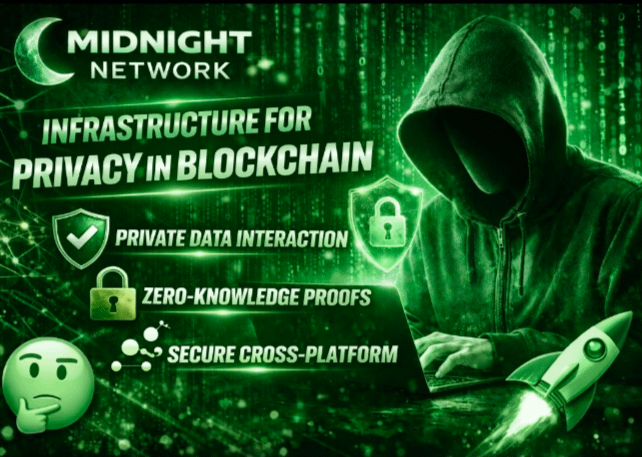 especially zero-knowledge proof systems to allow transactions to be verified without revealing sensitive information. This means that users can prove something is valid without sharing the underlying data. For example someone could prove they have enough funds to complete a transaction without revealing their exact account balance. This concept changes how blockchain systems can be used in real-world applications because it allows verification without exposure.
Zero-knowledge technology is one of the most important innovations in modern cryptography. The idea behind it is simple but powerful. One party can prove to another that a statement is true without revealing the information behind that statement. In blockchain systems, this technology allows networks to confirm transactions, identities, and data validity while protecting the privacy of users. Midnight Network integrates zero-knowledge cryptography directly into its infrastructure. Instead of treating privacy as an additional feature, the network builds privacy into the core design of its system.
This approach is important for the future of Web3. Early blockchain projects focused mainly on digital payments, but modern decentralized systems are expanding into many new areas. Decentralized finance, digital identity, supply chain management, and enterprise infrastructure all require secure data handling. Without privacy protections, many of these systems cannot operate effectively. Businesses cannot reveal sensitive operational data to the entire world, and individuals cannot safely share personal information on a public ledger. Midnight Network attempts to provide the infrastructure that makes privacy-focused decentralized applications possible.
Developers building applications on Midnight Network can design systems that process encrypted data while still allowing the blockchain to verify the results. This capability opens new possibilities for decentralized software. Instead of exposing every piece of information to the public network, developers can create systems that reveal only what is necessary. This approach is sometimes described as selective disclosure. Users and applications share only the data required to verify an action, while the rest of the information remains private.
Another important part of the Midnight ecosystem is its token structure. Like many blockchain networks, Midnight relies on a native token to support its operations. The token plays several roles within the network. It can be used to pay transaction fees, participate in staking mechanisms, and support governance decisions. Transaction fees reward network validators who confirm and process transactions. Staking allows participants to help secure the network by locking tokens and contributing to the consensus system. Governance systems may allow token holders to vote on upgrades and protocol changes. These mechanisms help maintain decentralization while encouraging community participation.
Recent development progress around Midnight Network has focused on improving privacy infrastructure and developer tools. Privacy technologies can sometimes be difficult to implement because they involve advanced mathematics and cryptography. To encourage adoption, developers are working to make the system easier to use. Simplified development frameworks allow programmers to create privacy-focused applications without needing deep expertise in cryptographic systems. This step is important because widespread adoption depends on accessibility. If the tools are too complex, developers may avoid using them.
Another focus of recent development is performance optimization. Zero-knowledge proof systems can require significant computing resources. Generating and verifying cryptographic proofs can be more demanding than processing traditional transactions. Researchers and engineers working on Midnight Network are exploring ways to reduce computational costs while maintaining strong privacy protections. Improving efficiency will be essential for scaling privacy infrastructure across large networks and real-world applications.
Privacy-focused blockchains introduce several important design trade-offs. One of the most significant trade-offs involves transparency. Traditional public blockchains are transparent by design. Anyone can verify transactions, which builds trust in decentralized systems. Privacy networks change this dynamic because transaction details may remain hidden. While cryptographic proofs can still verify the validity of actions, observers cannot always see the underlying data. This creates debates about accountability, regulation, and monitoring.
Another trade-off involves scalability and performance. Privacy technologies often require complex computations. Zero-knowledge proofs compress large pieces of information into small cryptographic proofs, but generating these proofs can take time and computing power. Blockchain designers must balance privacy protection with network speed and efficiency. If privacy systems slow down the network too much, adoption may become difficult.
Usability is another challenge in privacy-focused blockchain systems. Advanced cryptographic tools can be difficult to understand and implement. Developers must design systems that are powerful but also easy to use. Midnight Network attempts to address this challenge by providing developer-friendly tools and frameworks. Making privacy technology accessible is essential for building a strong ecosystem of decentralized applications.
Security also plays a critical role in privacy infrastructure. When data is hidden, the system must still ensure that transactions cannot be manipulated or exploited. Cryptographic proof systems must be carefully designed and tested to ensure reliability. Midnight Network relies on mathematical verification to ensure that hidden transactions remain secure and valid. Strong cryptography and peer-reviewed research are essential components of this process.
Privacy infrastructure can unlock many real-world applications. Financial services could use privacy-focused blockchain systems to process confidential transactions while maintaining decentralized security. Healthcare organizations could verify medical records and data without exposing sensitive patient information. Supply chain systems could track products while protecting proprietary business data. Digital identity systems could allow individuals to prove certain characteristics without revealing full personal information.
These applications demonstrate why privacy is becoming increasingly important in blockchain development. As decentralized technology moves beyond simple payments into complex systems, the need for secure data handling becomes more critical. Midnight Network is part of a growing group of projects exploring how privacy can be integrated into decentralized infrastructure.
The future of blockchain will likely involve a combination of transparency and privacy. Some transactions may remain fully public, while others require confidentiality. Flexible infrastructure will allow developers to choose the level of privacy needed for specific applications. Privacy layers may become standard components of blockchain systems, allowing users and businesses to control how their data is shared.
Midnight Network represents an important step toward this future. By focusing on privacy infrastructure, the project aims to provide tools that allow decentralized systems to handle sensitive information securely. This approach may help blockchain technology expand into industries that require strict data protection and confidentiality.
In the coming years, privacy technology is expected to become one of the most important areas of blockchain research and development. Zero-knowledge proof systems are advancing rapidly, and new cryptographic methods are being explored across the industry. These innovations may transform how digital systems handle data, identity, and verification.
Midnight Network contributes to this evolution by exploring how privacy and decentralization can work together. The project demonstrates that blockchain systems do not have to choose between transparency and confidentiality. With the right infrastructure, it is possible to build networks that maintain trust while protecting sensitive information.#night $NIGHT